
Call us now:

Stainless Steel Bar Selection Guide
316L vs 316LVM Stainless Steel Bar: Which Grade Should You Choose?
316L and 316LVM stainless steel bars share a low-carbon austenitic base, but their production routes, documentation, cleanliness, and target applications are different.
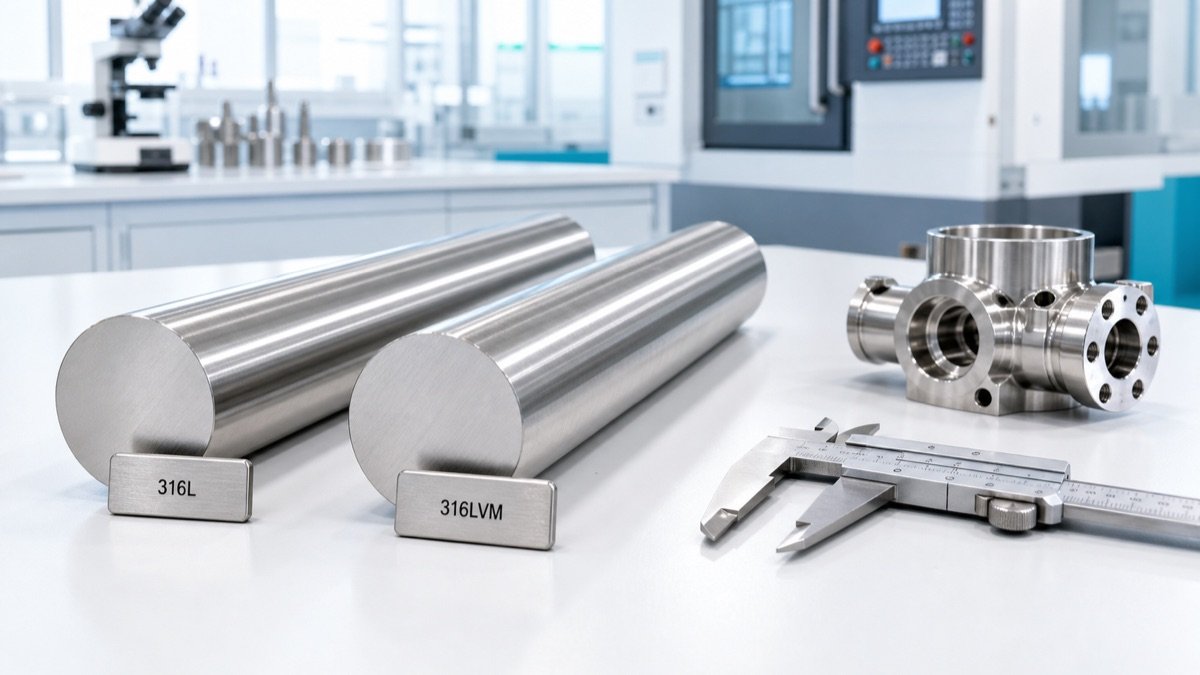
Quick answer: Choose standard 316L stainless steel bar for general corrosion-resistant industrial parts. Choose 316LVM when the project requires vacuum-controlled metallurgy, higher cleanliness, tighter traceability, or a medical implant specification such as ASTM F138. The final choice should be based on the drawing, service conditions, and required certification.
What Is the Difference Between 316L and 316LVM?
316L is a low-carbon chromium-nickel-molybdenum austenitic stainless steel used in chemical processing, marine equipment, food machinery, pharmaceutical systems, and general precision components.
316LVM is a vacuum-melted or vacuum-remelted version of low-carbon 316 stainless steel. The additional melting controls help improve metallurgical cleanliness, chemistry consistency, and microstructural control. 316LVM is commonly identified as UNS S31673 and is frequently specified for medical and implant-related components.
The term “VM” describes the material production route. It does not mean that every 316LVM bar is automatically approved for use in a finished medical device. Buyers must verify the standard, heat treatment, tests, and traceability for the intended application.
316L vs 316LVM Stainless Steel Bar Comparison
| Selection factor | 316L stainless steel bar | 316LVM stainless steel bar |
|---|---|---|
| Production route | Standard stainless steel melting and processing route | Vacuum melting or vacuum remelting controls |
| Typical priority | Reliable corrosion resistance and cost efficiency | Clean metallurgy, controlled structure, and traceability |
| Common applications | Marine, chemical, food, pharmaceutical, and industrial equipment | Implant-related parts, medical components, precision instruments, and high-purity systems |
| Documentation | Standard material certificate and required test reports | May require implant-related testing, metallography, and heat-level traceability |
| Cost position | Generally more economical for general industrial projects | Usually higher because of controlled melting and qualification requirements |
When Is 316L the Better Choice?
General industrial components
316L stainless steel bar is a practical option for shafts, fasteners, fittings, brackets, pump parts, and machined components exposed to moisture, chemicals, or chloride-bearing environments.
Cost-sensitive production
When the drawing does not require vacuum remelting or implant-related controls, standard 316L can provide a strong balance of corrosion resistance, machinability, availability, and cost.
When Is 316LVM the Better Choice?
316LVM is normally considered when the component or manufacturing process has stricter cleanliness and documentation requirements. Potential applications include:
- Orthopedic, spinal, dental, and trauma-related components
- Precision medical instruments and small machined parts
- Laboratory and analytical equipment
- High-purity pharmaceutical and processing components
- Applications where inclusion control and heat-level traceability are critical
For surgical implant bar and wire, ASTM F138 defines requirements covering chemistry, mechanical properties, metallography, and testing. Always confirm the applicable edition and purchase specification before ordering.
How to Select the Correct Grade
- Identify whether the part is a general industrial component or a medical/implant-related component.
- Confirm the required standard, such as ASTM F138 or the applicable general bar specification.
- Specify diameter, length, tolerance, straightness, surface finish, and delivery condition.
- Request chemical, mechanical, metallographic, and traceability documents when required.
- Confirm machining, polishing, sterilization, packaging, and regulatory expectations before production.
For a broader grade comparison, see Saky Metal’s 304 vs 316 stainless steel bar guide and the related 316LVM stainless steel bar applications article.
Need Help Choosing 316L or 316LVM?
Share the grade, dimensions, standard, quantity, surface finish, and application with Saky Metal. Our team can help you compare material documentation and prepare an export quotation.
Technical note: Grade selection must be confirmed against the project drawing, service conditions, applicable standard, and regulatory requirements. A material grade name alone does not certify a finished medical device.