
Call us now:


Alloy Steel Selection Guide
4130 vs 4140 vs 4340 Alloy Steel: Key Differences and Selection
Compare composition strategy, hardenability, strength potential, toughness, weldability and section-size response before choosing among three widely used engineering steels.
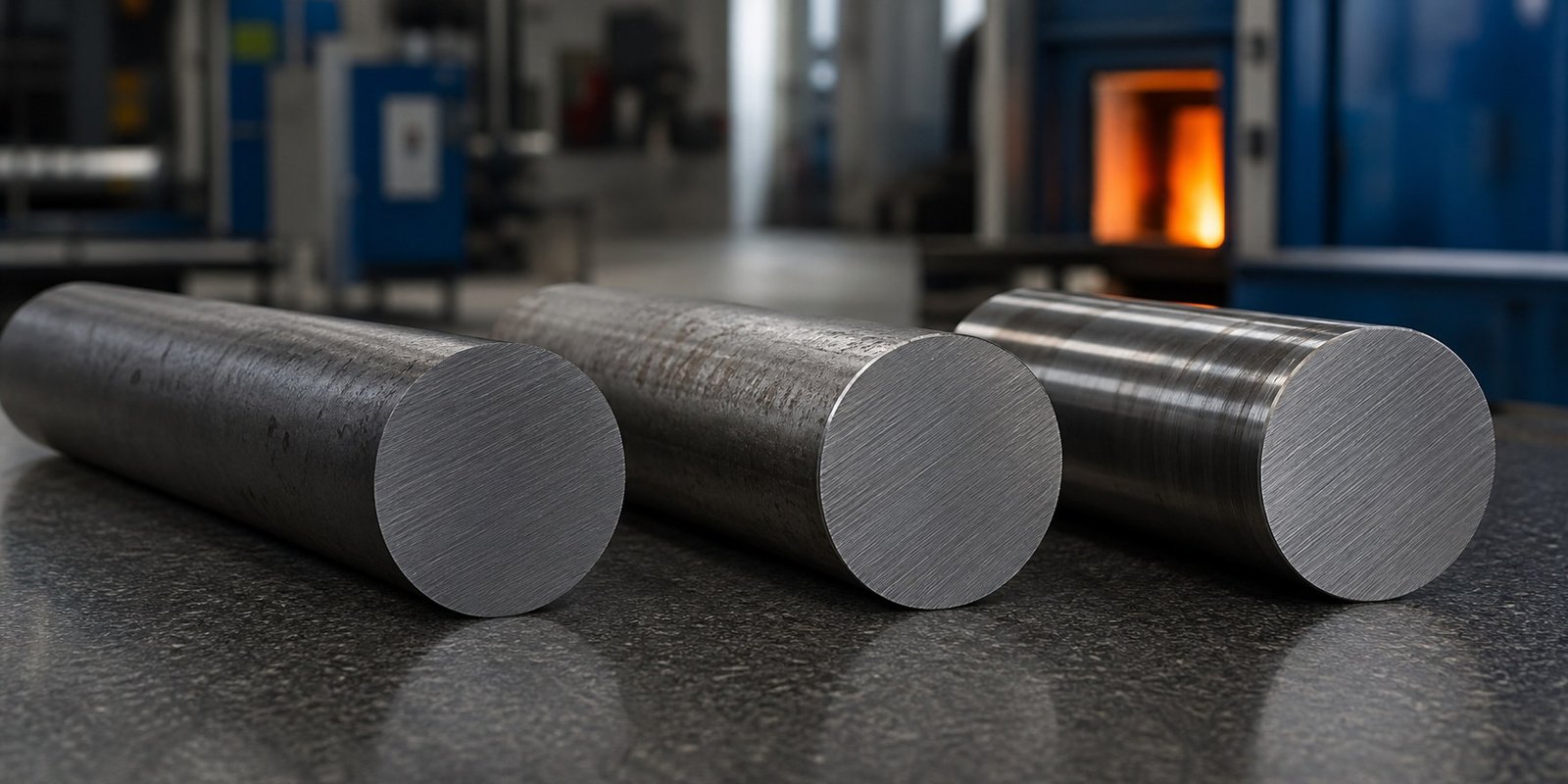
Quick answer: 4130 is often favored where moderate strength, fabrication and weldability matter. 4140 adds carbon for higher hardness, strength and wear resistance after heat treatment. 4340 adds nickel to a chromium-molybdenum base, supporting deeper hardening and high toughness in demanding or larger-section components. Heat treatment and section size can matter as much as the grade number.
What the grade numbers mean
SAE 4130, 4140 and 4340 are low-alloy engineering steels identified by standardized chemistry ranges. The first two digits indicate the alloy family, while the last two broadly reflect nominal carbon content in hundredths of a percent. Thus, 4130 is a chromium-molybdenum steel with roughly 0.30% carbon; 4140 is in the same family with roughly 0.40% carbon; and 4340 is a nickel-chromium-molybdenum steel with roughly 0.40% carbon.
These shorthand descriptions are useful, but purchasing must refer to the product-appropriate standard. SAE J404 covers chemical compositions for specified bar, billet and related forms, while mechanical tubing, sheet and other products can fall under different standards. The same grade designation does not guarantee the same delivery condition or mechanical properties across every product form.
4130: fabrication-friendly strength
4130 combines chromium and molybdenum with a lower carbon level than 4140 or 4340. That balance can support good strength after normalizing or quench-and-temper processing while generally offering better weldability than the higher-carbon alternatives. It is frequently considered for welded structures, aircraft tubing, frames, fittings, shafts and components where fabrication is central to the design.
“More weldable” does not mean weld without controls. Thickness, restraint, hydrogen level, preheat, interpass temperature, filler metal and post-weld treatment all affect the result. A qualified welding procedure remains essential for critical structures.
4140: the versatile middle ground
4140 increases carbon relative to 4130 and is one of the most familiar chromium-molybdenum alloy steels. After suitable heat treatment, it can provide a strong balance of hardness, tensile strength, fatigue resistance and wear performance. Common discussions include shafts, gears, axles, spindles, bolts, couplings, tool holders and machinery components.
The additional carbon increases hardening response but also raises fabrication sensitivity. Welding typically requires more control than for 4130, and the heat-affected zone must be considered. For large diameters, the engineer should confirm whether the required through-section properties can be achieved with the selected quench, temper and material quality.
4340: deep hardening and toughness
4340 adds nickel to chromium and molybdenum. Nickel helps support toughness, while the alloy combination provides high hardenability. This makes 4340 attractive for heavily loaded gears, crankshafts, aircraft landing-gear parts, high-strength shafts, connecting hardware and other components where a larger section must retain strong mechanical performance beyond the surface.
Its higher capability does not automatically make it the best commercial choice. Material cost, heat-treatment control, machinability, welding complexity and the risk of hydrogen-related cracking at very high strength levels must be managed. Specifying 4340 where 4130 or 4140 already meets the design can add cost without useful performance.
Practical comparison
| Selection factor | 4130 | 4140 | 4340 |
|---|---|---|---|
| Alloy family | Chromium-molybdenum | Chromium-molybdenum | Nickel-chromium-molybdenum |
| Nominal carbon level | About 0.30% | About 0.40% | About 0.40% |
| General strength potential | Moderate to high | Higher after heat treatment | High with strong toughness potential |
| Relative hardenability | Lower | Higher | Highest of the three |
| Relative weldability | Generally best of the three | More demanding | Most demanding, especially at high strength |
| Typical fit | Welded structures and moderate sections | General machinery and wear-loaded parts | Highly loaded or larger-section critical parts |
These are directional comparisons, not guaranteed values. The required hardness, yield strength, toughness and fatigue performance must be tied to a defined heat treatment, section size and test location.
Heat treatment changes the answer
Normalized 4130 can behave very differently from quenched-and-tempered 4130. The same is true for 4140 and 4340. Austenitizing temperature, quench severity, section size, tempering temperature and time determine the final microstructure and property balance. Comparing grade names without comparing heat-treatment conditions can therefore be misleading.
Higher hardness is not a free benefit. As strength rises, toughness, machinability, dimensional stability and resistance to hydrogen-assisted cracking may become more difficult to maintain. The designer should specify the required property window rather than simply asking for “maximum hardness.”
Section size and hardenability
Hardenability describes the ability to form a hardened microstructure to depth; it is not the same as surface hardness. In a thick bar or forging, the core cools more slowly than the surface. 4340’s alloy system is particularly useful where through-section response matters, while 4130 may be adequate in a thin section or a less demanding strength range.
For critical parts, state the test location, orientation and sampling plan. A surface hardness reading cannot by itself prove that the center of a large forging meets the required tensile or toughness properties.
Machining and welding considerations
Machinability depends on condition. Annealed or normalized stock is often chosen for rough machining, followed by heat treatment and finish machining or grinding. Allowance for distortion and decarburization should be planned. Welding should use an approved procedure that addresses preheat, heat input, consumables, hydrogen control, interpass temperature and any required post-weld heat treatment.
How to choose
Start with the required product form, section size, loading mode, design life, operating temperature, environment, fabrication route and property targets. Choose 4130 when welded fabrication and a moderate strength level dominate. Choose 4140 for a broad range of heat-treated machinery parts needing higher hardness or wear resistance. Evaluate 4340 when toughness and deep hardening in a highly loaded or larger section justify its added alloying and processing demands.
Is 4340 always stronger than 4140?
No. Either grade can be supplied across multiple strength conditions. 4340 generally offers greater hardenability and toughness potential, but the actual comparison depends on heat treatment, section size and acceptance requirements.
Can 4140 replace 4130 in a welded design?
Not automatically. The higher carbon level changes welding response and heat-affected-zone risk. Substitution requires an engineering review and a qualified welding procedure.
Technical references
SAE International: J404 chemical compositions of SAE alloy steels · SAE International: J412 steel characteristics and heat treatments · NASA: low-temperature mechanical properties of 4130, 4140 and 4340
Discuss Your Alloy Steel Requirement with SAKYMETAL
Send SAKYMETAL the grade, product form, dimensions, delivery condition, heat-treatment requirement, mechanical-property targets and inspection scope for a technically aligned quotation.
Next step: view steel bar products or contact SAKYMETAL.
Technical note: Comparative descriptions are general selection guidance. Actual chemistry, condition, section-size response and mechanical values shall be confirmed by the applicable specification, qualified heat-treatment procedure and MTC.