
Call us now:


Sheet Metal Reference Guide
Sheet Metal Gauge Size Chart
Compare nominal gauge thicknesses for standard steel, galvanized steel, stainless steel and aluminum in both inches and millimetres.
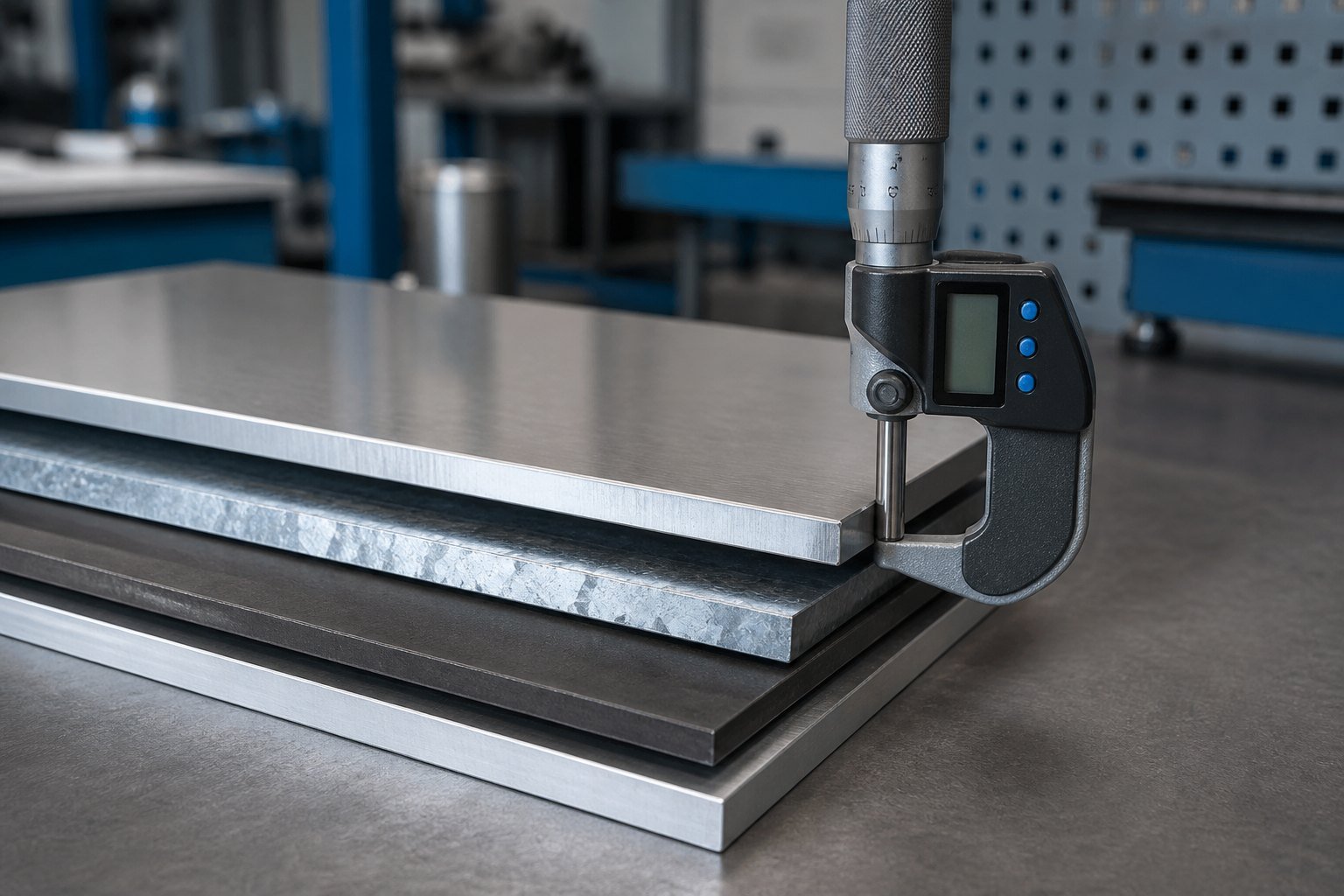
Quick answer: a higher sheet-metal gauge number normally means a thinner sheet, but gauge is not a universal thickness unit. Always select the correct material column and confirm the ordered thickness and tolerance in inches or millimetres. For example, 16 gauge is approximately 1.519 mm for standard steel, 1.613 mm for galvanized steel, 1.588 mm for stainless steel and 1.29 mm for aluminum.
Gauge thickness chart by material
The chart below provides nominal gauge values for four common sheet-metal families. Blank cells mean that a value is not listed for that material and gauge. Purchase orders should state the required actual thickness, permitted tolerance, applicable material specification and finish.
| Gauge (Ga.) | Thickness (inch) | Thickness (mm) | ||||||
|---|---|---|---|---|---|---|---|---|
| Standard steel | Galvanized steel | Stainless steel | Aluminum | Standard steel | Galvanized steel | Stainless steel | Aluminum | |
| 1 | — | — | 0.2813 | — | — | — | 7.145 | — |
| 2 | — | — | 0.2656 | — | — | — | 6.746 | — |
| 3 | 0.2391 | — | 0.2500 | 0.2294 | 6.07314 | — | 6.350 | — |
| 4 | 0.2242 | — | 0.2344 | 0.2043 | 5.69468 | — | 5.954 | — |
| 5 | 0.2092 | — | 0.2187 | 0.1819 | 5.31368 | — | 5.555 | — |
| 6 | 0.1943 | — | 0.2031 | 0.162 | 4.93522 | — | 5.159 | 4.1 |
| 7 | 0.1793 | — | 0.1875 | 0.1443 | 4.55422 | — | 4.763 | 3.67 |
| 8 | 0.1644 | — | 0.1719 | 0.1285 | 4.17576 | — | 4.366 | 3.26 |
| 9 | 0.1495 | 0.1532 | 0.1562 | 0.1144 | 3.7973 | 3.89128 | 3.967 | 2.91 |
| 10 | 0.1345 | 0.1382 | 0.1406 | 0.1019 | 3.4163 | 3.51028 | 3.571 | 2.59 |
| 11 | 0.1196 | 0.1233 | 0.1250 | 0.0907 | 3.03784 | 3.13182 | 3.175 | 2.30 |
| 12 | 0.1046 | 0.1084 | 0.1094 | 0.0808 | 2.65684 | 2.75336 | 2.779 | 2.05 |
| 13 | 0.0897 | 0.0934 | 0.0937 | 0.072 | 2.27838 | 2.37236 | 2.380 | 1.8 |
| 14 | 0.0747 | 0.0785 | 0.0781 | 0.0641 | 1.89738 | 1.9939 | 1.984 | 1.63 |
| 15 | 0.0673 | 0.071 | 0.0703 | 0.0571 | 1.70942 | 1.8034 | 1.786 | 1.4 |
| 16 | 0.0598 | 0.0635 | 0.0625 | 0.0508 | 1.51892 | 1.6129 | 1.588 | 1.29 |
| 17 | 0.0538 | 0.0575 | 0.0562 | 0.0453 | 1.36652 | 1.4605 | 1.427 | 1.1 |
| 18 | 0.0478 | 0.0516 | 0.0500 | 0.0403 | 1.21412 | 1.31064 | 1.270 | 1.02 |
| 19 | 0.0418 | 0.0456 | 0.0437 | 0.0359 | 1.06172 | 1.15824 | 1.110 | 0.91 |
| 20 | 0.0359 | 0.0396 | 0.0375 | 0.0320 | 0.91186 | 1.00584 | 0.953 | 0.81 |
| 21 | 0.0329 | 0.0366 | 0.0344 | 0.0285 | 0.83566 | 0.92964 | 0.874 | 0.71 |
| 22 | 0.0299 | 0.0336 | 0.0312 | 0.0253 | 0.75946 | 0.85344 | 0.792 | 0.64 |
| 23 | 0.0269 | 0.0306 | 0.0281 | 0.0226 | 0.68326 | 0.77724 | 0.714 | 0.58 |
| 24 | 0.0239 | 0.0276 | 0.0250 | 0.0201 | 0.60706 | 0.7004 | 0.635 | 0.51 |
| 25 | 0.0209 | 0.0247 | 0.0219 | 0.0179 | 0.53086 | 0.62738 | 0.556 | 0.46 |
| 26 | 0.0179 | 0.0217 | 0.0187 | 0.0159 | 0.45466 | 0.55118 | 0.475 | 0.40 |
| 27 | 0.0164 | 0.0202 | 0.0172 | 0.0142 | 0.41656 | 0.51308 | 0.437 | 0.36 |
| 28 | 0.0149 | 0.0187 | 0.0156 | 0.0126 | 0.37846 | 0.47498 | 0.396 | 0.32 |
| 29 | 0.0135 | 0.0172 | 0.0141 | 0.0113 | 0.3429 | 0.43688 | 0.358 | 0.29 |
| 30 | 0.012 | 0.0157 | 0.0125 | 0.0100 | 0.3048 | 0.39878 | 0.318 | 0.25 |
| 31 | 0.0105 | 0.0142 | 0.0109 | — | 0.2667 | 0.36068 | 0.277 | — |
| 32 | 0.0097 | 0.0134 | 0.0102 | — | 0.24638 | 0.34036 | 0.259 | — |
| 33 | 0.009 | — | 0.0094 | — | 0.2286 | — | 0.239 | — |
| 34 | 0.0082 | — | 0.0086 | — | 0.20828 | — | 0.218 | — |
| 35 | 0.0075 | — | 0.0078 | — | 0.1905 | — | 0.198 | — |
| 36 | 0.0067 | — | 0.0070 | — | 0.17018 | — | 0.178 | — |
| 37 | 0.0064 | — | 0.0066 | — | 0.163 | — | 0.168 | — |
| 38 | 0.0060 | — | 0.0062 | — | 0.152 | — | 0.157 | — |
Data note: the supplied chart shows 29 gauge standard steel as “0.035 in” and “0.3429 mm.” Because 0.3429 mm equals 0.0135 in, the inch value above is corrected to 0.0135. This table is a selection aid, not a dimensional acceptance standard.
Which products use sheet metal gauge?
Gauge terminology is most often used for relatively thin sheet, strip and coil products. Heavy plate is normally ordered directly by millimetre or inch thickness. The product form, alloy, temper or delivery condition, surface finish and manufacturing standard still control the final requirement.
| Material column | SAKY METAL product forms | Typical products and uses | Selection notes |
|---|---|---|---|
| Standard steel | Carbon steel sheet, plate, strip and coil | Machine guards, cabinets, brackets, duct components, fabricated panels, containers and general industrial enclosures | Confirm whether the order is hot rolled, cold rolled, pickled and oiled, coated or bare, because surface and tolerance requirements differ. |
| Galvanized steel | Hot-dip galvanized sheet, strip and coil | Roofing and wall cladding, flashing, HVAC ducts, cable trays, appliance panels, outdoor housings and light structural components | The zinc coating adds to the measured thickness. Specify the base steel thickness or total coated thickness, coating mass/designation and finish. |
| Stainless steel | Stainless sheet, plate, strip, coil and precision foil | Food-processing equipment, kitchen panels, tanks, chemical equipment, medical and laboratory housings, architectural trim and corrosion-resistant enclosures | State the stainless grade, finish, edge condition and flatness. Common choices include 304/304L, 316/316L, 430 and duplex grades. |
| Aluminum | Aluminum sheet, plate, strip and coil | Transport body panels, insulation cladding, electronics housings, signs, heat-exchanger parts, lightweight cabinets and architectural panels | State alloy and temper because formability, strength and minimum bend radius vary substantially among aluminum products. |
How to use the chart correctly
- Choose the material first. Do not use the standard-steel value for stainless steel, galvanized steel or aluminum.
- Convert units when necessary. Multiply inches by 25.4 to obtain millimetres; divide millimetres by 25.4 to obtain inches.
- Treat gauge as nominal. Actual delivered thickness is controlled by the applicable product standard and ordered tolerance.
- Account for coatings and finishes. Galvanizing, paint, plating, polishing and protective films can affect the measured total thickness.
- Verify manufacturing capability. Very thin or very thick gauges may not be commercially available in every width, alloy, temper or finish.
What to include in an RFQ
- Material family and exact grade
- Required thickness in mm or inches, plus tolerance
- Sheet, plate, strip or coil form; width and length or coil ID/OD
- Surface finish, coating, protective film and edge condition
- Applicable ASTM, ASME, EN, JIS, GB or customer specification
- Quantity, inspection, test certificate, packaging and destination
Frequently asked questions
Does a higher gauge mean thicker metal?
No. In common sheet-metal gauge systems, the number increases as the nominal sheet thickness decreases.
Is 16 gauge stainless the same thickness as 16 gauge steel?
No. This chart lists approximately 1.588 mm for 16 gauge stainless steel and 1.519 mm for 16 gauge standard steel.
Why is galvanized steel thicker at the same gauge?
Gauge conventions differ by material, and the zinc coating contributes to the finished measurement. The purchase order should clarify the base-metal and coated-thickness requirements.
Should plate be ordered by gauge?
Usually not. Plate and critical sheet applications are better specified by an explicit thickness and tolerance under the applicable material standard.
Related SAKY METAL product resources
Need a Thickness or Material Recommendation?
Send SAKY METAL your material grade, target thickness, tolerance, dimensions, finish, quantity and end-use environment. Our team can review a practical sheet, plate, strip or coil supply specification.
Engineering note: Gauge values are nominal references. For fabrication, structural design, pressure service or regulated products, use the specified actual thickness and applicable standard rather than gauge alone.