
Call us now:

Super Duplex Wire Comparison
S32760 Round Wire vs ER2594 Welding Wire
A standards-based comparison of composition, mechanical performance, corrosion behavior and correct purchasing terminology for super duplex stainless steel wire products.
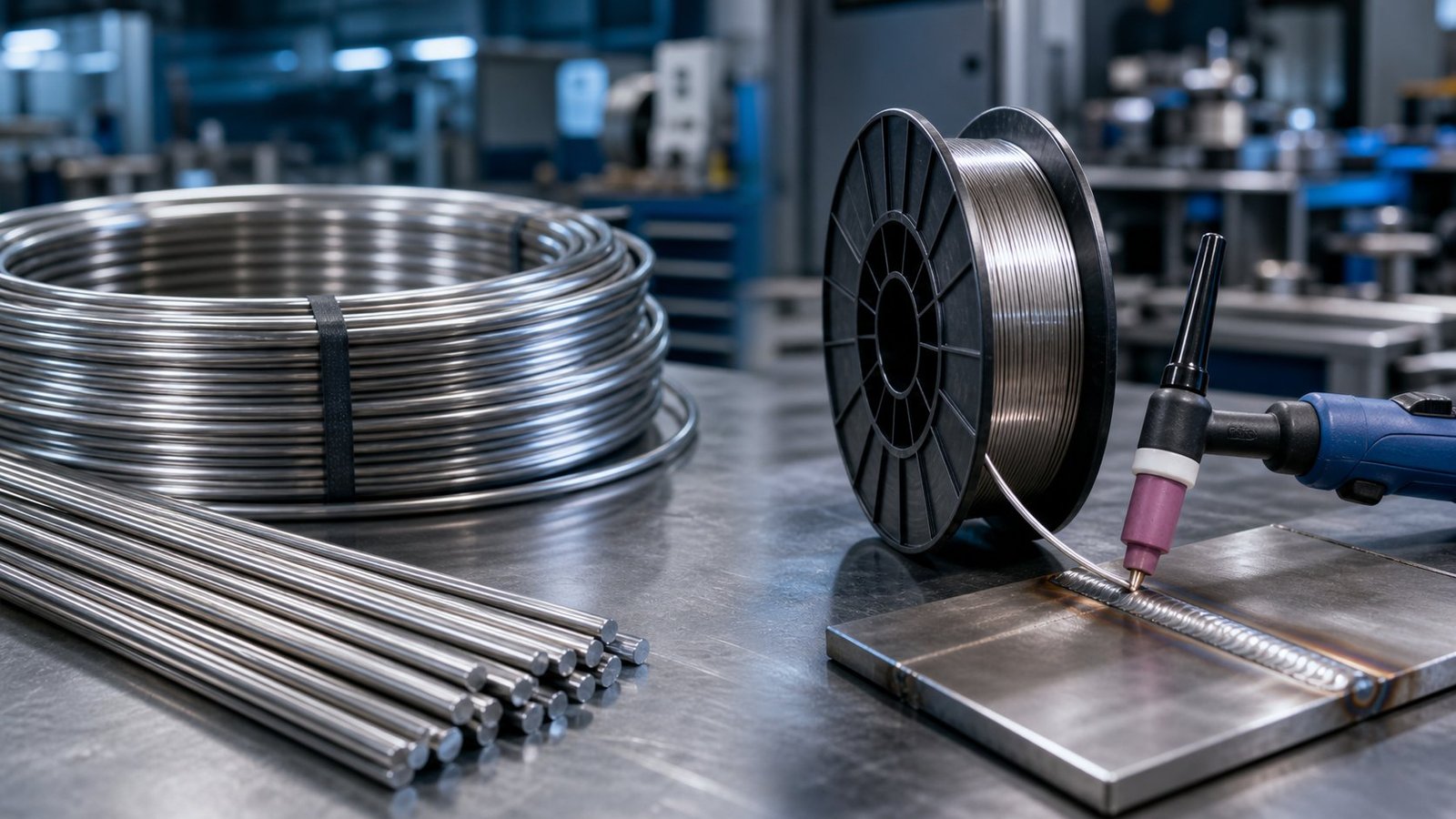
Quick answer: S32760 and ER2594 are related, but they are not interchangeable names. UNS S32760 identifies a tungsten- and copper-bearing super duplex stainless base metal. AWS ER2594 identifies a bare super duplex welding wire or rod by its filler-metal chemistry. ER2594 normally has more nickel than S32760 to help the weld metal recover a suitable austenite-ferrite balance after rapid cooling and dilution.
What is the difference between S32760 and ER2594?
| Comparison point | S32760 round wire / round material | ER2594 welding wire |
|---|---|---|
| Identity | UNS S32760 base-metal grade; EN 1.4501 is a commonly associated designation. | AWS A5.9/A5.9M bare stainless filler-metal classification. |
| Primary role | Becomes part of the finished component as solid parent material. | Is melted to create weld metal in GTAW, GMAW and other qualified processes. |
| Controlling data | Product standard, heat treatment, dimensions, tolerances and mechanical properties. | Classification chemistry, wire/rod form, size, cast or lot identity, finish and packaging. |
| Performance basis | Test the delivered base material in its specified condition. | Evaluate the completed weld using a qualified WPS/PQR; the bare wire’s chemistry alone does not define joint performance. |
Important terminology ASTM A479 covers stainless steel bars and shapes, including round bar. If a small-diameter product is sold as S32760 round wire, ASTM A479 chemistry can be a useful grade reference, but the order should still identify the applicable wire product standard, manufacturing route, delivery condition and mechanical acceptance criteria.
S32760 vs ER2594 chemical composition
The following weight-percent comparison transcribes the classification limits shown in the supplied ASTM A479/A479M and AWS A5.9/A5.9M extracts. A value preceded by “max” is an upper limit; iron is the balance.
| Element, wt.% | S32760 base metal | ER2594 filler metal | Practical meaning |
|---|---|---|---|
| C | 0.030 max | 0.030 max | Low carbon helps limit sensitization-related concerns. |
| Cr | 24.0-26.0 | 24.0-27.0 | High chromium supports passivity and localized-corrosion resistance. |
| Ni | 6.0-8.0 | 8.0-10.5 | ER2594 is nickel-overalloyed relative to S32760 to promote austenite in the weld metal. |
| Mo | 3.0-4.0 | 2.5-4.5 | Molybdenum strengthens resistance to chloride pitting and crevice corrosion. |
| N | 0.20-0.30 | 0.20-0.30 | Nitrogen contributes to strength, pitting resistance and austenite formation. |
| Cu | 0.50-1.00 | 1.50 max | Copper is characteristic of S32760 and may support performance in selected acid environments. |
| W | 0.50-1.00 | 1.00 max | Tungsten is part of the S32760 alloy concept; ER2594 permits a compatible tungsten level. |
| Mn | 1.00 max | 2.50 max | The filler classification allows more manganese than the base grade. |
| Si | 1.00 max | 1.00 max | Silicon is controlled in both chemistries. |
| P | 0.030 max | 0.030 max | Phosphorus is restricted as a residual element. |
| S | 0.010 max | 0.020 max | S32760 has the tighter sulfur limit in the supplied comparison. |
The largest intentional difference is nickel: the ER2594 range starts where the S32760 range ends. This does not make ER2594 a “better S32760.” It compensates for weld solidification, cooling and base-metal dilution so that a qualified weld can achieve the intended duplex phase balance.
Mechanical and corrosion performance comparison
| Performance item | S32760 base material | ER2594 all-weld-metal example |
|---|---|---|
| Condition represented | Solution-annealed and quenched solid bar data. | As-welded deposit made with a specific commercial ER2594 rod and argon shielding. |
| 0.2% proof strength | 550 MPa minimum. | 655 MPa typical. |
| Tensile strength | 760-930 MPa. | 934 MPa typical. |
| Elongation | 25% minimum. | 42% typical. |
| Impact toughness | Supplier data report at least 85 J average at -50°C for qualifying bar up to 180 mm under the cited program. | 100 J typical at -50°C for the cited all-weld-metal test. |
| Corrosion behavior | Designed for severe chloride environments; actual resistance depends on composition, phase balance, heat treatment, surface condition and service. | Designed to produce corrosion-resistant super duplex weld metal; dilution, heat tint, shielding, interpass temperature and post-weld cleaning can control the result. |
These numbers are not a winner-versus-loser ranking. The S32760 values describe parent material in a defined supply condition, while the ER2594 values are a manufacturer’s typical all-weld-metal result. AWS A5.9 classifies ER2594 primarily by chemical composition; it does not turn a bare-wire tensile value into a guaranteed property of every welded joint.
Why can ER2594 weld metal perform differently?
Super duplex weld quality depends on more than filler-metal classification. Heat input and interpass temperature influence cooling time and phase transformation. Excessively rapid cooling may leave high ferrite; excessive thermal exposure can encourage harmful intermetallic phases. Shielding and backing gas quality affect nitrogen retention and root oxidation, while dilution changes the final deposited chemistry.
- Use a qualified WPS/PQR: specify process, joint design, heat input, interpass temperature, gas composition, purge acceptance and pass sequence.
- Control surfaces: remove oil, iron contamination and moisture before welding; remove heat tint using an approved cleaning and passivation procedure.
- Verify the weld, not only the spool: project requirements may call for ferrite measurement, impact testing, hardness, bend or tensile tests, macro examination and ASTM G48 corrosion testing.
- Use actual certificates: PREN or PREW calculations based on nominal labels are screening tools. Final evaluation should use the reported heat/lot chemistry and the applicable project formula.
Can S32760 round wire replace ER2594 welding wire?
Not by grade name alone. A coil marked only UNS S32760 is base material, not automatically an AWS ER2594 welding consumable. It may have a different nickel range, surface condition, dimensional tolerance, cast/helix control, packaging and certification. Use it as filler metal only when it is manufactured, tested, identified and certified to the filler-metal specification required by the welding procedure.
The reverse is also true: ER2594 should not be specified as a structural round-wire material simply because its chemistry resembles super duplex stainless steel. Product-form requirements and mechanical-property acceptance are different.
How to specify each product correctly
| For S32760 round material | For ER2594 welding wire or rod |
|---|---|
| UNS S32760 / EN 1.4501 and the applicable product standard. | AWS A5.9/A5.9M ER2594 and any required ISO classification. |
| Diameter, tolerance, straightness, coil or straight length and surface finish. | GTAW rod or GMAW wire, diameter, spool/pack form, cast and helix requirements. |
| Solution-annealed, cold-worked or other specified delivery condition. | Consumable trade name, heat/lot traceability and certificate of conformance. |
| Chemistry, mechanical properties, hardness and heat-treatment traceability on the MTC. | Actual wire chemistry plus the WPS/PQR requirements governing deposited-metal performance. |
| Required corrosion, impact, phase-balance or NDT acceptance tests. | Shielding/backing gas, heat-input window, interpass limit and required weld qualification tests. |
Frequently asked questions
Is ER2594 the matching filler metal for S32760?
ER2594 is commonly selected for welding 25% Cr super duplex grades including S32760. Final approval must come from the governing fabrication code, project specification and qualified WPS/PQR.
Why does ER2594 contain more nickel than S32760?
The higher nickel range helps promote austenite formation in the weld deposit after solidification and dilution. It is deliberate filler-metal over-alloying, not evidence that the filler and base metal should have identical chemistry.
Which is stronger, S32760 or ER2594?
There is no universal direct ranking. S32760 data apply to delivered base material; ER2594 performance is measured on a weld deposit or joint made under specified welding conditions. Compare the MTC and qualified weld test results required by the project.
Are S32760 round bar and S32760 round wire the same product?
No. They can share the UNS grade chemistry, but bar and wire have different manufacturing routes, dimensions, tolerances, conditions and possible product standards. ASTM A479 is explicitly a bar-and-shape specification.
Does chemistry alone guarantee corrosion resistance?
No. Chemistry is essential, but phase balance, intermetallic phases, surface contamination, weld heat tint, crevices, temperature and the actual process environment also affect corrosion performance.
Technical sources
Discuss S32760 or ER2594 Requirements with SAKYMETAL
Send the product form, diameter, standard and edition, delivery condition, welding process, service environment, inspection plan and certification requirements. We can help separate base-metal requirements from welding-consumable requirements before quotation.
Explore: duplex stainless steel products, stainless steel wire, or contact SAKYMETAL.
Standard note: Chemistry in the comparison table is based on the supplied ASTM and AWS extracts. Standards are revised over time; the purchase order, applicable edition, approved WPS/PQR and issued material certificates remain controlling. Manufacturer mechanical values are examples for the stated conditions, not universal guarantees.