
Call us now:


Martensitic Stainless Steel Guide
8Cr13MoV Stainless Steel: Properties, Heat Treatment and Applications
A practical guide to the composition concept, heat-treatment dependence, performance and purchasing of 8Cr13MoV stainless steel.
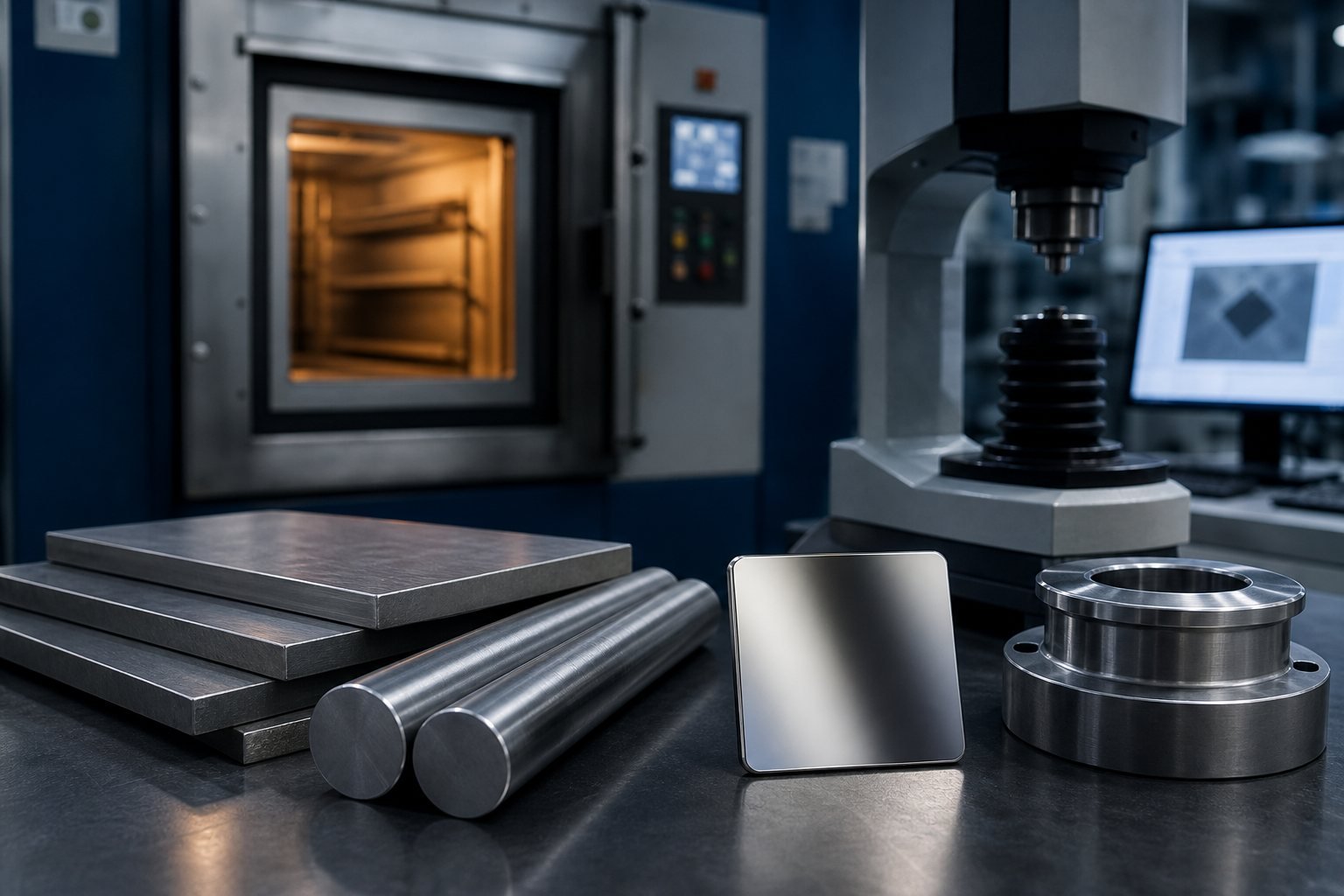
Quick answer: 8Cr13MoV is a medium-high-carbon martensitic stainless steel designation commonly associated with about 0.8% carbon and about 13% chromium plus molybdenum and vanadium. It is valued for attainable hardness, edge or wear performance, machinability and cost. Its final properties depend heavily on melt chemistry, cleanliness, heat treatment, section and finish.
What does 8Cr13MoV mean?
The designation indicates a martensitic stainless steel concept with nominal carbon near eight-tenths of one percent, chromium around thirteen percent and intentional molybdenum and vanadium additions. Published chemistry ranges vary, so the purchase document should identify the expected limits.
A peer-reviewed study of high-carbon martensitic 8Cr13MoV examined how titanium modification changed microstructure and mechanical behavior—useful evidence that small compositional and process changes can materially affect performance.
Typical alloying roles
| Element | Metallurgical role |
|---|---|
| Carbon | Enables martensitic hardness and supports carbide formation; excess can reduce toughness or corrosion performance. |
| Chromium | Provides stainless behavior and hardenability while also forming chromium-rich carbides. |
| Molybdenum | Can improve tempering response and localized corrosion behavior. |
| Vanadium | Supports grain refinement and hard carbide formation. |
| Mn and Si | Assist steelmaking and hardenability within controlled limits. |
Heat treatment and hardness
Material is typically annealed for machining or forming, then austenitized, quenched and tempered for service. The exact temperature window and quench route must follow a qualified producer or heat-treater recommendation for the actual melt and section.
A low temper may retain higher hardness; a different tempering strategy may prioritize toughness or dimensional stability. Retained austenite, carbide distribution, decarburization and grinding damage all influence the component beyond the nominal HRC value.
Performance and applications
- Useful balance of hardness, wear resistance and affordability
- Generally easier to sharpen or finish than very high-alloy carbide-rich steels
- Moderate stainless performance that still requires sensible cleaning and storage
- Common use in utility cutting tools, kitchenware, scissors, wear components and economical precision parts
How to buy 8Cr13MoV material
- Agree a chemistry range and reference document.
- State product form, size, tolerance, surface and annealed condition.
- Define any spheroidized-anneal or carbide-structure requirement.
- Specify final heat treatment and hardness only with a qualified process.
- Require heat traceability and chemistry/mechanical certification appropriate to risk.
- Validate corrosion, toughness and wear on representative finished parts.
Microstructure and manufacturing quality
Annealed material should support stable machining and subsequent hardening. Carbide size and distribution, segregation, inclusions and decarburization influence edge quality, polish, toughness and heat-treatment response. Two products with similar ladle chemistry can perform differently if steelmaking and rolling control differ.
After hardening, the microstructure contains tempered martensite, carbides and potentially retained austenite. Hardness alone cannot reveal their balance. For demanding components, representative metallography, hardness mapping and functional tests provide a clearer picture.
8Cr13MoV versus higher-alloy grades
8Cr13MoV is often attractive when cost, ease of processing and serviceable hardness are more important than maximum wear resistance. Higher-carbon or higher-alloy grades can deliver more carbide wear resistance but may increase sharpening, grinding, toughness, heat-treatment and material-cost challenges.
Selection should be application-led. An economical grade with stable heat treatment and a suitable edge geometry can outperform a premium alloy that is processed poorly or used at an unsuitable hardness.
Quality checks for incoming material
Match heat markings with the material certificate and review chemistry against the agreed limits. Positive material identification can verify major alloying elements, but light elements and carbon require suitable laboratory methods. Measure annealed hardness and inspect the surface for decarburization, scale, laps or grinding damage.
For strip and blade stock, flatness, thickness tolerance and carbide uniformity can influence blanking and grinding. A pilot heat-treatment coupon from the same heat helps confirm hardness response before a large production batch is processed.
Design and service considerations
Edge angle, section thickness and finish strongly influence performance. A thin hard edge can chip where a slightly tougher geometry survives. Likewise, a polished, clean surface generally resists corrosion and fatigue initiation better than a rough or contaminated one.
Define the service environment realistically: detergents, salts, food acids, dishwasher cycles, temperature and storage may be more severe than a brief room-temperature corrosion comparison.
Frequently asked questions
Is 8Cr13MoV stainless steel?
Yes. It is a martensitic stainless steel type, but stainless does not mean immune to corrosion.
Is 8Cr13MoV equivalent to AUS-8?
They are often compared because of similar composition concepts, but they should not be treated as exact equivalents without checking chemistry, standard, processing and properties.
What controls 8Cr13MoV hardness?
Melt chemistry, austenitizing, quench severity, retained austenite, tempering, section size and surface decarburization all affect final hardness.
Is 8Cr13MoV magnetic?
Yes. Its martensitic structure is normally ferromagnetic after hardening.
Technical references
Discuss Your Requirement with SAKYMETAL
Provide chemistry, form, size, quantity, annealed structure, final hardness, testing and certification requirements for a material availability review.
View related products or send your specification for a quotation.
Engineering note: Typical values are informative, not acceptance criteria. Confirm the applicable standard edition, grade designation, product form, dimensions, delivery condition and test requirements on the purchase order and material test certificate.