
Call us now:


Hot-Work Tool Steel Guide
1.2343 / H11 Tool Steel: Properties, Heat Treatment and Applications
DIN 1.2343 and AISI H11 identify a chromium-molybdenum-vanadium hot-work tool-steel family used where thermal fatigue, impact and hot strength must be balanced.
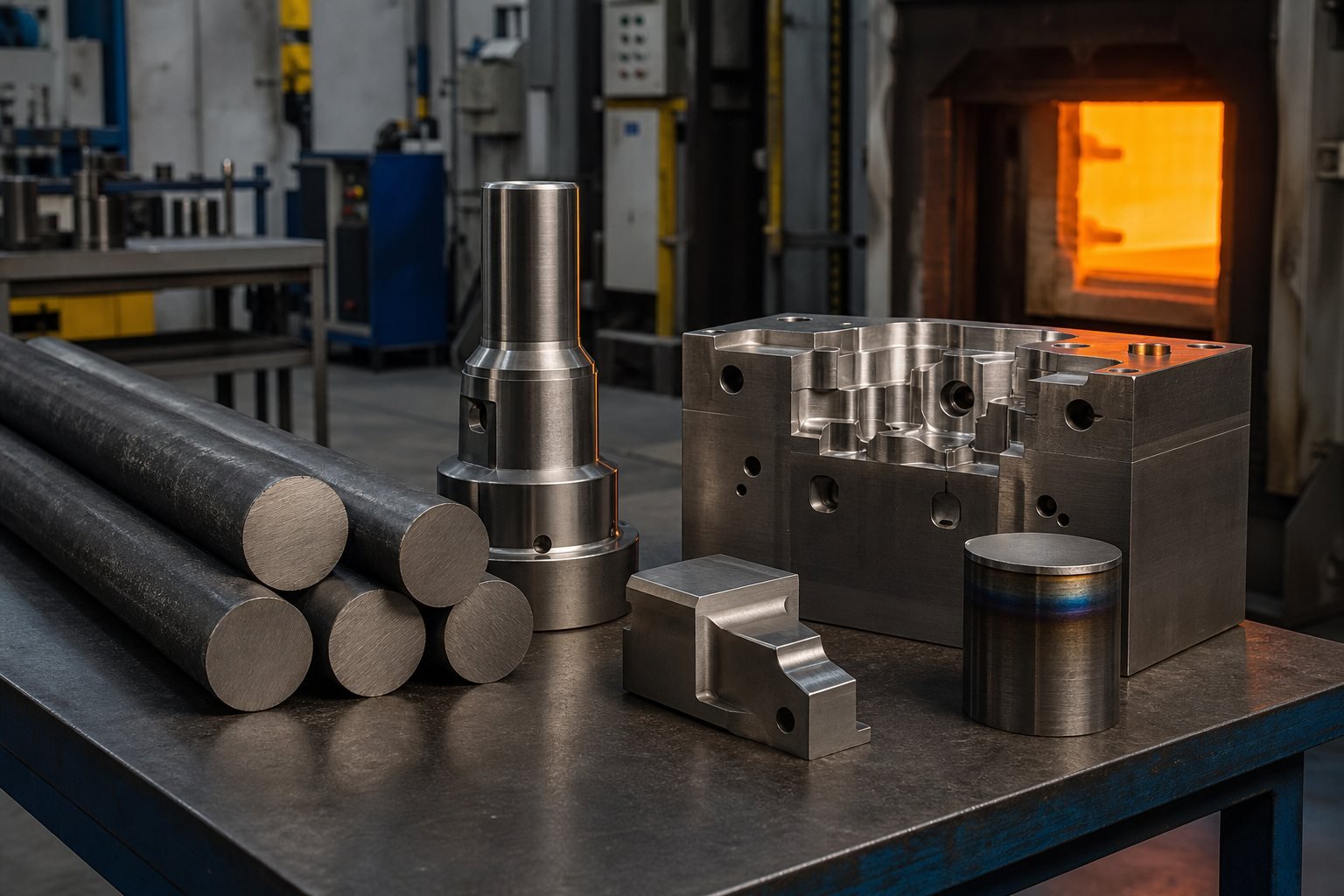
Quick answer: H11 / 1.2343 is an air-hardening hot-work tool steel commonly selected for die-casting dies, extrusion tooling, hot punches and high-temperature structural parts. It offers good toughness and thermal-fatigue resistance when cleanliness, heat treatment, hardness and surface condition are controlled.
What kind of steel is H11
H11 belongs to the 5% chromium hot-work tool-steel group with molybdenum and vanadium additions. The alloy is designed to retain strength at elevated temperature while offering more toughness than many higher-carbon wear-focused tool steels. The European designation 1.2343 is commonly treated as an H11 counterpart, but orders must use the exact product specification and chemistry limits.
It is normally supplied soft annealed for machining. Final hardening and multiple tempering develop the working microstructure. Electroslag-remelted or other premium-cleanliness routes may be specified for demanding dies.
Property balance
| Property | H11 profile | Application effect |
|---|---|---|
| Hot strength | Good retention at die and extrusion temperatures | Resists plastic deformation of working surfaces |
| Thermal-fatigue resistance | Good with correct heat treatment and cooling design | Helps resist heat-checking under repeated cycles |
| Toughness | High for a hot-work tool steel | Supports impact-loaded punches and complex dies |
| Wear resistance | Moderate; condition and surface treatment matter | May use nitriding for additional surface performance |
| Hardenability | Air-hardening in suitable sections | Supports controlled distortion, but section and furnace practice still matter |
Heat-treatment route
A typical qualified route includes staged preheating to reduce thermal shock, austenitizing within the supplier or specification range, controlled quenching and immediate tempering. Multiple tempers are often used to transform retained austenite and stabilize the structure. The final hardness must suit the tool size, impact, thermal cycle and crack risk.
Heating uniformity and protection from oxidation or decarburization are critical. Large blocks need thermocouple and soak planning, while sharp corners and abrupt sections raise quench stress. Actual temperatures should follow the selected producer datasheet and approved procedure.
Machining, EDM and grinding
Machine in the annealed state with adequate stock for heat-treatment movement and final finishing. Roughing should be balanced, and stress relief may be used after heavy machining under an approved route.
Electrical-discharge machining can leave a recast “white layer,” tensile stress and microcracks. Critical surfaces may require controlled finishing, polishing and stress tempering. Grinding burn has similar consequences and should be prevented through coolant, wheel and parameter control.
Applications
- Aluminum and magnesium die-casting dies and inserts.
- Extrusion dies, mandrels, dummy blocks and liners.
- Hot punches, hot shear blades and piercing tools.
- Forging dies and holders where toughness is important.
- High-temperature aerospace or mechanical parts under a dedicated material specification.
Failure prevention and inspection
Heat checking grows from repeated surface heating and cooling, while gross cracking can involve excessive hardness, stress concentration, poor preheating in service, aggressive cooling or an EDM-damaged layer. Tool design should provide radii, uniform sections and effective thermal management.
UT of starting blocks, hardness mapping, microstructure, surface crack inspection and heat-treatment records help control risk. Weld repair, if permitted, requires preheat, compatible filler, controlled deposition and post-weld tempering.
Conclusion
H11 / 1.2343 is a balanced hot-work steel rather than a maximum-hardness grade. Clean material, a controlled heat-treatment window and careful surface processing are the foundations of reliable service.
Technical references
Uddeholm Vidar Superior technical data · ASTM A681 standard page
Discuss Your Requirement with SAKYMETAL
Provide the required H11/1.2343 specification, block size, remelt route, annealed hardness, UT class, final hardness, heat treatment and certificate needs.
Next step: view related products or contact SAKYMETAL.
Technical note: This article is a general selection guide. Final material, condition, dimensions, testing and acceptance criteria shall follow the purchase order, governing specification and material test certificate.