
Call us now:


4140 Tensile Properties
4140 Alloy Steel Ultimate Tensile Strength: How Strong Is It Really?
A single tensile-strength number cannot represent every 4140 product because heat treatment, section size and test location can change the result substantially.
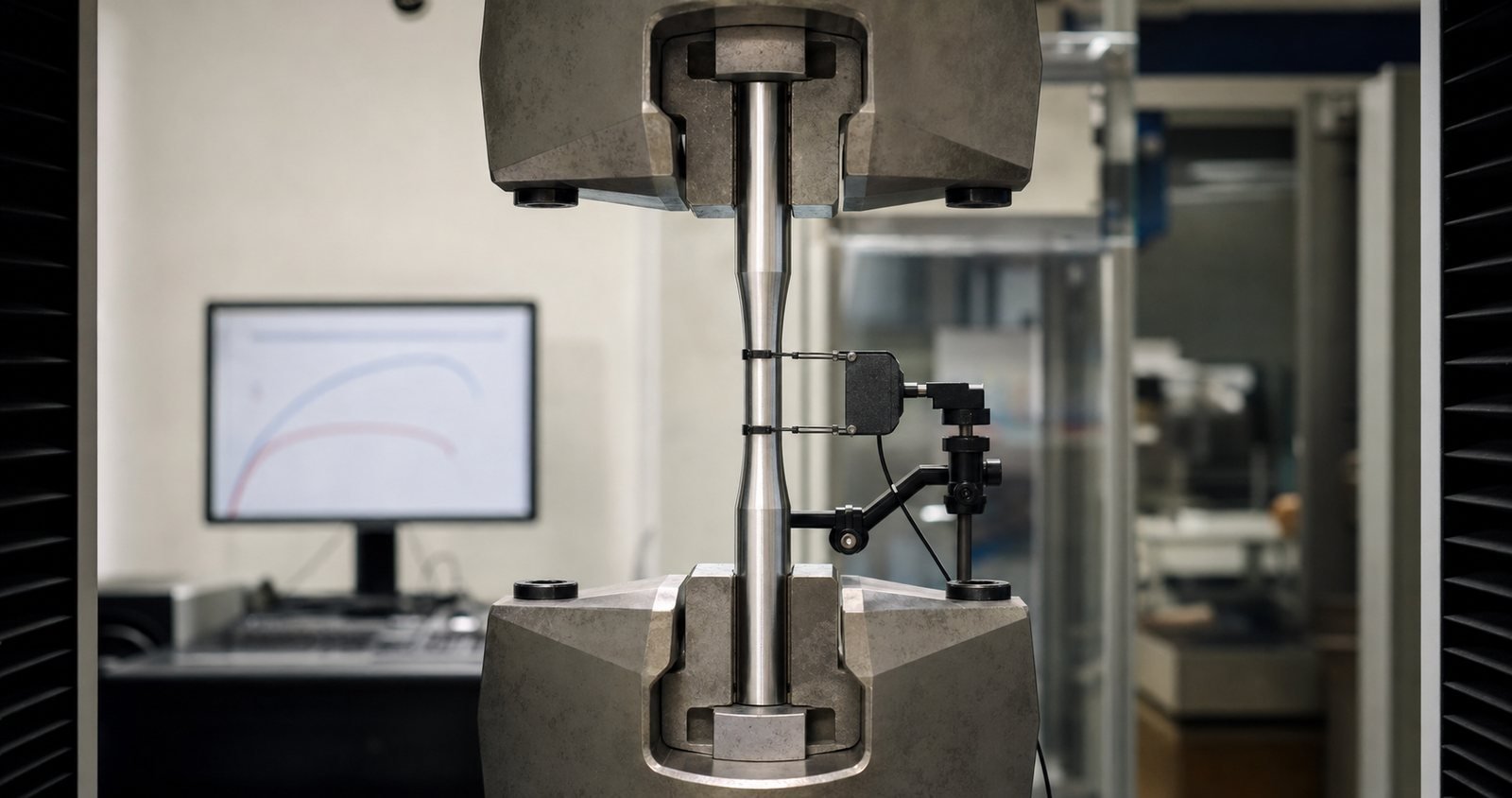
Quick answer: 4140 ultimate tensile strength is condition-dependent. Annealed or normalized material is lower in strength than quenched-and-tempered material, and increasing hardness generally raises tensile strength while reducing ductility and often toughness. Use the applicable product specification and MTC value for design or acceptance.
What ultimate tensile strength means
In a tensile test, engineering stress is calculated from force divided by the specimen’s original cross-sectional area. Ultimate tensile strength, or UTS, is the maximum engineering stress reached before necking and fracture. It is not the normal allowable design stress and it is not the point where permanent deformation first begins.
Yield strength, elongation and reduction of area provide different information. Two materials can share a similar UTS yet behave differently in yielding, ductility, toughness or fatigue.
Why 4140 has a wide strength range
Annealed 4140 is processed for machinability and lower hardness. Normalizing refines the structure and produces another property level. Quenching forms martensite when cooling is fast enough; tempering then reduces brittleness and selects the final balance. A lower tempering temperature generally retains more hardness and tensile strength, while higher tempering normally improves ductility and toughness.
The exact result depends on austenitizing, quench severity, tempering time and temperature, prior microstructure and chemistry within the grade range. Hardness-to-tensile conversions are estimates and should not replace a required tensile test.
Representative condition comparison
| Condition | Relative UTS level | Typical reason to choose it |
|---|---|---|
| Annealed | Lower | Machining and later heat treatment |
| Normalized | Moderate | Refined structure and general mechanical use |
| Quenched and tempered to moderate hardness | High with useful toughness | Shafts, pins, gears and heavy-duty parts |
| Quenched and tempered to high hardness | Very high but with reduced ductility margin | Specialized components after engineering review |
| Surface hardened over Q&T core | Hard surface; bulk UTS governed by core | Wear plus core toughness |
Section size and specimen location
The surface of a bar cools faster than its center. In large sections the core may not form the same martensitic fraction, so hardness and tensile properties can vary through thickness. 4140 has useful hardenability, but it is not unlimited.
Product specifications define sampling orientation and location because longitudinal and transverse results may differ. A coupon heat treated separately from the actual part may not represent the part unless the procedure establishes equivalence.
Using UTS correctly
Design should use values permitted by the governing code or approved material data, with factors for temperature, fatigue, stress concentration, environment and reliability. Yield strength often controls deformation-limited parts, while fatigue strength and fracture toughness may control cyclic or cracked components.
For purchasing, specify the material standard, condition and required tensile range. Review the MTC for heat number, specimen orientation, test temperature, yield strength, UTS, elongation and reduction of area. If the final heat treatment occurs after delivery, responsibility for final testing must be clear.
Common mistakes
- Quoting a handbook UTS without stating condition or hardness.
- Assuming the center of a thick bar matches a small surface specimen.
- Converting hardness to UTS and treating the estimate as certification.
- Using UTS as the allowable working stress.
- Ignoring fatigue, impact toughness, environment and residual stress.
Conclusion
4140 can reach a broad range of tensile strengths, which is a benefit only when the condition is controlled. The meaningful number is the specified and verified value for the actual product and heat-treatment route.
Technical references
ASTM E8/E8M tensile testing standard · SAE J404 alloy steel compositions
Discuss Your Requirement with SAKYMETAL
Send the product size, required condition or hardness, tensile/yield range, specimen orientation, heat-treatment responsibility and certification scope.
Next step: view related products or contact SAKYMETAL.
Technical note: This article is a general selection guide. Final material, condition, dimensions, testing and acceptance criteria shall follow the purchase order, governing specification and material test certificate.