
Call us now:


Stainless Steel Selection Guide
Is Stainless Steel Magnetic? A Grade-by-Grade Guide
Magnet response can offer a useful clue, but it cannot identify a stainless grade or prove material quality by itself.
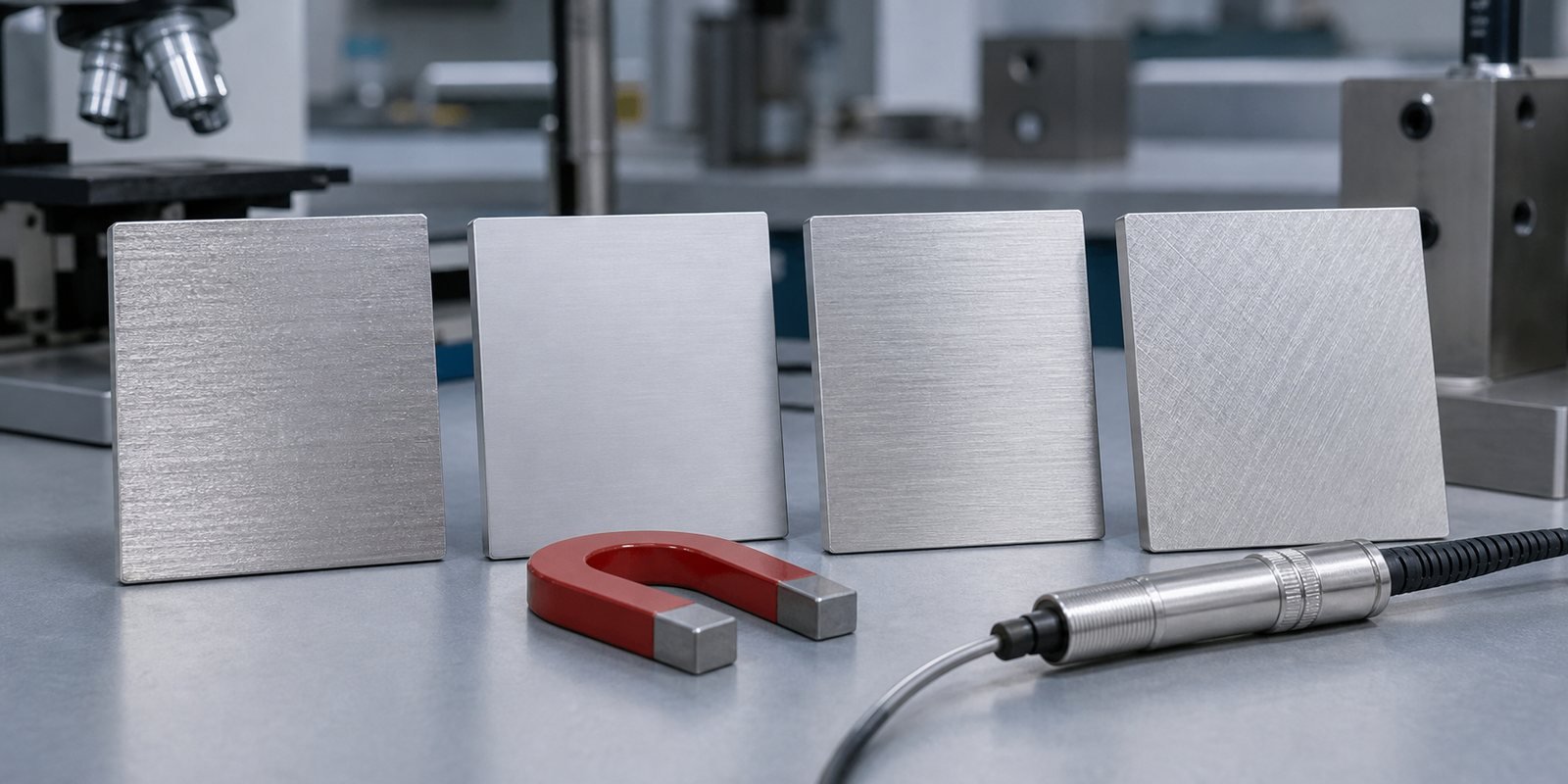
Quick answer: Some stainless steels are magnetic and some are not. Ferritic, martensitic and duplex grades are generally ferromagnetic. Fully solution-annealed austenitic grades such as 304 and 316 are normally weakly magnetic or essentially nonmagnetic, but cold work, forming and welding can create a measurable magnetic response.
Magnetism follows crystal structure
The word “stainless” describes corrosion-resistant iron alloys containing enough chromium to form a passive film; it does not describe one magnetic state. The dominant crystal structure is the key. Ferritic stainless steels, including many 400-series grades, have a body-centered cubic structure and normally show a strong attraction to a magnet. Martensitic grades are also magnetic, including hardened cutlery, valve and bearing grades. Duplex stainless combines ferrite and austenite, so its ferritic phase produces a clear response.
Austenitic stainless steels have a face-centered cubic structure. Stable, fully austenitic material has very low magnetic permeability. That is why annealed 304L or 316L sheet may appear “nonmagnetic” in a simple shop test even though it is still an iron-based alloy.
Why 304 and 316 can become magnetic
Cold rolling, bending, deep drawing, machining and other plastic deformation can transform part of the austenite into deformation-induced martensite. The transformed zones may attract a magnet, especially at sheared edges, formed corners, threads or heavily worked surfaces. 304 usually transforms more readily than 316 because the nickel and molybdenum balance of 316 tends to stabilize austenite, but actual response varies with chemistry, temperature and strain.
Welding creates another complication. Austenitic weld metal is often designed with a small amount of ferrite to reduce hot-cracking risk, and that ferrite is magnetic. A weld bead can therefore respond more strongly than the neighboring base metal without indicating that the entire component is the wrong grade.
Typical response by stainless family
| Stainless family | Typical magnet response | Examples |
|---|---|---|
| Austenitic | Very weak in the annealed condition; may increase after cold work or welding | 304, 304L, 316, 316L |
| Ferritic | Strong | 409, 430, 444 |
| Martensitic | Strong | 410, 420, 440C |
| Duplex | Strong to moderate because ferrite is present | S31803/2205, S32750 |
| Precipitation hardening | Usually magnetic after transformation/heat treatment | 17-4 PH / 630 |
What a magnet test can and cannot tell you
A magnet can quickly separate a strongly ferritic or martensitic item from a fully annealed austenitic sample. It cannot reliably distinguish 304 from 316, establish corrosion resistance, confirm heat treatment or prove compliance with ASTM, EN or another product standard. Magnet strength, surface gap, part geometry and work hardening all change the apparent result.
For grade verification, match markings and heat numbers to the material test certificate. Positive material identification by X-ray fluorescence can screen major alloying elements such as chromium, nickel and molybdenum; optical emission methods can add carbon information when required. Critical orders may also require chemistry, mechanical tests, microstructure, ferrite measurement or corrosion testing under the applicable specification.
A practical receiving checklist
- Check grade, product standard, size, condition and heat number against the purchase order.
- Confirm that markings on the material correspond to the MTC and packing list.
- Use the magnet only as a quick comparative observation, not the final acceptance test.
- Apply PMI with a suitable calibrated instrument when grade mix-up risk matters.
- Investigate differences between base metal, cut edges, formed areas and welds before rejecting material.
Conclusion
Stainless steel is not automatically nonmagnetic. Its magnetic behavior depends on alloy family, microstructure and processing history. Treat a magnet as a useful first look, then rely on traceability, PMI and specification-based tests for a defensible grade decision.
Technical references
Outokumpu: Stainless steel types · Outokumpu: Cold rolled stainless products
Discuss Your Requirement with SAKYMETAL
Send the required grade, product form, dimensions, surface finish, magnetic-permeability limit if applicable, and certification scope for a technically aligned quotation.
Next step: view related products or contact SAKYMETAL.
Technical note: This article is a general selection guide. Final material, condition, dimensions, testing and acceptance criteria shall follow the purchase order, governing specification and material test certificate.