
Call us now:


Failure Analysis Fundamentals
Why Do Metals Suddenly Break? Understanding Brittle Fracture
A component that looked sound can fail without obvious warning when a crack, a severe stress state and insufficient toughness meet.
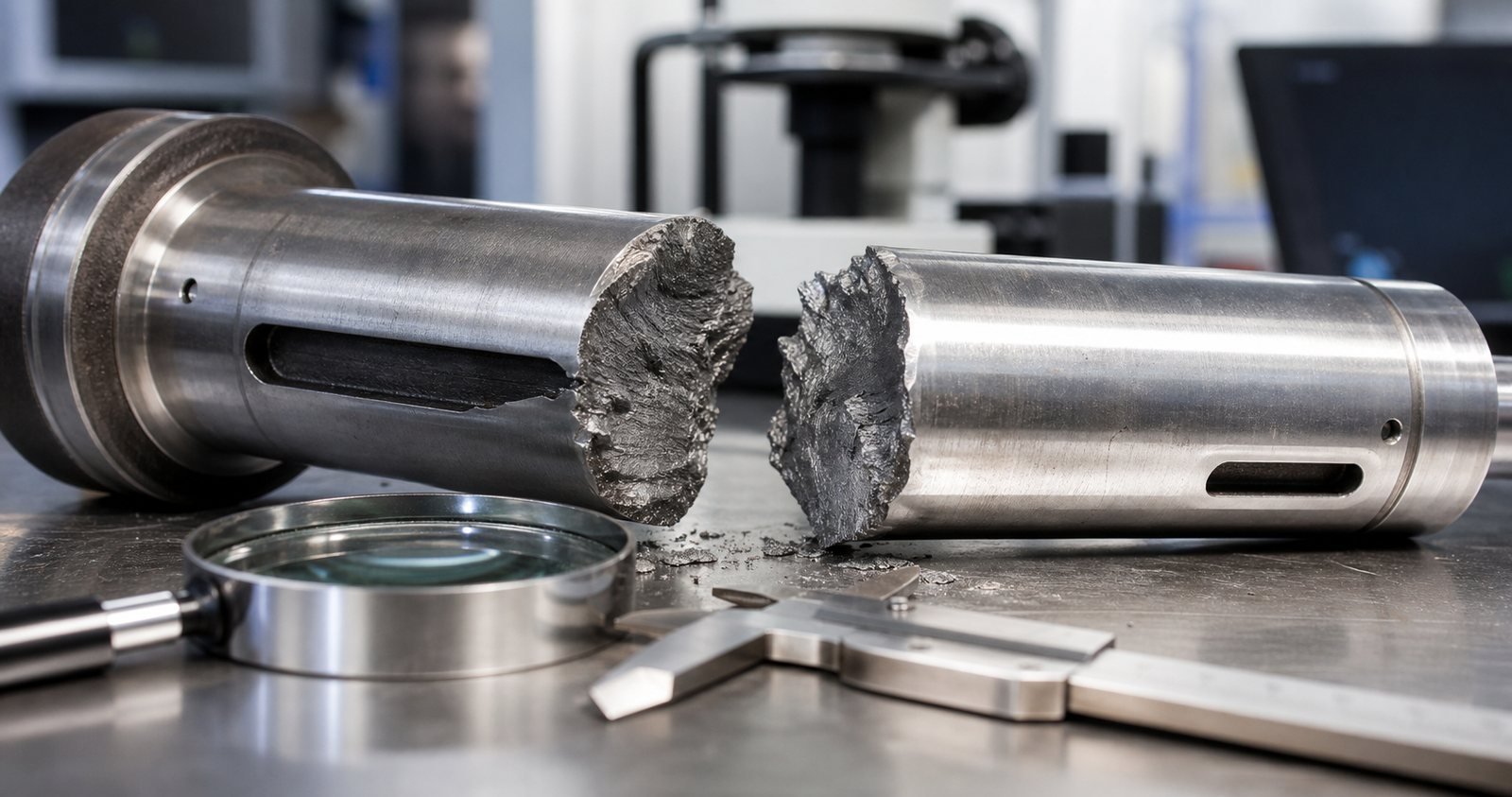
Quick answer: Metals rarely break for no reason. Sudden fracture commonly results from a pre-existing flaw, high local stress, low temperature, an embrittled microstructure, fatigue growth or an aggressive environment. The final fast fracture may be sudden even though the damage accumulated over a long period.
The final break is only the last event
A machine operator may hear one sharp sound and see a shaft or bracket separate immediately. Metallurgically, however, the sequence may have started with a machining mark, inclusion, weld defect, corrosion pit or service overload. Repeated loading can extend a small crack by fatigue until the remaining ligament can no longer carry the load. Final separation then happens in a fraction of a second.
A sound investigation therefore avoids describing every fast failure as “brittle.” It asks where the crack started, how it grew, what the load history was and whether the material had the toughness required at the service temperature.
Ductile fracture versus brittle fracture
Ductile fracture absorbs substantial energy and normally shows plastic deformation, necking or shear lips. Brittle fracture absorbs less energy and can propagate rapidly with little macroscopic distortion. Steel can shift toward brittle behavior as temperature falls, strain rate rises, section constraint increases or toughness decreases.
Thick sections, sharp notches and highly restrained details create a triaxial stress state that suppresses plastic flow. This helps explain why a small laboratory specimen and a thick welded structure made from nominally the same grade may not behave identically.
Six common drivers
- Stress concentration at a sharp corner, undercut, thread root, keyway or abrupt section change.
- Fatigue growth under cyclic load, often beginning at a surface discontinuity.
- Low service temperature relative to the material’s ductile-to-brittle transition behavior.
- Improper heat treatment, excessive hardness, temper embrittlement or an unfavorable heat-affected zone.
- Hydrogen-assisted cracking, stress-corrosion cracking or corrosion fatigue.
- Overload, impact, misalignment, residual stress or a load path not considered in the original design.
What the fracture surface can reveal
The first priority is preservation. Do not wire-brush, grind, oil or fit the broken halves together before documentation. Photograph the part, orientation and nearby evidence; record operating conditions; and protect the surfaces from handling damage and corrosion. Beach marks, ratchet marks, chevrons, shear lips and the location of the origin help guide later microscopy.
A complete analysis may combine visual examination, dimensional checks, penetrant or magnetic-particle testing of adjacent areas, scanning electron microscopy, chemistry, hardness mapping, metallography and review of heat treatment and MTC records. Loading calculations and maintenance history are equally important because laboratory observations must be connected to service.
How to reduce the risk
Design smooth transitions, provide adequate radii and control weld profiles. Select material using fracture-toughness or impact requirements appropriate to thickness and minimum design temperature, not room-temperature tensile strength alone. Manage hardness and hydrogen when welding high-strength steels, and qualify the heat treatment that establishes the final microstructure.
In service, inspect locations where stress, corrosion and access conditions make cracks most likely. A risk-based interval should be short enough to find a crack before it reaches the critical size. For safety-critical equipment, an engineering fracture-control plan links allowable flaw size, inspection capability, expected growth and remaining life.
Conclusion
Sudden metal fracture is normally the visible end of a chain involving material, flaw, stress, environment and time. Preserving evidence and evaluating that full chain leads to better corrective action than simply choosing a “stronger” grade.
Technical references
NIST: Fatigue and Fracture Group · NIST: Fracture control guidance
Discuss Your Requirement with SAKYMETAL
For replacement steel, provide the component drawing, governing grade, condition, minimum-temperature requirement, inspection scope and traceability needs.
Next step: view related products or contact SAKYMETAL.
Technical note: This article is a general selection guide. Final material, condition, dimensions, testing and acceptance criteria shall follow the purchase order, governing specification and material test certificate.