
Call us now:


Engineering Strength Explained
What Makes the Strongest Metal? Strength Depends on the Job
There is no single strongest metal because “strength” can mean yield resistance, ultimate tensile strength, hardness, impact toughness, fatigue life or strength-to-weight ratio.
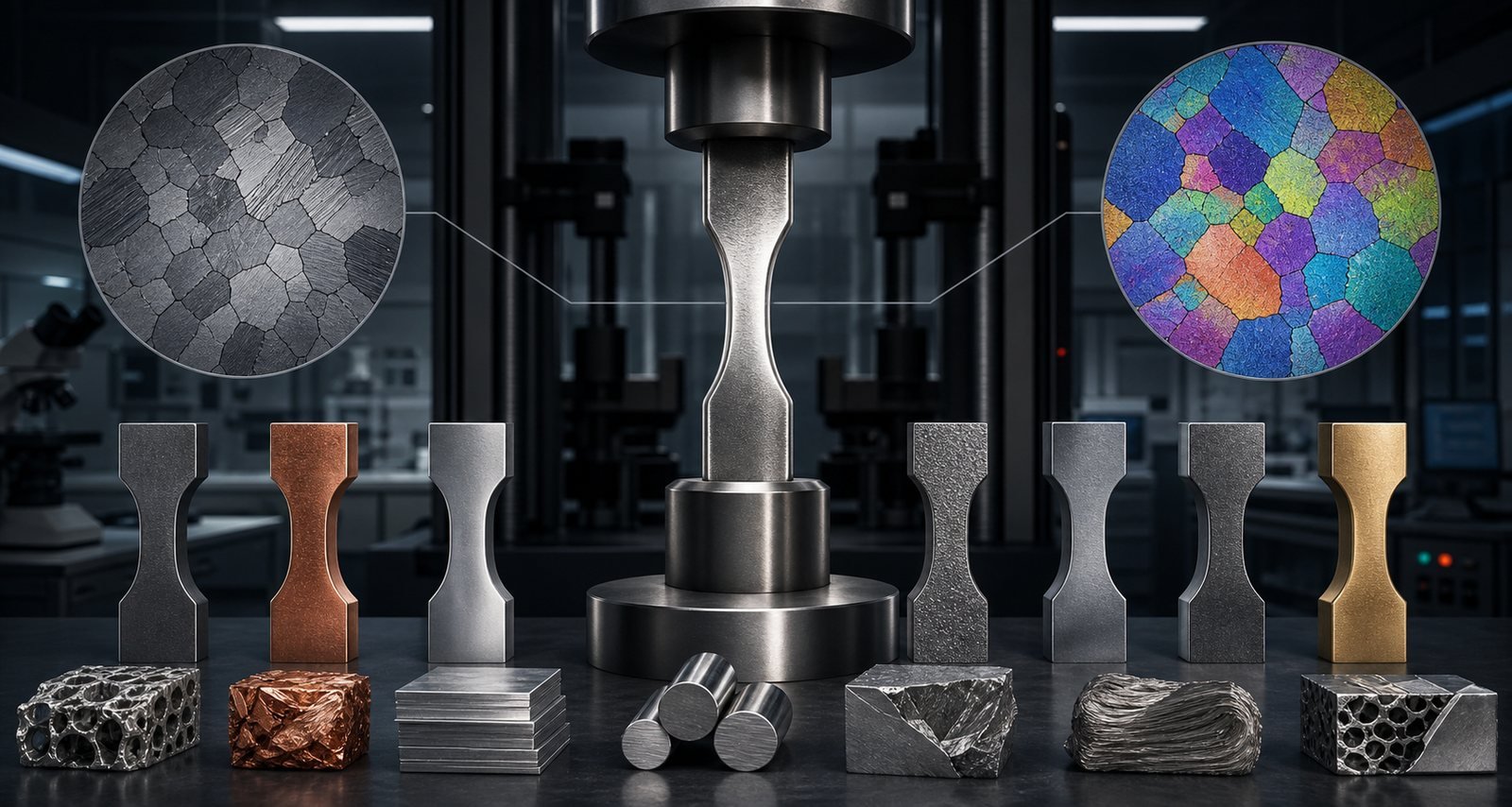
Quick answer: The strongest metal depends on the property and condition being compared. Hardened tool steels can offer exceptional hardness, maraging steels very high tensile strength, tungsten high temperature capability, and titanium alloys high specific strength. A useful selection begins with the load, environment, temperature, geometry, manufacturing route and failure mode.
First define what “strong” means
| Property | What it measures | Why it matters |
|---|---|---|
| Yield strength | Stress where permanent deformation begins | Frames, shafts and pressure parts that must keep their shape |
| Ultimate tensile strength | Maximum engineering stress in a tensile test | Material comparison and processing control |
| Hardness | Resistance to indentation or scratching | Wear surfaces, tools and bearings |
| Fracture toughness | Resistance to crack extension | Thick, flawed or safety-critical structures |
| Fatigue strength | Resistance to repeated loading | Rotating shafts, springs and aircraft parts |
| Specific strength | Strength divided by density | Weight-sensitive transportation and aerospace design |
Composition creates potential
Alloying changes crystal structure, phase stability and precipitation. Carbon supports martensitic hardening in steel; chromium, molybdenum, nickel and vanadium influence hardenability, temper resistance, toughness and carbide formation. Nickel superalloys use coherent precipitates to retain strength at temperatures where many steels soften. Titanium alloys combine relatively low density with high room-temperature strength.
Composition alone does not establish final properties. The same nominal alloy can be soft and machinable in an annealed condition or extremely strong after quenching, tempering, aging or cold work.
Microstructure is the real engine
Grain size, dislocation density, phases, precipitates and inclusions determine how a metal resists deformation and cracking. Heat treatment controls these features. Quenched-and-tempered steel develops martensite and tempers it to balance strength and toughness; precipitation-hardening alloys form fine particles that obstruct dislocations; cold working raises strength by increasing dislocation density.
Strengthening usually brings a tradeoff. Very high hardness can reduce toughness and machinability. Cold work can leave residual stress. High alloy content can increase cost or complicate welding. Good engineering identifies the property combination rather than chasing the largest number on a datasheet.
Why size and temperature change the ranking
A small test coupon can cool rapidly during heat treatment, while the center of a thick bar cools more slowly. Hardenability and section size therefore control whether through-thickness properties match surface properties. Statistical size effects and the probability of a critical flaw also matter for large components.
Temperature may rearrange the ranking completely. Ferritic steels can lose toughness at low temperature, while aluminum or titanium may be chosen for weight. At high temperature, creep and oxidation resistance become more important than room-temperature tensile strength.
Examples of different winners
- Hardened tool steels for hardness, edge retention and abrasive wear.
- Maraging and ultra-high-strength steels for very high tensile strength with controlled heat treatment.
- Titanium alloys for high strength-to-weight ratio and corrosion performance.
- Nickel-base superalloys for sustained strength, creep and oxidation resistance at elevated temperature.
- Tungsten and refractory metals for exceptional melting temperature and high-temperature stiffness, despite density and fabrication challenges.
A better selection process
Define normal, peak and cyclic loads; minimum and maximum temperature; corrosion and wear mechanisms; required life; acceptable deformation; inspection access; joining and repair. Then compare property values in the actual delivery and heat-treated condition, at the relevant section size and temperature.
Finally, confirm that the selected product specification controls chemistry, cleanliness, heat treatment, mechanical testing and traceability. The “strongest” alloy is not useful if it cannot be manufactured, inspected or maintained into the required part.
Conclusion
Metal strength is a system property shaped by alloy, microstructure, processing, geometry and service. The correct answer is the material that safely resists the governing failure mode with practical fabrication and verification.
Technical references
NIST: Mechanical performance research · ASM International: Mechanical testing overview
Discuss Your Requirement with SAKYMETAL
Send the loading, temperature, environment, product dimensions, weight target, heat-treatment route and governing standard so the right property combination can be evaluated.
Next step: view related products or contact SAKYMETAL.
Technical note: This article is a general selection guide. Final material, condition, dimensions, testing and acceptance criteria shall follow the purchase order, governing specification and material test certificate.