
Call us now:


4140 Application Guide
Uses for 4140 Steel: Where This Tough Alloy Shines Most
AISI 4140 is widely used for shafts, gears, pins, tooling and oilfield components because heat treatment can tune its strength, toughness and wear response.
Quick answer: 4140 is a chromium-molybdenum low-alloy steel chosen for loaded mechanical parts that need greater hardenability and fatigue performance than plain carbon steel. It is especially useful for medium-to-large sections, but the final application depends on hardness, heat treatment, toughness, machining, welding and service environment.
Why 4140 is so versatile
Nominal chromium and molybdenum additions improve hardenability compared with plain medium-carbon steel. That means a thicker section can develop a more useful through-section microstructure after quenching. Tempering then adjusts hardness, strength and toughness.
The grade is available as hot-rolled or cold-finished bar, plate, tube, forgings and prehardened stock under different standards. Product form and heat history affect properties, so “4140” is only the beginning of a complete selection.
Power-transmission components
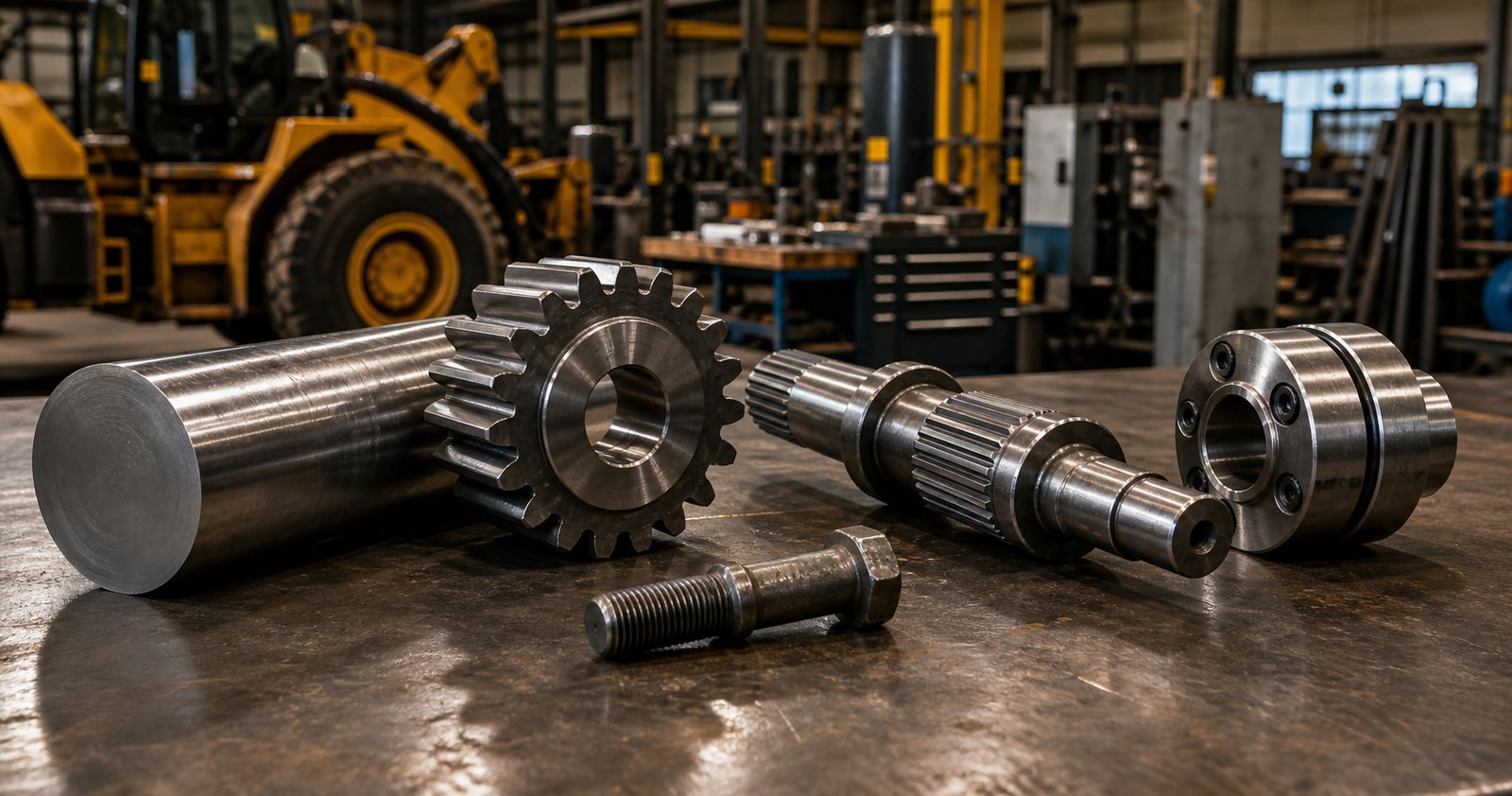
Shafts, axles, spindles, couplings and some gears are classic 4140 applications. These parts combine torsion, bending, contact stress and cyclic loading. Quenched-and-tempered 4140 can provide a useful strength-toughness balance, while induction hardening or nitriding can add a hard surface over a tougher core.
Geometry remains decisive. Fillet radii, keyways, threads, splines and surface finish can control fatigue life more strongly than a modest change in bulk tensile strength.
Pins, fasteners and structural hardware
Heavy-duty pins, studs, tie rods, bolts and connecting hardware may use 4140 when higher proof load and better section response are needed than a simpler carbon grade provides. The drawing must define final heat-treatment condition and mechanical acceptance, especially for threaded parts.
Hydrogen control is important for high-hardness electroplated components. Welding also requires care because carbon equivalent and hardenability can create a hard heat-affected zone without suitable preheat, consumables, heat input and post-weld practice.
Tooling and industrial equipment
4140 is used for holders, arbors, fixtures, mold bases, rams and moderate-temperature tooling where extreme hot hardness is not required. Prehardened material can reduce the risk of distortion after machining and shorten lead time.
It is not a direct substitute for H11, H13 or a cold-work tool steel when thermal fatigue, red hardness or severe abrasive wear dominates. Application temperature and wear mechanism should drive that choice.
Oil, gas, mining and mobile equipment
Drilling components, subs, collars, mandrels, hydraulic parts, wear pins and machine elements often require high strength and good fatigue resistance in substantial sections. 4140 or modified 4140 chemistry may be selected under industry-specific specifications.
Sour or hydrogen-bearing service needs additional hardness, cleanliness, heat-treatment and environmental controls. A generic commercial 4140 bar should not be assumed suitable for every pressure or downhole component.
Application and condition guide
| Application need | Common 4140 route | Key verification |
|---|---|---|
| Machinable general component | Annealed or normalized stock | Hardness, dimensions, chemistry |
| High-strength shaft or pin | Quenched and tempered | Tensile/yield, impact if required, hardness profile |
| Wear-resistant journal | Q&T plus induction hardening or nitriding | Case depth, surface hardness, core properties |
| Precision mold or fixture | Prehardened stock | Uniform hardness, stress relief, machining allowance |
| Welded repair or fabrication | Qualified weld procedure | Preheat, hydrogen control, HAZ hardness |
Conclusion
4140 shines when a part needs tunable bulk strength and toughness, reasonable machinability and the option of surface hardening. The successful application pairs the grade with a specified condition, section-size capability and verification plan.
Technical references
SAE J404: Chemical compositions of SAE alloy steels · SAE J412: General characteristics of steels
Discuss Your Requirement with SAKYMETAL
Send the component drawing, section size, final hardness or mechanical properties, heat treatment, surface-hardening needs, inspection and certificate requirements.
Next step: view related products or contact SAKYMETAL.
Technical note: This article is a general selection guide. Final material, condition, dimensions, testing and acceptance criteria shall follow the purchase order, governing specification and material test certificate.