
Call us now:


Custom Stainless Pipe Processing
304 and 316 Stainless Steel Custom-Cut Pipe Sections: Angled Cutting, Inspection and Applications
These 304 and 316 stainless steel pipe sections are cut to customer-defined angles and lengths, then checked and organized for fabrication or assembly.
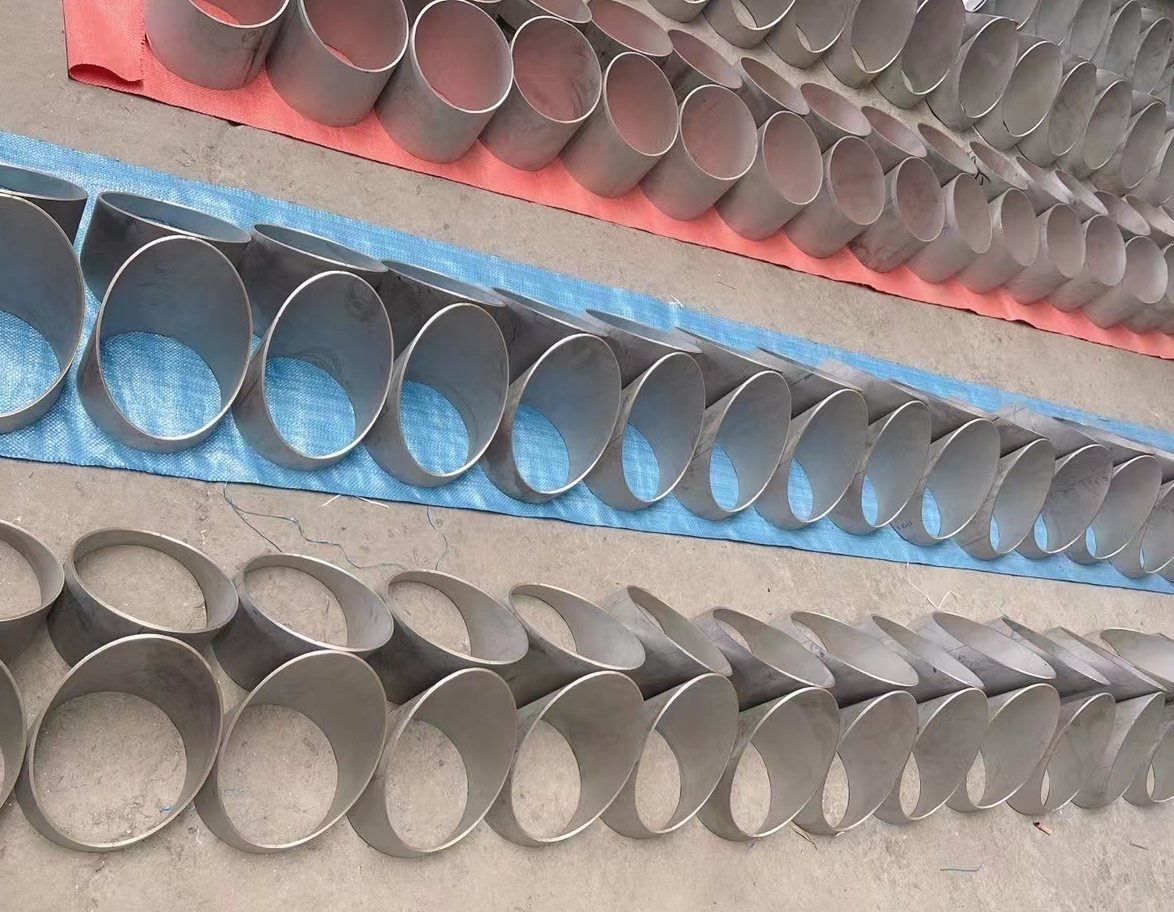
Quick answer: Custom angled pipe sections reduce downstream fitting time when cut geometry, orientation, length and edge condition are controlled. Grade 304 suits many general fabrication environments, while 316 adds molybdenum for improved resistance in many chloride and process applications. The order should define the exact grade, dimensions, angle tolerance and inspection.
What the photographs show
The finished pieces are short pipe sections with oblique end faces rather than square cuts. Multiple diameters and angle configurations are separated in rows, allowing operators to check orientation and count before the next fabrication stage. These parts may be used as branch interfaces, transition pieces, nozzles or preforms for welded assemblies.
Angled cutting is more demanding than cutting square rings. The shop must control the reference line around the pipe, high and low points of the cut, rotational orientation, length datum and heat input. A small angular error can become a large gap when the piece is fitted to another surface.
Cut quality and angle verification
The close view shows the cut face and edge condition, while the inspection image records an operator checking the angle with a protractor-style gauge. Production inspection should use a defined datum and a calibrated tool appropriate to the tolerance. For tighter work, a fixture, height gauge, profile template or coordinate measurement may be needed.
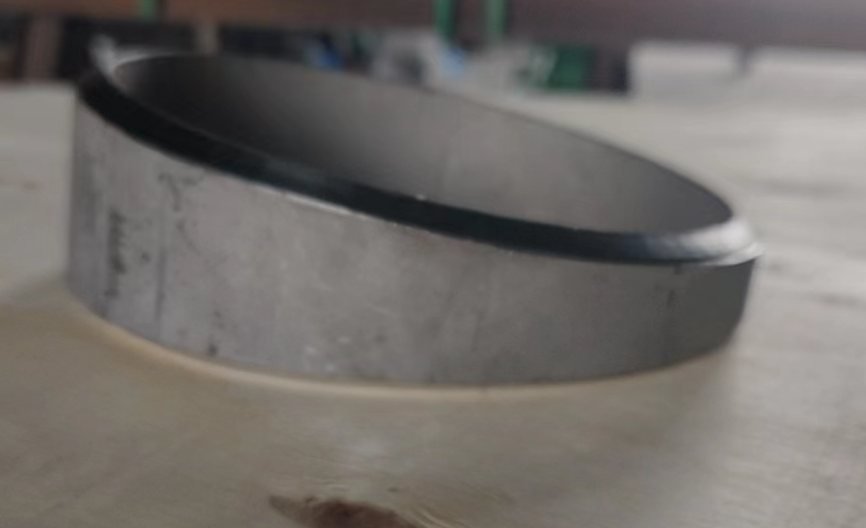
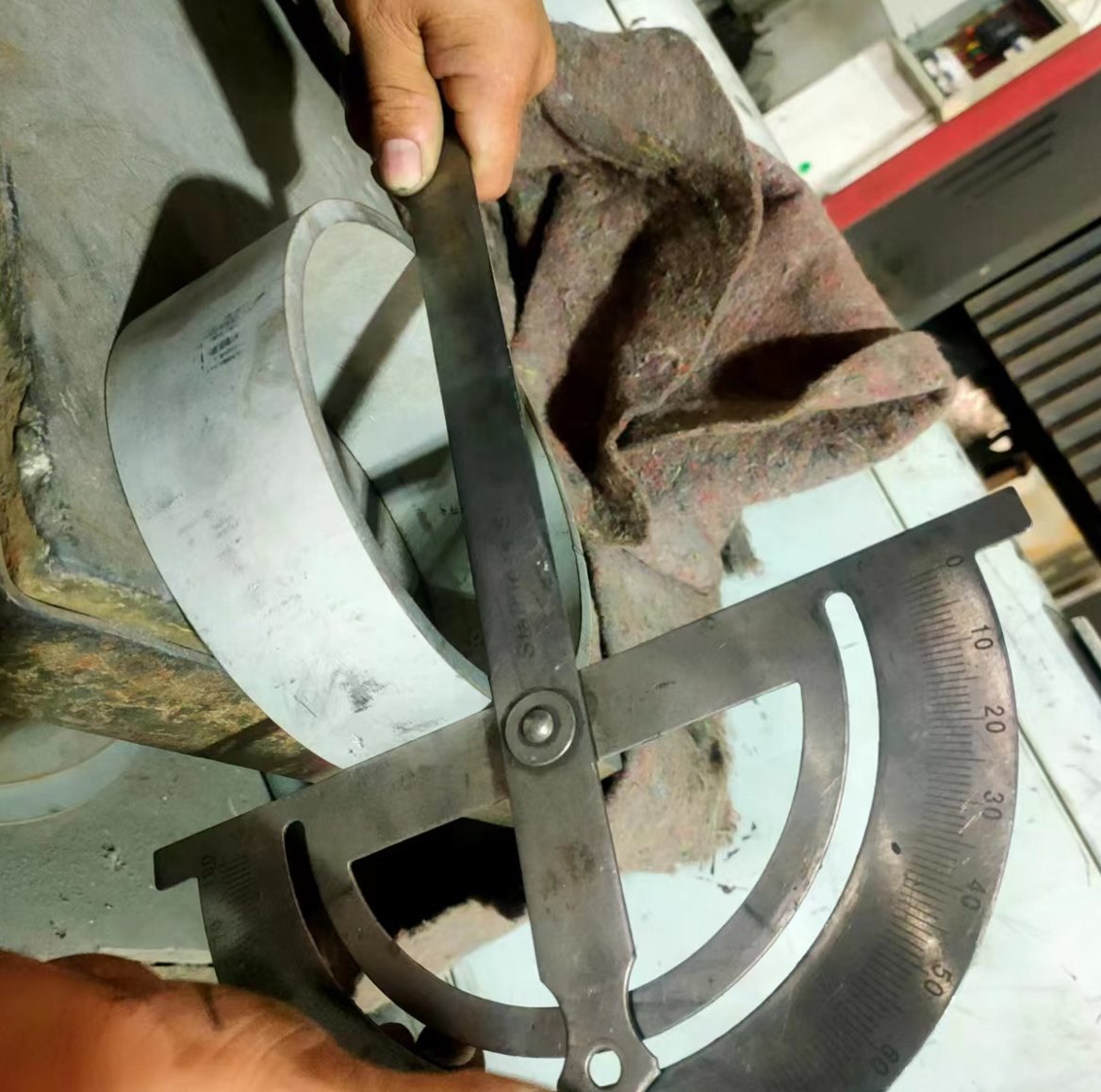
Inspection should also cover outside diameter, wall thickness, overall high-point and low-point length, cut orientation, ovality, burrs and local heat-affected discoloration. A first-piece approval helps confirm the machine program before the full batch is processed.
Choosing between 304 and 316
| Factor | 304 / 304L | 316 / 316L |
|---|---|---|
| General use | Food equipment, architectural and industrial fabrication in compatible environments | Process, coastal and chloride-bearing service where improved resistance is needed |
| Molybdenum | Normally not intentionally added | Typically contains molybdenum for improved localized-corrosion resistance |
| Welding | L grades often selected to control sensitization in welded construction | L grades often selected for welded construction |
| Final decision | Confirm medium, cleaning chemistry and temperature | Confirm chloride level, crevices, temperature and lifecycle requirements |
Cutting methods and edge control
Cold saws, band saws, abrasive systems, plasma, laser and waterjet processes can be applied depending on diameter, wall, angle, volume and tolerance. Mechanical sawing limits the thermal zone but must control blade deflection and burr. Thermal processes are flexible but can create dross, heat tint and a local heat-affected surface requiring finishing.
After cutting, remove loose burrs and sharp edges without changing the required geometry. Tools used on stainless should be kept free from carbon-steel contamination. If welding or corrosion service is demanding, qualified grinding, pickling or passivation may be specified to restore a clean surface.
From batch processing to delivery
Large batches benefit from clear part labels that link grade, heat, size, angle and drawing item. Pieces should be segregated by grade and protected from impact or carbon-steel contact. Counting and nesting plans reduce material waste while maintaining heat-number traceability.
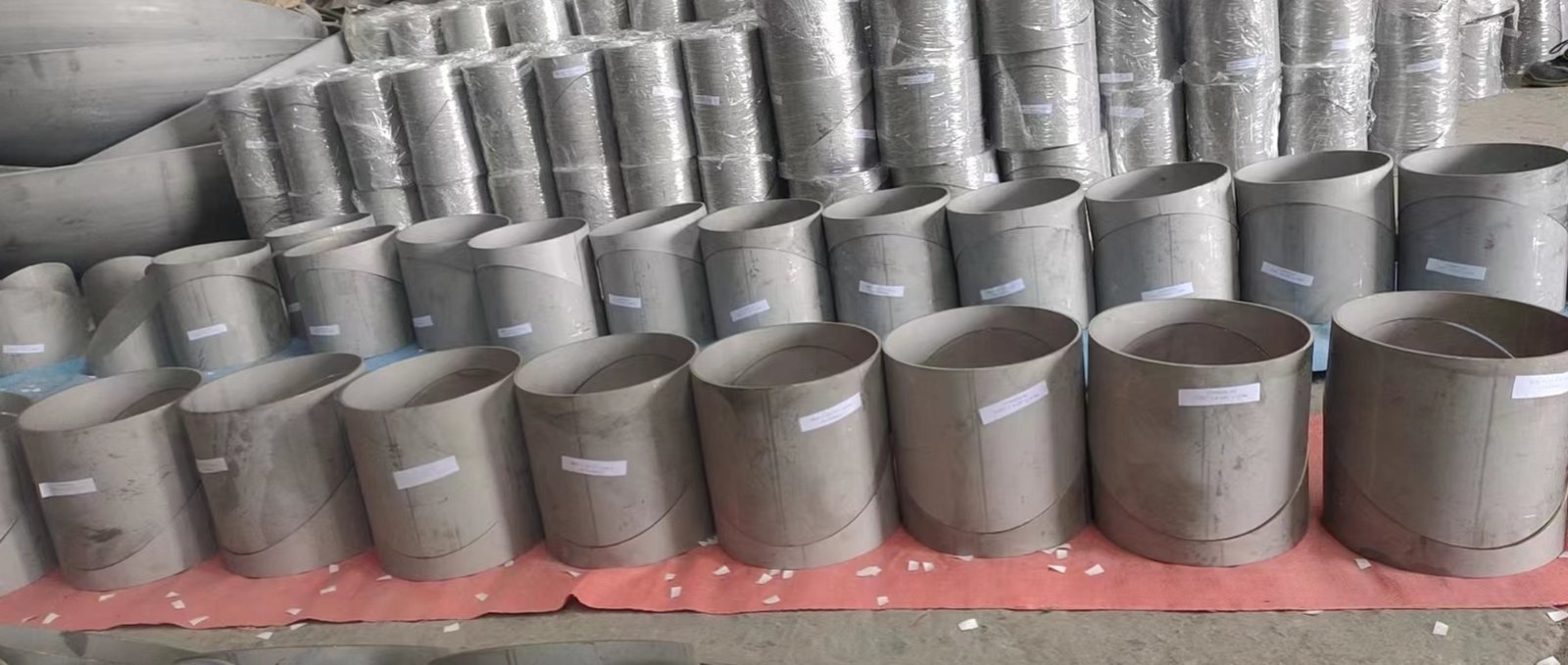
Packaging should prevent cut edges from rubbing together and should keep moisture or chloride-bearing debris away from the surfaces. The delivery pack may include the cut list, dimensional report, material certificate and any PMI or surface-treatment record required by the order.
What to place on the drawing or inquiry
- 304/304L or 316/316L grade and applicable pipe/tube product standard.
- Outside diameter, wall thickness, starting length and quantity.
- Cut angle with a clearly identified datum and tolerance.
- High-point/low-point length and rotational orientation where relevant.
- Edge condition, burr limit, bevel or weld-preparation requirements.
- Surface finish, heat-tint removal, pickling/passivation or cleanliness requirements.
- PMI, dimensional report, marking, heat traceability and certificate type.
Applications for angled pipe sections
Precut sections can support manifolds, branch connections, hoppers, tanks, process skids, architectural nodes, exhaust or ventilation assemblies and custom tubular frames. Their main value is repeatable geometry that shortens layout and fit-up at the customer’s fabrication station.
The finished assembly design still determines pressure rating, weld procedure, examination and corrosion suitability. A cut component should not be treated as a finished pressure fitting unless it is designed and qualified as one under the applicable code.
Conclusion
The photographed 304 and 316 parts demonstrate practical batch processing: consistent angled cutting, direct angle checks, labeling and organized staging. A clear cut drawing and agreed inspection plan turn that capability into repeatable fit-up for downstream fabrication.
Technical references
Outokumpu: Stainless steel types and grades · ASTM A312 standard page
Discuss Your Requirement with SAKYMETAL
Send the grade, OD, wall, quantity, cut angle and datum, high/low lengths, tolerance, edge preparation, surface treatment and certificate requirements.
Next step: view related products or contact SAKYMETAL.
Technical note: This article is a general selection guide. Final material, condition, dimensions, testing and acceptance criteria shall follow the purchase order, governing specification and material test certificate.