
Call us now:


Metal Forging Fundamentals
What Is Forging? Process, Types, Benefits and Applications
Forging shapes metal with compressive force from hammers, presses or rolls, often refining the starting structure and directing grain flow through the component.
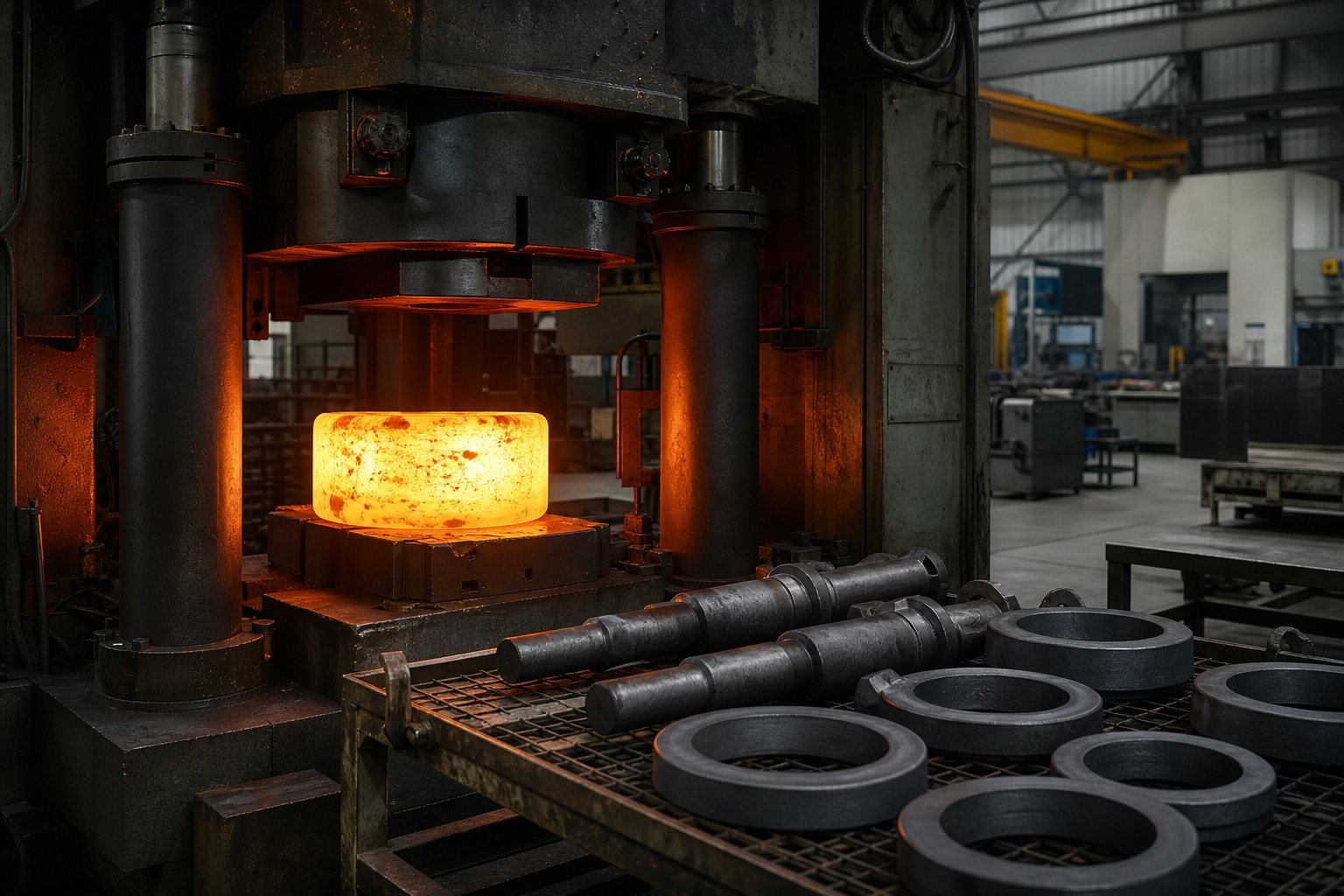
Quick answer: Forging is the controlled deformation of metal by hammering, pressing or rolling. It can be performed hot, warm or cold and with open dies, closed dies or ring-rolling equipment. Forgings are widely used for highly loaded parts because the process can improve structural integrity and fatigue resistance.
How forging works
The starting stock may be an ingot, billet, bar or preform. For hot forging it is heated into a plastic working range, then compressed in stages. Metal flows in directions not constrained by the dies. Repeated deformation can close internal voids, break down cast structure and refine grains when temperature and reduction are controlled.
Forging is followed by trimming, heat treatment, cleaning, machining and inspection as required. The forging drawing includes allowances, draft, radii and test locations that may differ from the final machined drawing.
Main process types
| Process | How it shapes metal | Typical products |
|---|---|---|
| Open-die forging | Workpiece compressed between simple dies and manipulated between blows | Large shafts, blocks, discs and custom low-volume parts |
| Closed-die / impression forging | Metal fills shaped die cavities | Connecting rods, hand tools and high-volume near-net parts |
| Seamless rolled ring | Punched preform expanded between rolls | Bearing, gear, pressure-vessel and turbine rings |
| Cold forging | Metal deformed near room temperature | Fasteners and small precision parts with work hardening |
| Warm forging | Intermediate temperature reduces load while retaining accuracy | Automotive and precision components |
| Radial forging | Multiple hammers or dies work around the circumference | Long shafts, stepped bars and tubes |
Why forgings can be strong
Controlled working can refine the cast structure and align flow lines with part geometry. Properly designed grain flow supports fatigue and impact performance, while consolidation can reduce internal porosity. These advantages are process-dependent, not automatic. Insufficient reduction, laps, overheating or poor die fill can create defects.
The final mechanical properties also require correct chemistry and heat treatment. A forging is not necessarily stronger than every rolled or cast alternative; compare verified properties, flaw tolerance, geometry and cost.
Design and manufacturing considerations
Generous radii and gradual section transitions promote metal flow and reduce die stress. Parting line, draft and machining allowance affect material use. Open-die pieces need enough reduction and manipulation to work the intended volume; closed-die parts require controlled billet weight and die filling.
Large forgings cool slowly and may need staged heat treatment. Test coupons and prolongations should represent the critical section under the applicable specification. Simulation and process qualification can support complex grain-flow requirements.
Inspection and defects
Visual and dimensional inspection address shape, scale and laps. Magnetic-particle or penetrant testing finds suitable surface-breaking discontinuities, while UT examines internal volume. Metallography, hardness and mechanical tests confirm the heat-treated structure and properties.
Common concerns include laps, seams, underfill, bursts, flakes, decarburization and heat-treatment cracking. Acceptance criteria must come from the product specification and drawing, not from a generic expectation that forging removes every flaw.
Common applications
- Crankshafts, connecting rods, axles and gear blanks.
- Pressure-vessel rings, flanges and valve bodies.
- Aircraft landing gear and structural fittings.
- Turbine rotors, generator shafts and energy equipment.
- Mining, offshore and heavy-equipment pins, rolls and tooling.
Conclusion
Forging is a family of compressive forming processes that can deliver reliable, highly loaded components. The benefits come from qualified material, sufficient working, correct heat treatment, inspection and a design that works with metal flow.
Technical references
Scot Forge: Advantages of forging processes · Scot Forge: Metallurgical forging FAQ
Discuss Your Requirement with SAKYMETAL
Send the grade, finished drawing, forging envelope, heat treatment, grain-flow, test coupon, NDT and certification requirements.
Next step: view related products or contact SAKYMETAL.
Technical note: This article is a general selection guide. Final material, condition, dimensions, testing and acceptance criteria shall follow the purchase order, governing specification and material test certificate.