
Call us now:


Critical Cable Engineering
How 904L Cable Ensures Reliability in Critical Engineering Projects
904L stainless steel cable can extend service life in aggressive environments, but dependable performance comes from matching the alloy, rope construction, terminations and inspection plan to the real duty.
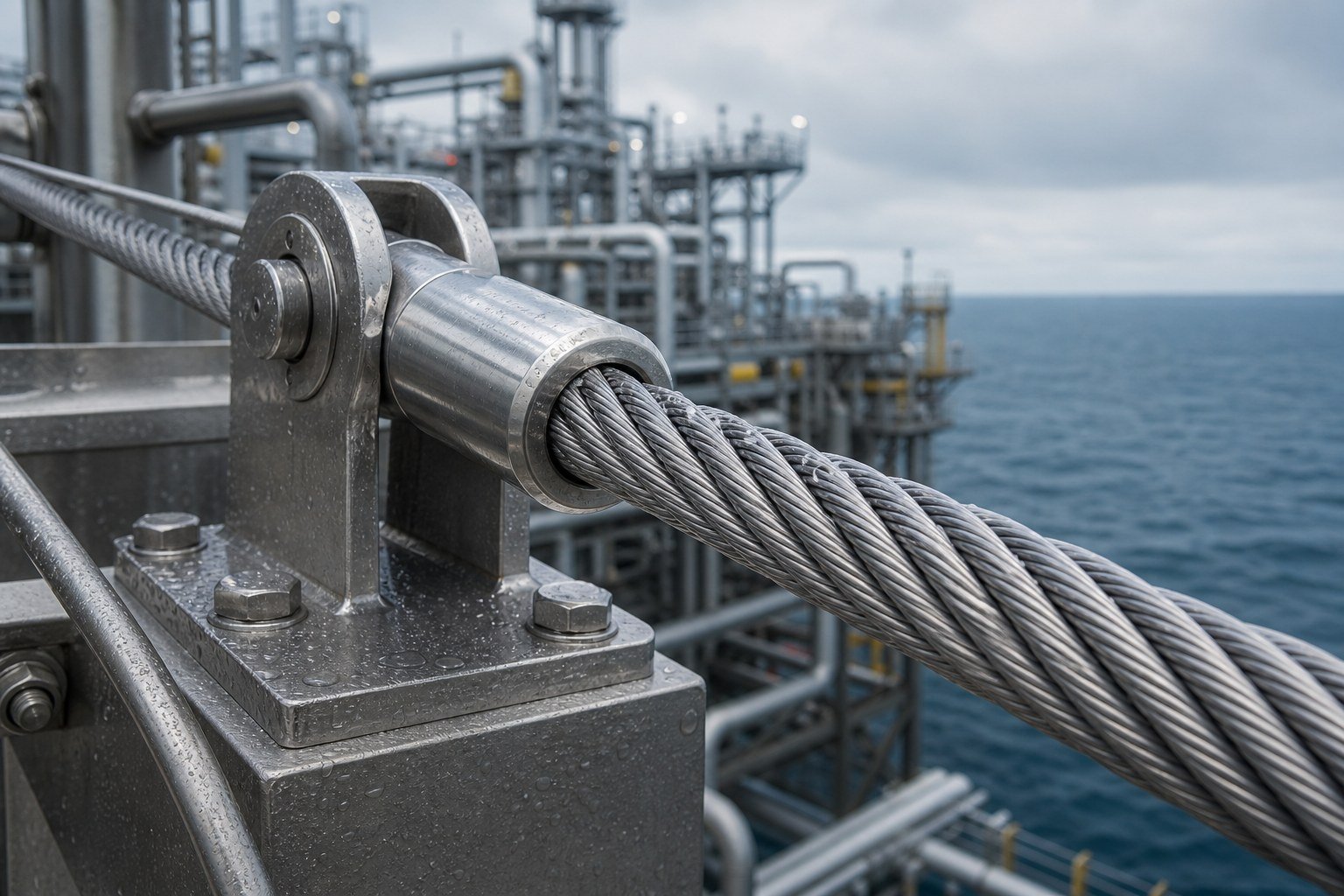
Quick answer: 904L cable supports reliability where chloride exposure, acidic process media or contaminated industrial atmospheres make conventional stainless steel vulnerable. Its high nickel, molybdenum and copper content improves resistance to pitting, crevice corrosion, reducing acids and stress-corrosion cracking. It does not guarantee reliability by grade name alone: minimum breaking force, bend fatigue, end fittings, surface condition, fabrication quality and inspection must all be specified.
What is 904L cable?
904L is a high-alloy austenitic stainless steel identified as UNS N08904 and EN 1.4539. A typical nominal composition includes about 20% chromium, 25% nickel, 4% molybdenum and 1.5% copper, with low carbon. The alloy was developed for severe corrosion conditions, particularly in chemical-process service.
“904L cable” may describe a single wire, a multiwire strand, a flexible wire rope or a finished cable assembly with terminals. Those products do not behave identically. The grade defines the alloy chemistry; the cable construction defines much of the strength, flexibility, rotation behavior and fatigue life.
Why 904L can improve reliability
Critical cables often fail through a chain of small problems rather than one dramatic overload. Moisture enters the spaces between wires, deposits concentrate chlorides, a termination traps contamination, or repeated bending opens a local surface defect. Once corrosion removes metallic area or initiates a crack, the remaining wires carry more load and degradation can accelerate.
904L increases the corrosion margin in several ways. Chromium supports the passive surface film. Molybdenum improves resistance to localized attack, especially pitting and crevice corrosion. High nickel stabilizes the austenitic structure and contributes to resistance in aggressive media. Copper improves performance in selected reducing acids, notably sulfuric-acid service within suitable concentration and temperature ranges.
This chemistry makes 904L substantially more corrosion resistant than common 304- and 316-type stainless steels in many environments. It is not immune to corrosion, and laboratory resistance cannot be applied to every combination of temperature, chloride level, acidity, oxygen, deposits and stress.
904L versus 316L cable: an engineering comparison
| Selection factor | 316L stainless cable | 904L stainless cable |
|---|---|---|
| Alloy level | General-purpose molybdenum-bearing austenitic stainless steel | Higher nickel and molybdenum, with copper addition |
| Chloride pitting and crevice corrosion | Suitable for many moderate environments; limits can be reached in warm, concentrated or poorly washed chloride exposure | Higher resistance in many chloride-bearing environments, subject to application review |
| Reducing acids | Limited in demanding sulfuric-acid conditions | Improved resistance in selected sulfuric, phosphoric and acetic-acid service |
| Stress-corrosion cracking | Better than many non-stainless materials but still susceptible in some hot chloride conditions | Improved resistance, not complete immunity |
| Availability and cost | Widely available and normally more economical | Specialized availability and a higher alloy cost |
| Best decision basis | Process chemistry, temperature, deposits, cable geometry, design life, inspection access and total life-cycle cost | |
Reliability depends on the complete cable system
1. Rope construction and metallic area
A 1×19 strand offers different stiffness and stretch behavior from a 7×7 or 7×19 construction. More flexible constructions contain more interfaces between wires and may create additional sites where moisture can remain. Diameter alone is not a capacity rating. The procurement specification should state construction, lay, core, nominal diameter, minimum breaking force and any proof-load requirement.
2. Working load and dynamic effects
Design load must include static tension, acceleration, shock, vibration, wind, thermal movement, misalignment and any load redistribution after wire damage. A suitable design factor is selected under the governing equipment code, not copied from an unrelated application. For lifting or personnel-support duties, the applicable legal and equipment requirements take precedence over general material guidance.
3. Bend fatigue
Running cables accumulate fatigue as individual wires move over sheaves and drums. Sheave diameter, groove profile, fleet angle, tension and cycle count can dominate service life even when corrosion is minimal. A corrosion-resistant alloy cannot compensate for a sheave that is too small or a cable that is forced through an unsuitable guide.
4. End fittings and galvanic compatibility
Terminations are frequent reliability bottlenecks. Swaged sleeves, sockets, thimbles and pins must match the cable material, diameter and construction. Dissimilar metals can create galvanic corrosion when they remain electrically connected in a conductive electrolyte. The assembly specification should define terminal material, attachment method, expected efficiency and qualification testing.
5. Surface condition and cleanliness
Iron contamination from carbon-steel tooling, heat tint, grinding debris and chloride-bearing cleaners can reduce local corrosion resistance. Clean production handling, appropriate pickling or passivation where specified, and protection during transport help preserve the passive surface. Smooth, well-drained details are generally easier to keep clean than tight water-retaining crevices.
Where 904L cable makes engineering sense
- Chemical processing: cable assemblies exposed to compatible acidic media, washdown or corrosive vapors.
- Offshore and coastal installations: restraints, control cables and structural assemblies exposed to salt spray, provided direct seawater and crevice conditions are evaluated.
- Flue-gas and pollution-control equipment: mechanisms exposed to acidic condensate and chloride deposits.
- Pulp, paper and bleaching systems: cable components operating near chloride-bearing process environments.
- High-value architectural systems: external cable details in severe coastal or polluted locations where access and replacement are costly.
- Food, pharmaceutical or clean-process equipment: selected assemblies where corrosion resistance and cleanability are required, subject to the relevant hygienic standard.
These examples are screening applications, not automatic approvals. Each project needs a corrosion review based on actual exposure and an engineering review based on the cable’s function.
When 904L may not be the best choice
904L is not automatically the most economical or technically strongest option. In a mild indoor environment, 316L may provide the required life at lower cost and with easier sourcing. Where very high strength is needed, another alloy family or cable design may carry more load at the same diameter. In severe warm seawater, concentrated chlorides or strongly oxidizing media, a 6% molybdenum stainless steel, super duplex grade, nickel alloy or another material may deserve evaluation.
The right comparison is therefore not “904L versus every other stainless steel.” It is a life-cycle comparison among candidate systems, including initial cost, availability, fabrication, inspection, downtime, replacement access and consequence of failure.
Procurement checklist for a 904L cable assembly
| Requirement | What to define | Why it matters |
|---|---|---|
| Material identity | UNS N08904 / EN 1.4539, product form and applicable standard | “904L” alone may not define every contractual limit |
| Cable geometry | Construction, lay, core, wire and cable diameter, tolerances and length | Controls flexibility, stretch, rotation and fitting compatibility |
| Strength | Minimum breaking force, working load, design factor and proof test if required | Separates material chemistry from assembly capacity |
| Terminations | Material, dimensions, swaging or socketing process and rated efficiency | Prevents the end connection from becoming the weak link |
| Environment | Chemicals, chloride level, pH, temperature, wet/dry cycle, deposits and cleaning media | Provides the basis for corrosion selection |
| Quality records | Heat traceability, EN 10204 certificate type, dimensional report and test certificates | Creates an auditable link from alloy to finished assembly |
| Acceptance | Visual, dimensional, tensile/proof-load, surface and NDT requirements where applicable | Turns performance expectations into verifiable criteria |
Testing and quality assurance
A critical cable should arrive with more than a grade label. Material certificates should be traceable to the heat or lot, and finished cable testing should follow the purchase specification. Depending on the duty, the quality plan may include chemical verification, diameter and lay measurements, minimum breaking-force testing, proof loading of completed assemblies, termination qualification and surface examination.
If 904L is not explicitly listed in the selected wire-rope or wire-strand standard, the purchaser and manufacturer should agree on an equivalent or project-specific route before production. ASTM A492 covers commonly used stainless rope wire, while ASTM A368 covers specified stainless wire strand applications; neither standard title by itself proves that a proposed 904L cable assembly is compliant. Confirm the current edition, covered grades and project scope.
Inspection and life-cycle control
Inspection frequency should reflect consequence of failure, operating cycles, exposure and the ability to detect damage. Typical warning signs include broken wires, corrosion staining, diameter reduction, abrasion, flattening, kinks, birdcaging, heat damage and movement or cracking at end fittings. Areas that pass over sheaves or collect deposits deserve particular attention.
A clean external surface does not prove that the spaces between wires are sound. Where inspection cannot reliably examine internal condition, the maintenance plan may need periodic detailed examination, nondestructive methods suited to the geometry, or a conservative scheduled replacement interval. Record initial dimensions and photographs so that later changes can be compared with a known baseline.
Frequently asked questions
Is 904L cable stronger than 316L cable?
Not necessarily. Alloy grade alone does not determine finished cable strength. Construction, wire diameter, cold work, core, lay and termination efficiency all matter. Compare certified minimum breaking force and assembly test results, not only the stainless steel designation.
Does 904L cable rust?
904L is highly corrosion resistant, but it is not corrosion-proof. Localized attack can occur if chloride deposits, stagnant crevices, high temperature, unsuitable chemicals, contamination or poor surface condition exceed the alloy’s resistance.
Can 904L cable be used in seawater?
It may be suitable for some marine and splash-zone duties, but continuous warm seawater and tight crevices require specific evaluation. Water chemistry, temperature, flow, deposits, cleaning and terminal design can change the result. More highly alloyed stainless steel, duplex steel or a nickel alloy may be preferred in severe cases.
Why choose 904L instead of 316L?
Choose 904L when the verified environment needs a higher corrosion margin, particularly against certain reducing acids, chloride pitting, crevice corrosion or stress-corrosion cracking. If 316L already meets the required life, upgrading may add cost without a proportional benefit.
What information is needed to quote 904L cable?
Provide cable construction, diameter, length, minimum breaking force, working load, end fittings, quantity, operating temperature, chemical exposure, standards, testing, certificate type and packaging requirements. Drawings are strongly recommended for completed assemblies.
Conclusion
904L cable can materially improve reliability in corrosion-critical projects because the alloy offers a higher resistance margin than conventional stainless steel in many aggressive environments. That advantage becomes dependable only when the cable is engineered as a system: correct construction, verified load capacity, qualified terminations, clean fabrication, traceable testing and an inspection plan matched to service.
Technical references
Outokumpu: Ultra 904L product range · Alleima: 2RK65 (904L) material datasheet · ASTM A492: Stainless steel rope wire · ASTM A368: Stainless steel wire strand · OSHA: Wire rope inspection
Discuss Your 904L Cable Requirement with SAKYMETAL
Send the cable construction, diameter, minimum breaking force, end fittings, process environment, operating temperature, inspection scope and certification requirements for a technically aligned quotation.
Next step: view stainless steel cable products or contact SAKYMETAL.
Technical note: This article is a general engineering selection guide. It does not replace application-specific corrosion testing, cable design calculations, equipment codes or the governing purchase specification.