
Call us now:


Nickel Alloy Selection Guide
Common Types of Nickel Alloys: Grades, Properties and Applications
A practical map of nickel alloy families for corrosion, heat, strength, electrical and dimensional-control duties.
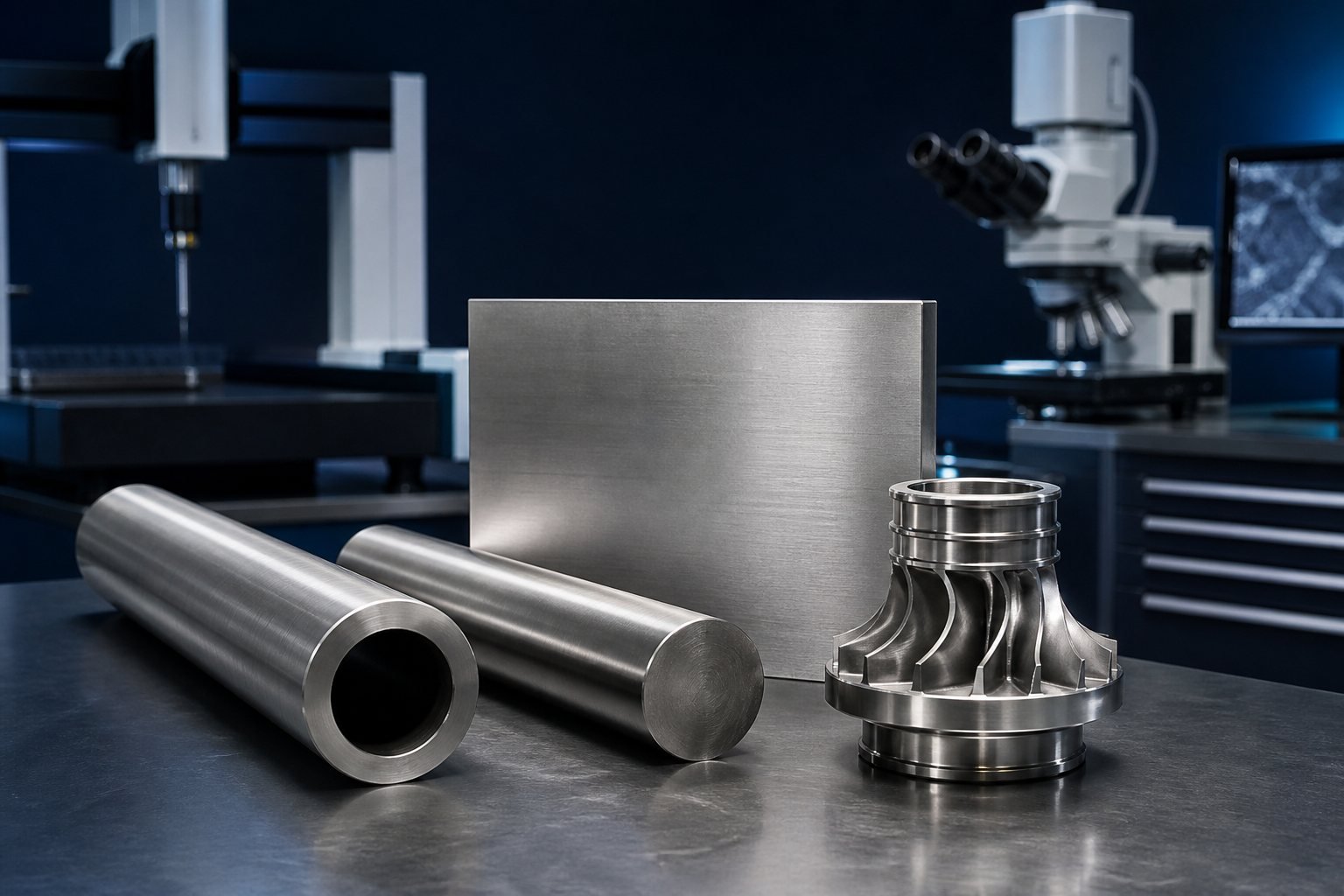
Quick answer: Nickel alloys are selected by service mechanism, not by nickel content alone. Nickel-copper alloys such as Alloy 400 suit many seawater and reducing environments; nickel-chromium alloys such as Alloy 600 resist oxidation; nickel-chromium-molybdenum alloys such as C-276 target severe mixed-acid corrosion; and precipitation-hardened grades such as 718 provide high strength at elevated temperature.
What is a nickel alloy?
A nickel alloy is a metallic material in which nickel is a principal alloying element. Chromium, molybdenum, iron, copper, cobalt, niobium, titanium and aluminium are added in controlled combinations to create corrosion resistance, oxidation resistance, high-temperature strength, low thermal expansion or magnetic and electrical behavior.
Commercial names are useful, but procurement should identify a recognized grade or UNS number and the relevant product specification. The same nominal alloy may be supplied as bar, plate, sheet, pipe, tube, wire, forging or fitting under different standards.
Main nickel alloy families and common grades
| Family | Representative grades | Why engineers select it | Typical applications |
|---|---|---|---|
| Commercially pure nickel | Nickel 200 (UNS N02200), 201 (N02201) | Caustic-alkali resistance, ductility and useful electrical properties | Chemical processing, food equipment, electrical components |
| Nickel-copper | Alloy 400 (N04400), K-500 (N05500) | Resistance to seawater, alkalis and many non-oxidizing media; K-500 adds strength | Marine hardware, pumps, valves, shafts |
| Nickel-chromium | Alloy 600 (N06600), 601 (N06601) | Oxidation and scaling resistance plus useful high-temperature strength | Furnace hardware, heat-treatment equipment, process tubing |
| Nickel-chromium-molybdenum | 625 (N06625), C-276 (N10276), C-22 (N06022) | Broad localized and general corrosion resistance in severe process media | Chemical plants, pollution control, offshore and sour service equipment |
| Nickel-iron-chromium | 800/800H/800HT, 825 (N08825) | High-temperature stability or resistance to acids and reducing/oxidizing conditions | Heat exchangers, furnace tubes, chemical process equipment |
| Precipitation-hardened superalloy | 718 (N07718), X-750 (N07750) | High strength, creep resistance and fatigue performance at temperature | Aerospace, energy, fasteners and rotating equipment |
Properties that matter in selection
- Corrosion mode: general corrosion, pitting, crevice corrosion, stress-corrosion cracking or high-temperature attack.
- Temperature and time: short thermal excursions differ from continuous creep or oxidation service.
- Mechanical load: yield strength, fatigue, toughness, creep and stress-rupture requirements.
- Fabrication: hot forming, cold forming, welding, machining and post-weld treatment.
- Availability: required section size, product specification, certification and minimum order quantity.
Nickel alloy selection examples
For reducing-acid service, molybdenum-bearing alloys may outperform simpler Ni-Cr materials. For hot oxidizing atmospheres, chromium-rich grades are often the starting point. For seawater hardware, Alloy 400 or higher-strength K-500 may enter the shortlist. For high-load components at temperature, precipitation-hardened Alloy 718 may be more relevant than a corrosion-focused alloy.
These are screening directions only. Concentration, contaminants, aeration, velocity, deposits, fabrication and temperature can reverse an apparently simple material ranking. Use published corrosion data and project-specific engineering review.
How to specify nickel alloy products
- State the UNS grade and product specification.
- Define product form, dimensions, tolerance, surface and delivery condition.
- Identify heat treatment and any solution-annealed or age-hardened requirement.
- Specify NDE, PMI, corrosion tests and supplementary requirements where applicable.
- Request traceable mill test certification and agree marking and packing requirements.
Nickel alloy product forms and applicable standards
A grade name does not define the finished product. Seamless tube, welded pipe, plate, round bar, wire, forging and fitting standards can impose different chemistry, mechanical, heat-treatment, dimensional and test provisions. An RFQ for “Alloy 625” is therefore incomplete until the product form and governing specification are known.
For pressure or corrosive service, the purchaser may also need design-code compliance, solution heat treatment, hydrostatic or nondestructive testing, intergranular or localized corrosion testing and positive material identification. These requirements should be agreed before manufacture because they can change both route and lead time.
Verification and quality documents
Review the material test certificate against the purchase order: UNS designation, heat number, chemistry, mechanical results, heat treatment, dimensions and invoked specification should agree. Markings on the product and packing list should maintain the same traceability.
X-ray fluorescence PMI can screen nickel, chromium, molybdenum, copper and several other alloying elements, but it does not replace the certified laboratory analysis and is limited for light elements. Critical components may require independent testing, NDE or corrosion qualification based on project risk.
Frequently asked questions
What is the most corrosion-resistant nickel alloy?
There is no universal winner. Nickel-chromium-molybdenum alloys such as C-276 and C-22 have broad resistance, but the best grade depends on the exact chemicals, concentration, temperature, contaminants and fabrication.
Is Inconel the same as nickel alloy?
Inconel is a trademark used for a group of nickel-chromium alloys. Nickel alloy is the broader material category and also includes nickel-copper, nickel-molybdenum and other families.
How do Alloy 625 and Alloy 718 differ?
Alloy 625 is commonly selected for corrosion resistance and solid-solution strength. Alloy 718 is precipitation hardenable and is widely selected where substantially higher mechanical strength is required.
What should a nickel alloy RFQ include?
Include UNS grade, governing standard, form, size, quantity, condition, testing, certification, surface, tolerances and delivery destination.
Technical references
Discuss Your Requirement with SAKYMETAL
Send the alloy or service environment, product form, dimensions, quantity, standard, condition and certification scope. Our team can review availability against your RFQ.
View related products or send your specification for a quotation.
Engineering note: Typical values are informative, not acceptance criteria. Confirm the applicable standard edition, grade designation, product form, dimensions, delivery condition and test requirements on the purchase order and material test certificate.