
Call us now:


Martensitic Stainless Steel Guide
7Cr17MoV Stainless Steel: Composition, Hardness, Heat Treatment and Uses
What the 7Cr17MoV designation usually means, where it is used and why chemistry and heat treatment must be verified before purchase.
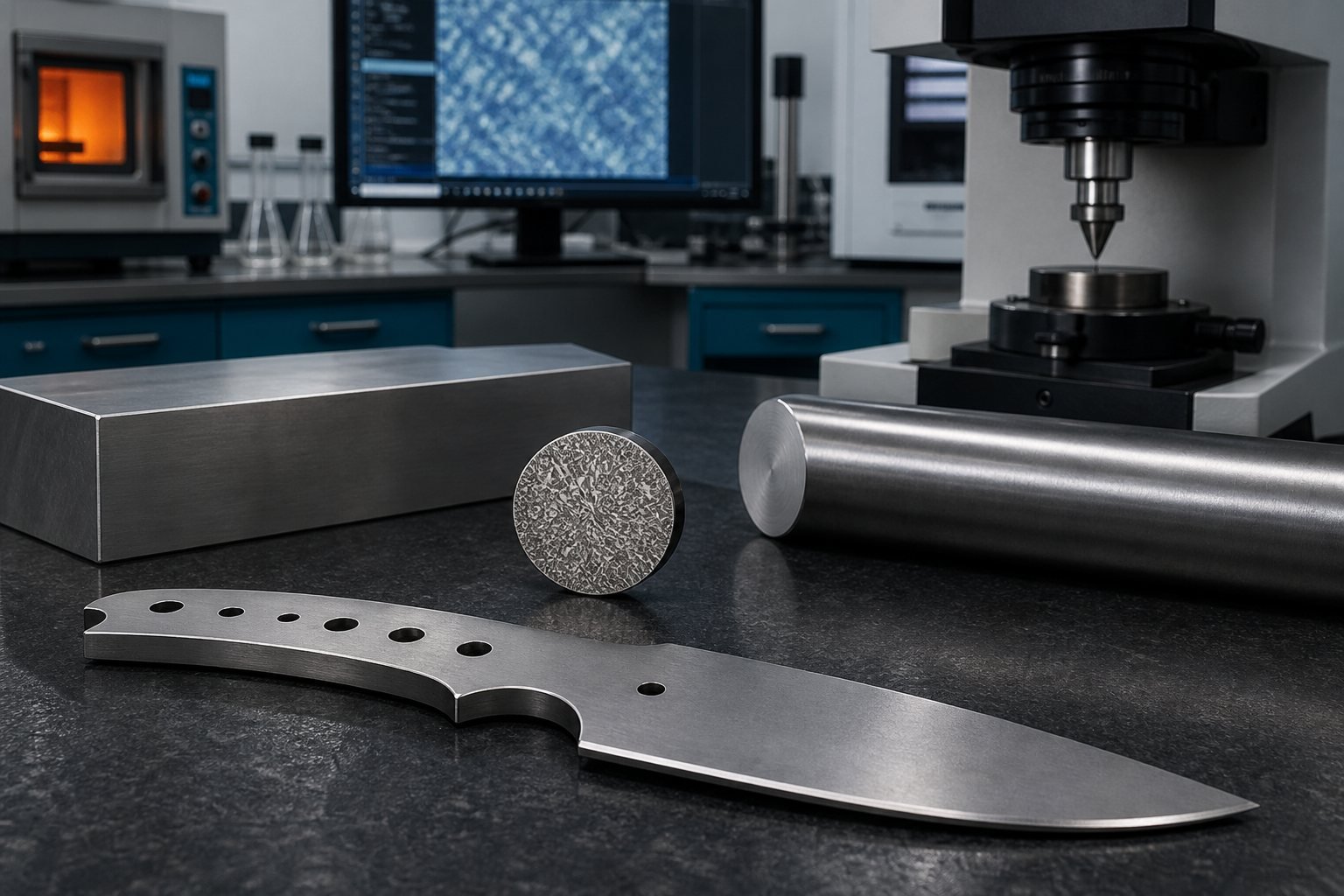
Quick answer: 7Cr17MoV is a commercial designation commonly used for a high-chromium martensitic stainless steel containing molybdenum and vanadium. It can combine hardenability, wear resistance and moderate corrosion resistance after heat treatment. However, the designation is not consistently listed as a formal grade in every GB stainless standard, so buyers should require an agreed chemistry, hardness, product form and material certificate rather than relying on the name alone.
Understanding the 7Cr17MoV name
In Chinese-style alloy naming, “7” generally points to roughly 0.7% carbon and “17” to roughly 17% chromium, while Mo and V indicate molybdenum and vanadium additions. Commercial composition ranges vary by producer and source.
An important procurement caveat is that 7Cr17MoV is often used as a market designation rather than a universally standardized grade name. The Chinese national standard catalogue lists GB/T 1220-2007 for stainless steel bars, but buyers should verify whether the exact ordered designation and chemistry are explicitly covered by the invoked document.
Typical composition profile—not a purchase specification
Use these figures only to understand the grade concept. Put the required min/max chemistry in the purchase specification or reference an applicable standard that contains it.
| Element | Commonly published range or role |
|---|---|
| Carbon | Often reported around 0.60–0.75%; supports martensitic hardness and carbide formation |
| Chromium | Often reported around 16–18%; supports hardenability and corrosion resistance |
| Molybdenum | A modest addition often reported up to about 0.75%; may support pitting and tempering response |
| Vanadium | Small controlled addition; can refine grain and form hard carbides |
| Mn, Si, Ni, P, S | Controlled residual or alloy additions; limits must be agreed with the supplier |
Hardness and heat treatment
7Cr17MoV is supplied and fabricated in a softer annealed condition, then hardened and tempered where the application requires wear resistance. Final hardness is strongly affected by actual chemistry, section size, austenitizing practice, quench method, retained austenite and tempering.
Published claims can differ widely. Do not specify a universal HRC number without a validated producer datasheet and component heat-treatment trial. Higher hardness can improve edge or wear behavior but can reduce toughness and increase grinding or cracking risk.
Properties and common uses
- Good potential hardness for cutting and wear components
- Moderate corrosion resistance when correctly heat treated, finished and maintained
- Better wear behavior than lower-carbon martensitic grades in many conditions
- Typical use in kitchen and utility blades, cutting tools, wear parts and selected hand-tool components
Procurement checklist
- Do not accept the grade name alone—agree the chemistry range.
- State bar, plate, strip or another product form and governing dimensional standard.
- Define annealed or hardened-and-tempered delivery condition.
- Specify target hardness and test location if heat treated.
- Request mill test certification, heat number and PMI/chemistry verification where mix-up risk matters.
- Qualify heat treatment and corrosion expectations using representative material.
Corrosion, toughness and finish trade-offs
High carbon enables hardness but also encourages chromium-rich carbide formation. Chromium tied up in carbides is not available to support the passive film, so a high-hardness martensitic grade does not necessarily match the corrosion resistance of a low-carbon austenitic stainless steel.
Coarse carbides, excessive hardness, decarburization or grinding damage can reduce toughness and edge stability. Surface finish, cleaning and dry storage influence field performance. For food-contact or hygiene applications, the finished component must meet the applicable regulatory, cleaning and corrosion requirements—not merely carry a stainless name.
Possible alternatives
If corrosion resistance and toughness matter more than maximum hardness, a lower-carbon martensitic grade may be considered. If wear and hardness dominate, 440C-type or other higher-performance grades may enter the comparison. If the component needs weldability, deep forming or nonmagnetic behavior, an austenitic stainless family may be more appropriate.
No equivalence should be declared from a nickname. Compare chemistry, carbide structure, heat-treatment response, corrosion data, mechanical behavior, product availability and cost for the finished application.
Frequently asked questions
Is 7Cr17MoV the same as 440A stainless steel?
They may be described as broadly similar by some sellers, but they are not automatically interchangeable. Compare the actual chemistry, standard, condition and required properties.
What hardness can 7Cr17MoV reach?
The achievable hardness depends on chemistry, section size and heat treatment. Use supplier data and a qualified heat-treatment procedure instead of a universal online value.
Does 7Cr17MoV rust?
It is stainless, not rust-proof. Chlorides, contamination, poor finish, deposits and inadequate maintenance can still cause staining or corrosion.
How should 7Cr17MoV be specified?
State an agreed chemistry, product form, dimensions, delivery condition, heat treatment, hardness, surface, testing and certificate requirements.
Technical references
Discuss Your Requirement with SAKYMETAL
Send the required chemistry, product form, size, delivery condition, hardness, surface, quantity and certificate scope. We will review the requirement against available supply.
View related products or send your specification for a quotation.
Engineering note: Typical values are informative, not acceptance criteria. Confirm the applicable standard edition, grade designation, product form, dimensions, delivery condition and test requirements on the purchase order and material test certificate.