
Call us now:


Tool Steel Family Guide
Types of Tool Steel: Grades, Properties and Applications
A practical guide to water-hardening, cold-work, shock-resistant, hot-work, high-speed and mould steels for tooling decisions.
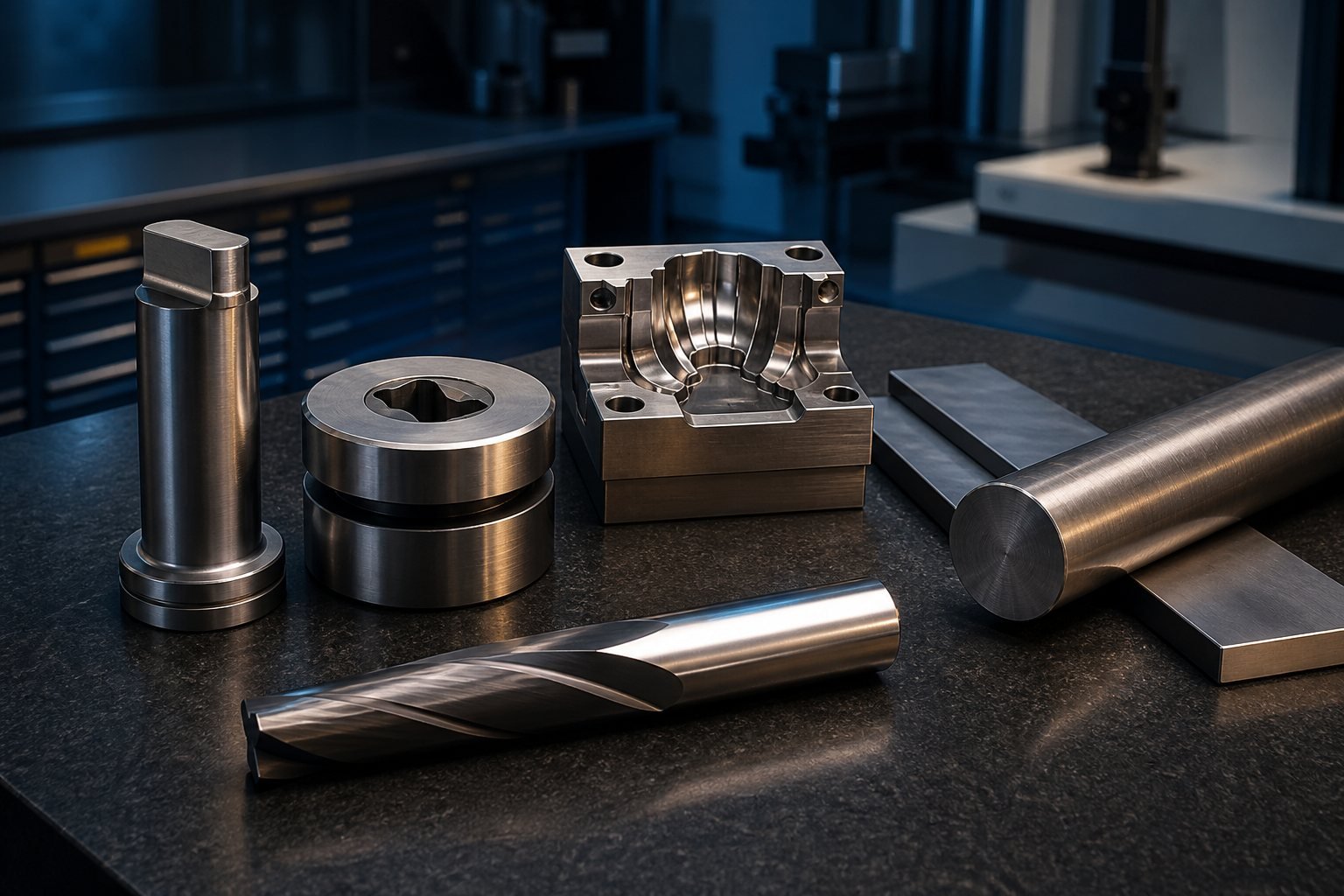
Quick answer: Tool steels are alloy steels engineered for hardness, wear resistance, toughness, hot strength or dimensional stability. The main AISI families include W, O, A, D, S, H, M and T grades. Plastic mould steels are also selected as a dedicated application group. The best grade is the one that balances the actual failure mechanism with manufacturability and total tooling cost.
Main types of tool steel
| Family | Examples | Primary strengths | Common uses |
|---|---|---|---|
| W — water hardening | W1, W2 | Simple composition, high hardness, economical | Hand tools, punches, simple short-run tooling |
| O — oil hardening cold work | O1, O2 | Good machinability and moderate dimensional change | Gauges, dies, knives and general tooling |
| A — air hardening cold work | A2, A8 | Good balance of wear resistance and toughness | Blanking, forming dies, punches and gauges |
| D — high-carbon, high-chromium cold work | D2, D3 | High wear resistance and compressive strength | Long-run blanking, rolls, shear blades and wear parts |
| S — shock resisting | S1, S7 | High impact toughness | Chisels, punches, shear blades and impact tooling |
| H — hot work | H11, H13 | Hot strength, thermal-fatigue resistance and toughness | Die casting, extrusion, forging and hot shear tooling |
| M/T — high speed | M2, M4, T1 | Red hardness and cutting wear resistance | Drills, cutters, broaches and high-speed cutting tools |
| Plastic mould steels | P20-type, 420-type, H13 and specialty ESR grades | Machinability, polishability, corrosion/wear resistance as required | Mould bases, cavities, cores and inserts |
Properties that control tool life
Hardness alone does not predict tool life. Abrasive wear may favor more hard carbides, while chipping demands toughness. Hot tooling additionally needs temper resistance, hot yield strength and heat-checking resistance. A polished optical mould demands cleanliness and polishability that a conventional wear-resistant grade may not deliver.
- Wear resistance against the actual work material
- Toughness and resistance to chipping or gross cracking
- Compressive strength and plastic-deformation resistance
- Hot hardness, temper resistance and thermal-fatigue resistance
- Hardenability, dimensional stability and heat-treatment risk
- Machinability, grindability, weld repair and surface-treatment response
How to select a tool steel
- Identify the dominant failure mode on the current tool.
- Define contact stress, impact, temperature, cycle rate and lubrication.
- Consider workpiece abrasiveness, strength and tendency to gall.
- Set realistic target hardness and heat-treatment route.
- Evaluate tool size, section changes, distortion tolerance and machining sequence.
- Compare total cost per produced part—not steel price alone.
Heat treatment is part of the material system
Tool steel performance depends on austenitizing, quenching, tempering, section size, furnace control and any cryogenic or surface treatment. A sound grade can fail early if decarburized, overheated, inadequately tempered or ground with excessive thermal damage.
The steel producer’s heat-treatment datasheet and a qualified heat treater should govern the process. Generic temperatures copied from unrelated grades are not an acceptance basis.
Conventional, ESR and powder metallurgy tool steels
Conventional ingot metallurgy remains appropriate for many standard tools. Electro-slag remelting can improve cleanliness, homogeneity and isotropy, which is valuable for large dies, demanding polish, toughness or thermal-fatigue service. Powder metallurgy produces a fine, uniform carbide distribution in highly alloyed grades and can improve the combination of wear resistance and toughness.
The premium route is justified only when it addresses the failure mechanism or reduces total cost. A short-run fixture may not benefit from PM steel, while a high-volume abrasive blanking die may recover the added material cost through longer predictable life.
Inspection and traceability for critical tools
- Match heat number and grade to the material test certificate.
- Confirm annealed hardness and dimensions before machining.
- Use ultrasonic testing where block size, cleanliness or customer specifications justify it.
- Record heat-treatment furnace charts and final hardness locations.
- Inspect EDM and ground surfaces for recast layer, grinding burn and cracks.
- Maintain tool history so material, process and service life can be compared.
Frequently asked questions
What are the most common tool steel types?
Common groups include water-hardening, oil-hardening, air-hardening, high-carbon high-chromium, shock-resistant, hot-work, high-speed and plastic mould steels.
Is D2 the best tool steel?
D2 offers high wear resistance, but it is not best for every tool. Applications dominated by impact or chipping may need a tougher grade.
What tool steel is used for hot work?
H-series grades such as H11 and H13 are common starting points because they combine hot strength, toughness and thermal-fatigue resistance.
Can tool steel be welded?
Many grades can be repair welded with grade-specific preheat, filler, heat input and post-weld procedures. Poorly controlled welding can cause cracking or soft and hard zones.
Technical references
Discuss Your Requirement with SAKYMETAL
Send the tooling application, work material, failure mode, dimensions, target hardness, heat-treatment condition and required certification for a grade and supply review.
View related products or send your specification for a quotation.
Engineering note: Typical values are informative, not acceptance criteria. Confirm the applicable standard edition, grade designation, product form, dimensions, delivery condition and test requirements on the purchase order and material test certificate.