
Call us now:


Spring Wire Engineering Guide
ASTM A228 Music Wire: Material, Properties, Young’s Modulus and Density
A buyer-focused explanation of music spring wire, including material condition, typical physical constants, fatigue-sensitive applications and RFQ data.
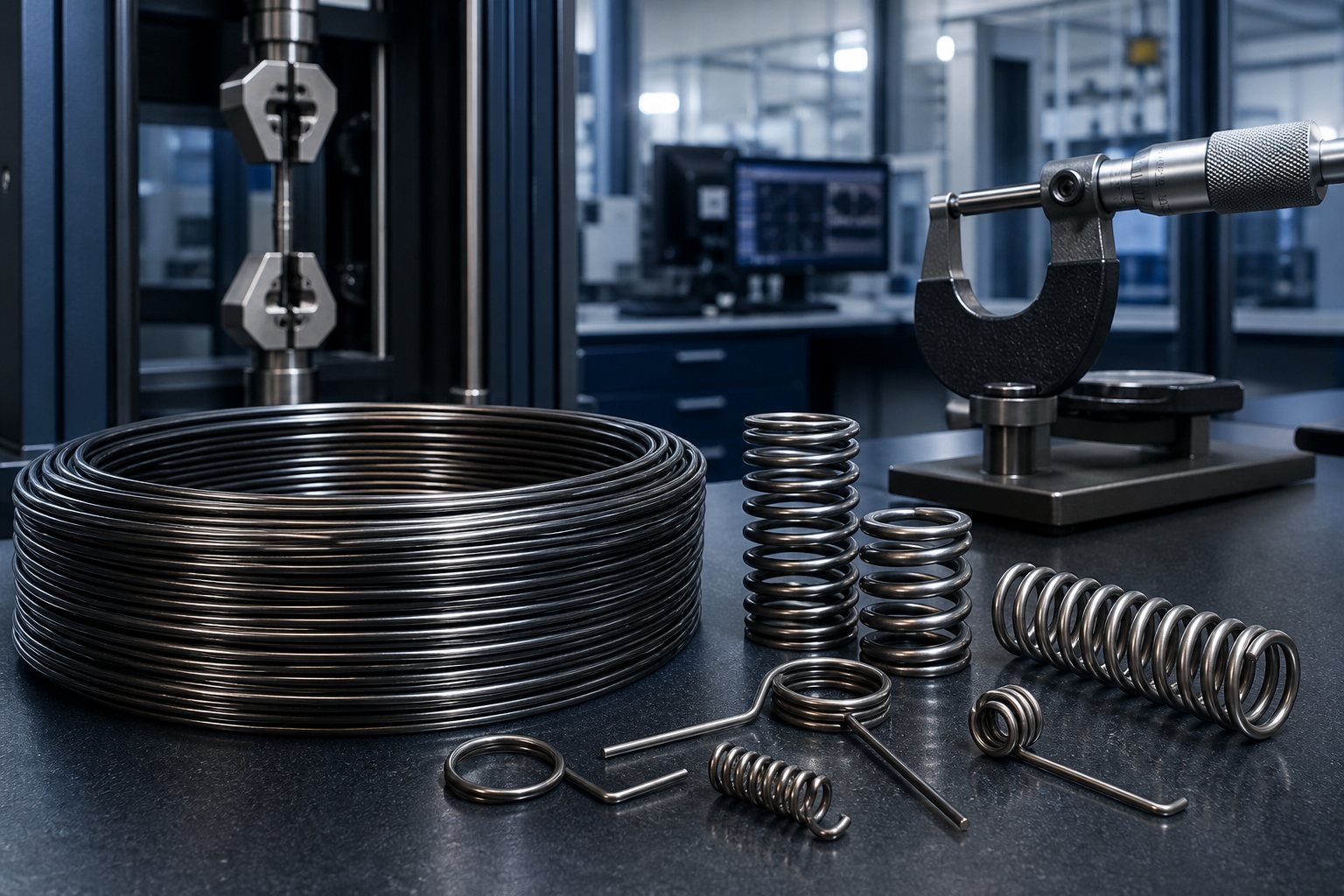
Quick answer: ASTM A228/A228M covers high-quality round cold-drawn steel music spring wire intended for springs under high stress or requiring good fatigue properties. Young’s modulus and density are useful design constants—commonly about 207 GPa and 7.85 g/cm³ for carbon steel—but they are typical engineering values, not a substitute for the ordered specification and certified tensile requirements.
What is ASTM A228 music wire?
Music wire is a high-carbon, round, cold-drawn spring wire produced with tight control of surface quality, tensile properties and consistency. The name comes from historical piano-wire applications, but industrial use now extends across precision mechanical springs.
ASTM A228/A228M-18(2024)e1 is listed by ASTM as the active specification at the time of writing. Always identify the edition required by the customer or design document.
Typical engineering properties
| Property | Typical reference value | Design caution |
|---|---|---|
| Young’s modulus, E | Approximately 207 GPa (30 × 10⁶ psi) | Use the project-approved design value and account for temperature if relevant. |
| Shear modulus, G | Approximately 79–80 GPa (11.5 × 10⁶ psi) | Critical for helical spring-rate calculations. |
| Density | Approximately 7.85 g/cm³ (0.284 lb/in³) | Useful for mass estimates; certification generally focuses on chemistry and mechanical requirements. |
| Tensile strength | Diameter-dependent; controlled by the specification | Do not publish or order one universal tensile value for every wire diameter. |
Why music wire performs well in springs
- High tensile strength created by controlled cold drawing
- Good elastic response for compact spring designs
- Clean, consistent round wire for predictable coiling
- Surface quality appropriate for fatigue-sensitive service
- Wide use in precision compression, extension and torsion springs
Applications and limitations
Typical applications include small precision springs, control springs, clips, wire forms, mechanical devices and other components where high stress and fatigue resistance matter.
Uncoated carbon-steel music wire is not the first choice for wet, chloride-rich, high-temperature or strongly corrosive environments. Stainless spring wire, chromium-silicon, chromium-vanadium or other specialty wire may be more suitable depending on temperature, corrosion, stress and required cycle life.
How to order music spring wire
- ASTM A228/A228M edition and unit system
- Wire diameter and tolerance
- Coil, spool or straightened form and package weight
- Quantity and destination
- Surface, coating or lubrication requirements
- Required test report, heat/lot traceability and special testing
- End-use information when fatigue, coiling or environment is critical
Spring design implications
Young’s modulus governs axial elastic response, while shear modulus is used directly in the spring-rate equation for a helical compression or extension spring. Wire diameter enters that equation to the fourth power, so a small diameter variation can create a meaningful rate change. Coil diameter, active coils and end geometry also matter.
Tensile strength is not one fixed value because the cold-drawing reduction and achievable strength change with diameter. The designer should use the diameter-specific specification requirement, apply an appropriate fatigue method and consider presetting, residual stress and stress-relief after coiling.
Surface condition, fatigue and inspection
Fatigue cracks often initiate at the surface. Seams, laps, scratches, decarburization, corrosion pits and handling damage can therefore matter more than a small difference in bulk hardness. The ordered quality level and incoming inspection should reflect the spring’s stress and consequence of failure.
Typical quality planning may include diameter measurement, surface examination, tensile or torsion testing, coil-cast or helix checks and lot traceability. Shot peening, stress relief and protective finishing are downstream spring-manufacturing decisions and should be qualified for the final geometry.
Storage and handling
High-strength wire should be protected from moisture, corrosive contamination, kinks and uncontrolled uncoiling. Packages need stable support and clear lot identification. A damaged coil can create feeding problems or local surface defects even when the original material met specification.
For long storage, agree protective oil, wrapping and warehouse conditions. Remove preservatives with a cleaning method that does not attack the wire before coiling or finishing.
Frequently asked questions
Is ASTM A228 music wire stainless steel?
No. ASTM A228 music wire is high-carbon steel spring wire. Stainless spring wire is ordered to different material specifications.
What is the Young’s modulus of music wire?
A commonly used room-temperature design value is about 207 GPa (30 million psi). The approved value should match the design method and project requirements.
What is the density of music wire?
Carbon-steel music wire is commonly estimated at about 7.85 g/cm³ or 0.284 lb/in³.
Is music wire suitable outdoors?
Bare music wire can corrode. Outdoor selection should consider coating, lubrication, stainless spring wire or another corrosion-resistant material.
Technical references
Discuss Your Requirement with SAKYMETAL
Provide diameter, tolerance, package form, quantity, destination, coating or lubrication, test report and end-use requirements so the correct wire condition can be reviewed.
View related products or send your specification for a quotation.
Engineering note: Typical values are informative, not acceptance criteria. Confirm the applicable standard edition, grade designation, product form, dimensions, delivery condition and test requirements on the purchase order and material test certificate.