
Call us now:

High-Alloy Stainless Steel History
Development History of Super Austenitic Stainless Steel
Super austenitic stainless steels evolved to bridge the performance gap between conventional 300-series grades and costlier nickel alloys in chloride-rich process service.
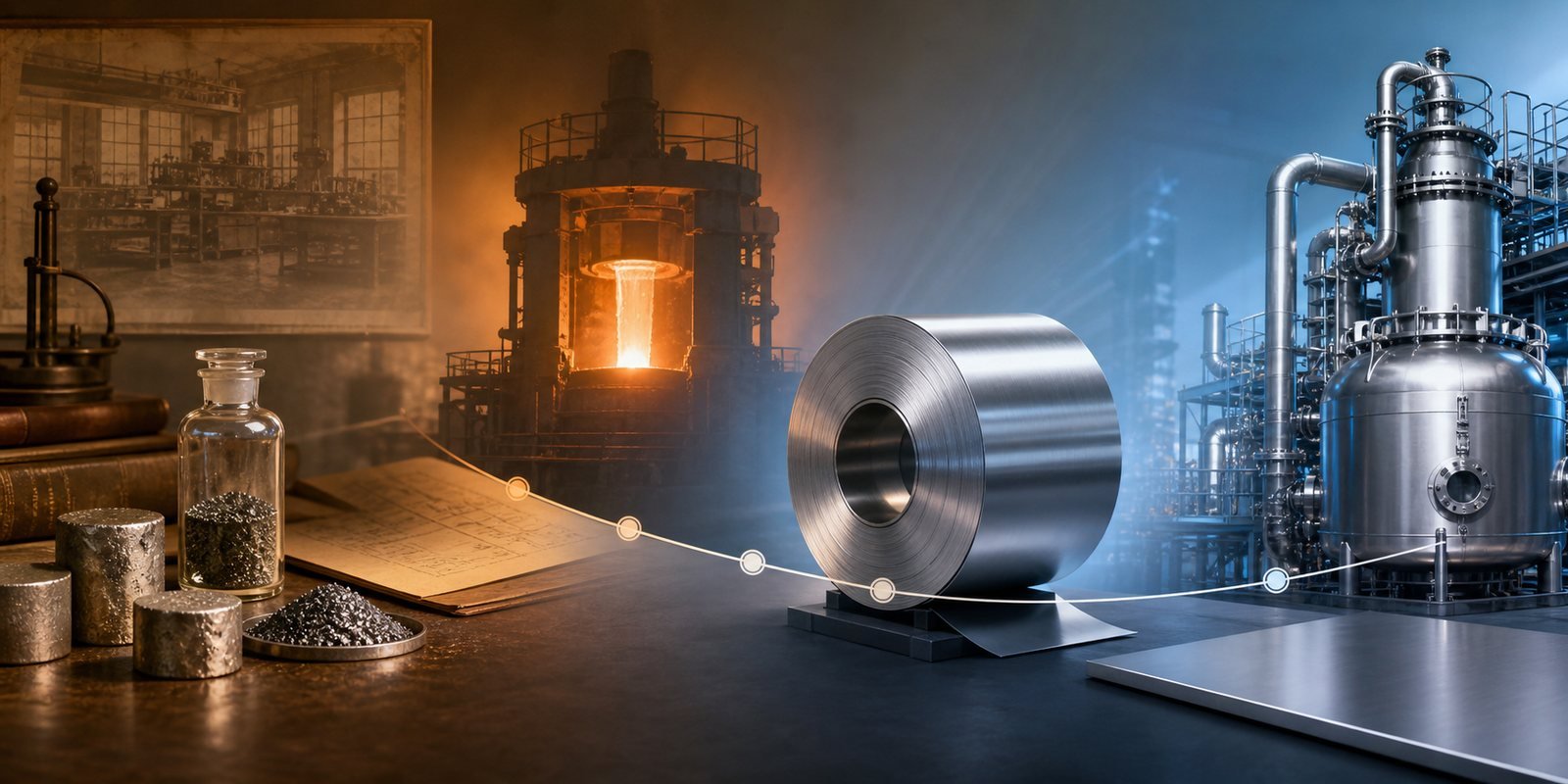
Quick answer: The family developed through progressive increases in nickel, molybdenum, chromium and nitrogen, combined with tighter control of carbon and impurities. The goal was stable austenite, weldability, high strength and substantially better resistance to pitting, crevice corrosion and stress-corrosion cracking.
From general-purpose austenitic grades to severe service
Early chromium-nickel austenitic stainless steels established the corrosion-resistant 18Cr-8Ni family that later included familiar 304-type grades. Adding molybdenum improved resistance to localized attack and produced 316-type materials. These alloys remain excellent engineering choices, but warm seawater, bleach plants, flue-gas cleanup and chloride-bearing acids can exceed their pitting and crevice-corrosion limits.
Metallurgists responded by increasing the elements that stabilize the passive film and resist localized corrosion. The challenge was not simply to add molybdenum: the alloy also had to remain austenitic, producible, weldable and free from harmful intermetallic phases after processing.
The high-molybdenum step
Grades with roughly 4.5% molybdenum, commonly represented by the 904L family, extended performance beyond 316 in reducing acids and many chloride environments. Further development led to the 6% molybdenum group, including UNS N08367 and UNS S31254-type materials. Higher nickel stabilizes the austenitic structure, while chromium and molybdenum raise localized-corrosion resistance.
Nitrogen became a particularly important addition. It contributes to pitting resistance, strengthens austenite and helps maintain phase balance. Modern production methods made it possible to control nitrogen and very low carbon more consistently while limiting sulfur and other residuals that can harm corrosion performance.
PREN as a useful comparison tool
Engineers often compare stainless grades with a pitting resistance equivalent number, commonly calculated from chromium, molybdenum and nitrogen. PREN is useful for screening, but it is not a complete corrosion specification. Different formulas exist, and the number does not capture fabrication quality, surface condition, temperature, crevices, contaminants or every alloying interaction.
A high PREN therefore supports grade comparison; it does not guarantee field life. Laboratory critical-pitting or critical-crevice tests and documented experience in the real process environment remain important for demanding service.
Fabrication drove the next improvements
High alloy content narrows the processing window. Excessive time at intermediate temperatures can precipitate sigma or other intermetallic phases that reduce toughness and corrosion resistance. Producers refined melting, hot working and solution annealing, while fabricators developed welding procedures that control heat input, filler composition, interpass temperature, shielding and post-weld cleaning.
Low-carbon practice reduced sensitization risk, but clean weld surfaces still matter. Heat tint and embedded iron can weaken the local passive film. Pickling or another qualified chemical cleaning method, followed by thorough rinsing, may be required to restore corrosion performance after fabrication.
Where the family is used today
- Seawater handling, desalination and high-chloride cooling systems.
- Pulp and paper bleaching equipment.
- Flue-gas desulfurization and pollution-control equipment.
- Chemical processing, sulfuric and phosphoric acid service where verified suitable.
- Heat exchangers, pressure equipment and piping exposed to chloride concentration.
How to specify super austenitic material
Use the UNS or EN grade together with the correct product standard and form. State solution-annealed delivery condition, dimensions, surface finish, heat treatment, corrosion test if required, inspection, marking and EN 10204 or other certificate needs. For welded construction, align base metal, filler and procedure requirements.
Because these alloys are selected for severe environments, substitution should never be based on a similar trade name alone. Confirm chemistry, PREN calculation method if contractually relevant, mechanical properties and full heat traceability.
Conclusion
Super austenitic stainless steel developed through an integrated metallurgy-and-fabrication effort: more chromium, molybdenum, nickel and nitrogen; lower carbon and impurities; and more controlled processing. The result is a family positioned between conventional stainless steel and nickel alloys for demanding corrosion service.
Technical references
Outokumpu: Ultra range in corrosive environments · Outokumpu: Stainless steel types
Discuss Your Requirement with SAKYMETAL
Send the process chemistry, chloride level, operating and cleaning temperatures, pressure, product form, welding plan and documentation requirements for grade discussion.
Next step: view related products or contact SAKYMETAL.
Technical note: This article is a general selection guide. Final material, condition, dimensions, testing and acceptance criteria shall follow the purchase order, governing specification and material test certificate.