
Call us now:


Wire Rope Protection Guide
Types of Coated Wire Rope: Materials, Uses and Selection
A polymer coating can improve handling, weather protection, noise and sheave contact, but it does not remove the need to specify the underlying wire rope correctly.
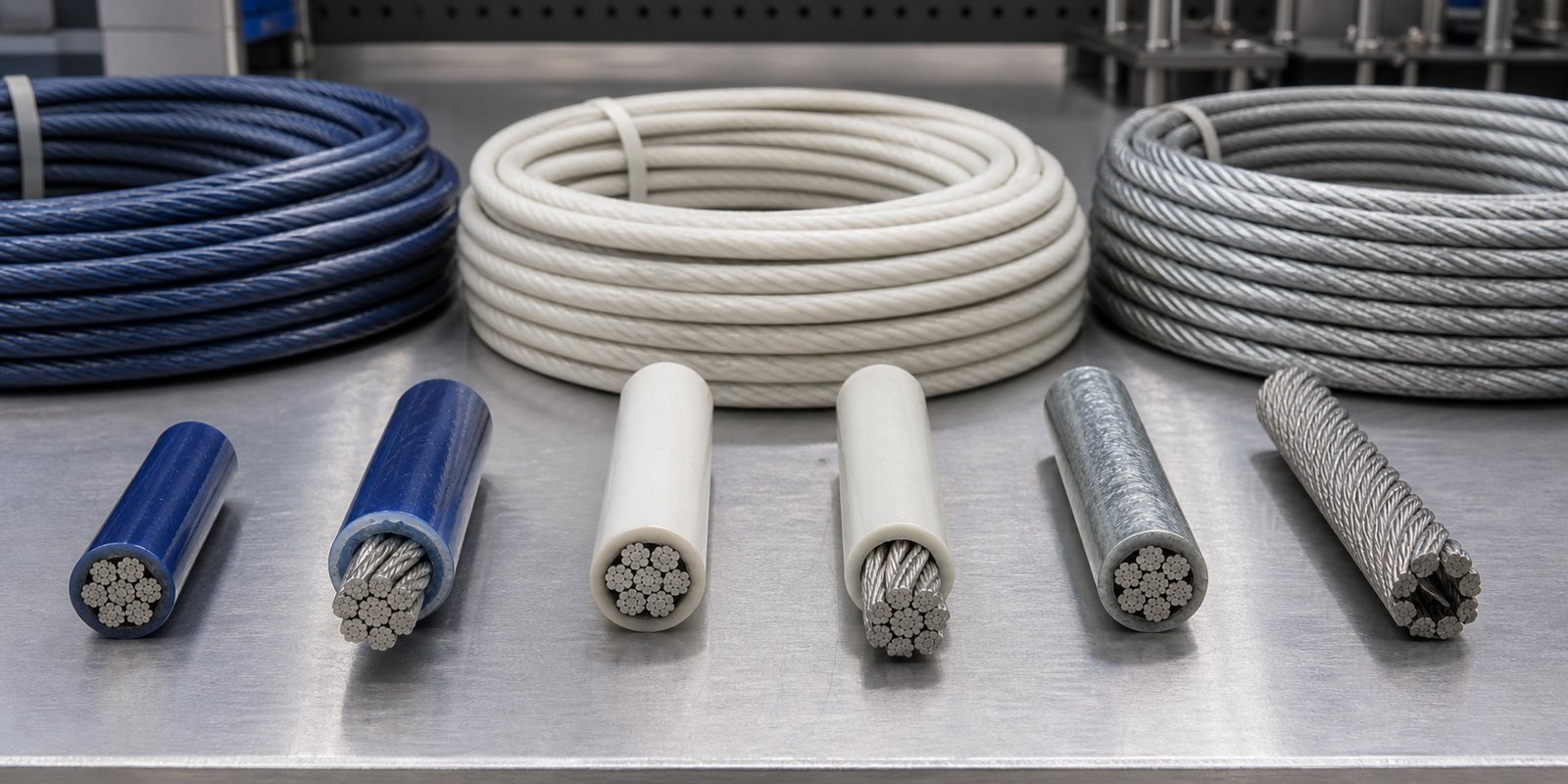
Quick answer: Common coated wire rope uses PVC, nylon/polyamide, polyethylene, polypropylene or specialty polyurethane and fluoropolymer jackets. Some constructions coat the completed rope; others plastic-impregnate internal spaces. Select by temperature, UV, chemicals, flexibility, abrasion, diameter tolerance and inspection needs.
What the coating does
An extruded jacket separates wire from users, adjacent surfaces, dirt and some moisture. It can reduce noise and improve color identification. Plastic impregnation can fill spaces inside the strand or rope, limiting internal movement and ingress for a dedicated construction.
Coating also hides the wire surface. Damage or corrosion can develop beneath an intact-looking jacket, and the coating changes overall diameter and sheave fit. Inspection and discard criteria must address the complete coated assembly.
Common coating materials
| Coating | Typical strengths | Selection cautions |
|---|---|---|
| PVC | Economical, flexible, many colors, general weather barrier | Plasticizer, cold-temperature, abrasion and chemical limits vary |
| Nylon / polyamide | Tough, abrasion resistant, low friction | Moisture absorption and stiffness/temperature behavior need review |
| Polyethylene | Good moisture and chemical resistance, low density | Grade-dependent UV and temperature capability |
| Polypropylene | Lightweight and chemical resistant for selected uses | Lower temperature and abrasion capability in many formulations |
| Polyurethane | Excellent abrasion and cut resistance; flexible formulations available | Higher cost and formulation-specific hydrolysis/UV behavior |
| Fluoropolymer / specialty | High chemical or temperature capability | Cost, adhesion, bend radius and availability |
Clear versus colored jackets
Clear coating supports visual observation of outer wires, although scratches, discoloration and optical distortion limit what can be seen. Colored coating aids identification and can improve UV performance when properly compounded. Black is common where carbon-black UV stabilization is appropriate.
Color is not a reliable indicator of polymer type or performance. The supplier datasheet should define resin, hardness, thickness, temperature range and stabilization.
Rope construction comes first
Specify galvanized or stainless wire, strand pattern, core, lay, minimum breaking force and flexibility before selecting a jacket. A flexible cable for controls differs from a load-bearing running rope. The coating must adhere without restricting required articulation or interfering with end fittings.
Finished diameter, minimum coating thickness and concentricity are important where the rope passes through guides, pulleys or fittings. Terminations must be qualified on the coated construction; stripping the jacket can change grip and sealing.
Application examples
- Fitness and exercise-machine cables.
- Guardrails, architectural cable and display systems.
- Control cables, lanyards and security cables.
- Marine or outdoor restraints using a compatible corrosion-resistant rope.
- Guides and motion systems needing reduced noise or protected contact surfaces.
Inspection and safety
Follow the equipment manufacturer and applicable wire-rope standard. Look for jacket cuts, bulges, flattening, diameter change, heat damage, hardening, corrosion staining and movement at terminations. Where the coating prevents adequate inspection, the design may need scheduled replacement or removable inspection zones.
Never infer working load from coated outside diameter. Capacity is governed by the metallic rope, construction, termination, efficiency, condition and applicable safety factor.
Conclusion
Coated wire rope is a combined metallic-and-polymer product. The best selection matches rope construction, jacket material, finished diameter, environment, termination and inspection plan.
Technical references
Wire Rope Technical Board: Wire rope resources · OSHA: Wire rope inspection guidance
Discuss Your Requirement with SAKYMETAL
Send the rope construction, metallic material, minimum breaking force, finished diameter, coating resin/color, temperature, chemicals, pulleys and termination details.
Next step: view related products or contact SAKYMETAL.
Technical note: This article is a general selection guide. Final material, condition, dimensions, testing and acceptance criteria shall follow the purchase order, governing specification and material test certificate.