
Call us now:


Request 7×19 Stainless Steel Wire Rope with the required standard, dimensions, tolerance, finish, inspection and mill test certificates from SAKY METAL.
Technical procurement data
Standards, supply and inspection
7×19 Stainless Steel Wire Rope is supplied as a wire rope within the stainless steel products family. A reliable enquiry identifies the exact designation, governing standard, dimensions, condition, inspection scope and documentation before quotation.
| Material / grade | 7×19 Stainless Steel Wire Rope; confirm the exact grade, temper or heat-treatment designation on the purchase order. |
|---|---|
| Product form | Wire rope |
| Standards and order reference | State the governing ASTM, ASME, EN, DIN, JIS, GB, AWS or customer specification on the purchase order; no standard is assumed from the product name alone. |
| Dimensions and tolerances | State the required section or diameter, wall or thickness, length, tolerance, straightness or flatness, edge/end condition and machining allowance. |
| Surface and supply condition | Hot-finished, cold-worked, solution-annealed, pickled, ground or polished condition is stated on the order as applicable to the product form. |
| Inspection options | The inspection plan may include material identification, chemistry and mechanical-property review, dimensional and visual inspection, plus construction, lay, diameter and breaking-load verification when required by the applicable rope standard. |
| MTC and traceability | Specify EN 10204 3.1 MTC or the required certificate type, heat/lot traceability, inspection reports, marking, packing list and any third-party release before order confirmation. |
| Typical applications | Lifting?Do not select lifting cable from construction alone. |
| RFQ checklist | Send the wire rope grade and standard, required dimensions and tolerance, quantity, surface/condition, inspection and certificate requirements, packing preference and delivery destination. |
Final compliance is defined by the purchase order, approved drawing and issued mill documentation. Availability is confirmed for each grade, size and production route.
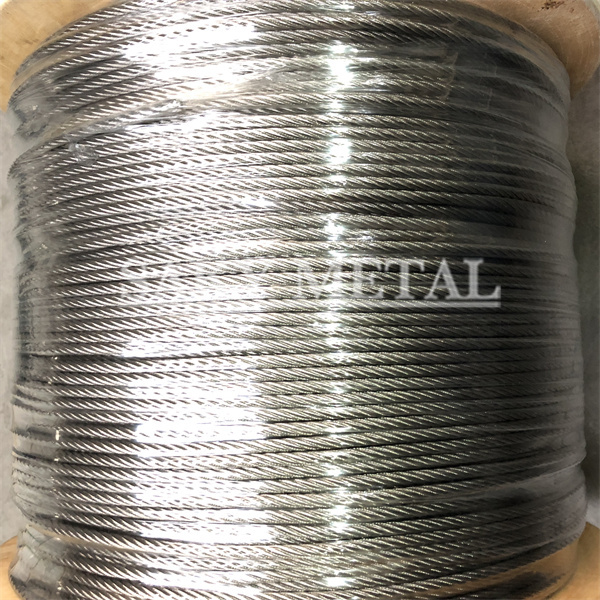
Flexible Stainless Cable Construction
7×19 stainless cable for flexible routing and industrial assemblies
SAKYMETAL supplies 7×19 stainless steel wire rope to an agreed grade, diameter, lay, length and inspection plan. The 7×19 construction is selected where flexibility matters, but the final rope must always be matched to load, fatigue, environment, termination and safety requirements.
Flexible construction
Seven strands with nineteen wires per strand provide greater flexibility than 1×19 cable.
304 or 316 options
Select the stainless grade against atmosphere, chloride exposure, fabrication and lifecycle requirements.
Order-controlled supply
Diameter, lay, length, minimum breaking force and termination requirements are reviewed before quotation.
Supply Specification
The quotation and purchase order should define the fields below. Availability and acceptance criteria are confirmed against the governing product specification.
| Construction | 7 strands × 19 wires; confirm strand pattern and core arrangement |
|---|---|
| Material | AISI 304 or 316 stainless steel, subject to purchase specification |
| Diameter | Nominal diameter and tolerance to be stated in the enquiry |
| Lay | Right- or left-hand; regular or lang lay when applicable |
| Finish | Clean, passivated or lubricated as required by service |
| Supply length | Cut lengths, coils or reels by agreement |
| Inspection | Dimensions, construction and measured breaking force when specified |
| Documentation | Material certificate and inspection records to the agreed scope |
Standards and Selection Notes
Construction is not a load rating
A 7×19 description identifies the strand-and-wire arrangement, not a universal safe working load. Grade, wire tensile level, diameter, terminations, design factor and service conditions all affect capacity.
Standards must match the application
ISO 2408 defines requirements for several wire-rope applications, but it excludes certain services including aircraft control, lifts, mining and aerial ropeways. State the governing standard and end use in the RFQ.
Terminations require engineering review
Eyes, swaged fittings, thimbles and other end fittings can govern assembly efficiency. Specify the termination design and any proof-load or pull-test requirement.
Typical Applications
- Marine and architectural cable assemblies
- Flexible control and positioning assemblies where the governing specification permits
- Guard, restraint and display systems
- Industrial routing with repeated bending around suitably sized sheaves
- Custom cable assemblies with agreed terminations
Send a Complete RFQ
For a faster technical review, include material grade, applicable standard and revision, product form or construction, dimensions and tolerances, condition or finish, quantity, inspection and certificate requirements, delivery destination and intended service.
Related Products and Guides
Frequently Asked Questions
How is 7×19 different from 1×19?
7×19 is generally more flexible, while 1×19 is comparatively stiff and is often selected where low stretch and straight runs matter. Final selection depends on load, bending radius, fatigue and terminations.
Should I choose 304 or 316?
316 is commonly considered for more demanding chloride or marine exposure, while 304 can be suitable for many general environments. The complete service environment and maintenance plan should govern the choice.
Can 7×19 cable be used for lifting?
Do not select lifting cable from construction alone. Provide the lifting standard, design factor, end termination, inspection regime and required minimum breaking force for engineering review.
Technical References
- ISO 2408:2017 — Steel wire ropes — Requirements
- ISO 3108:2017 — Determination of measured breaking force
Reference links define general material or specification scope. The final purchase order, applicable standard revision and material test certificate govern supplied product acceptance.