
Call us now:

Duplex Stainless Steel Selection Guide
2205 vs 2507 Duplex Stainless Steel Bar: Which Grade Fits Your Application?
2205 duplex and 2507 super duplex stainless steel bars combine high strength with corrosion resistance, but they are designed for different levels of chloride exposure and project severity.
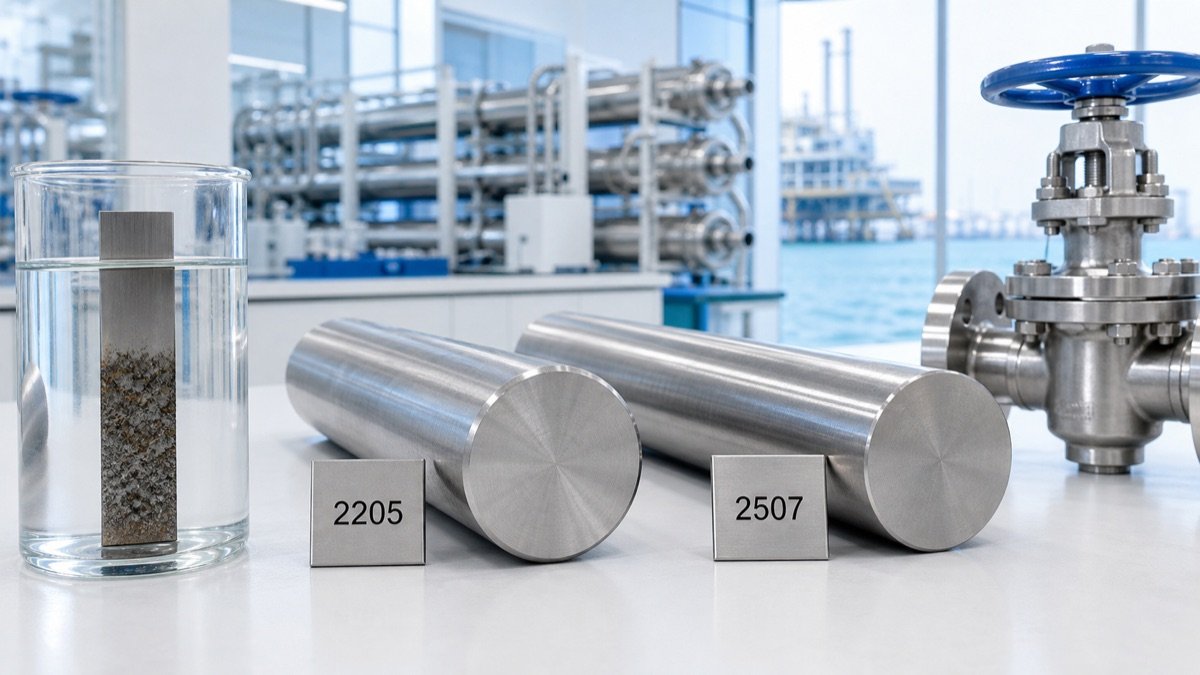
Quick answer: 2205 is a versatile duplex grade for many offshore, chemical, process, and structural applications. 2507 is a higher-alloy super duplex grade for more aggressive chloride, seawater, desalination, and subsea environments. The correct choice depends on temperature, chloride concentration, stress, fabrication limits, and the project specification.
What Are 2205 and 2507 Duplex Stainless Steel?
Duplex stainless steels contain both austenitic and ferritic phases. This two-phase structure can provide a useful combination of strength, toughness, and resistance to corrosion-related damage.
2205 is commonly associated with UNS S32205 and EN 1.4462. 2507 is commonly associated with UNS S32750 and EN 1.4410. Exact chemistry, delivery condition, and performance must be confirmed on the material certificate and project standard.
Compared with standard austenitic grades such as 316L, duplex grades can provide higher strength and improved resistance to chloride stress corrosion cracking in suitable service conditions.
2205 vs 2507 Duplex Stainless Steel Bar Comparison
| Selection factor | 2205 duplex stainless steel bar | 2507 super duplex stainless steel bar |
|---|---|---|
| Alloy level | Standard duplex stainless steel, commonly called 22Cr duplex | Higher-alloy super duplex stainless steel, commonly called 25Cr super duplex |
| Corrosion resistance | Strong performance for many chloride-bearing and process environments | Higher resistance for aggressive chloride and seawater service |
| Strength | Higher strength than many common austenitic grades | Very high strength with higher alloy content |
| Typical applications | Process equipment, storage tanks, offshore structures, pumps, and piping components | Desalination, subsea equipment, seawater systems, chemical processing, and severe offshore service |
| Cost and fabrication | Generally easier to source and more economical | Higher alloy cost and more demanding welding and heat-control requirements |
When Is 2205 the Better Choice?
Balanced performance
2205 is a strong starting point when the project needs more strength and chloride resistance than 316L, but does not require the higher alloy level of super duplex 2507.
Broad industrial use
Common applications include chemical process equipment, oil and gas components, pressure-related parts, storage systems, heat exchangers, and offshore structures.
When selecting 2205, confirm the service temperature, chloride level, hydrogen sulfide exposure, heat treatment, phase balance, and welding procedure.
When Is 2507 the Better Choice?
2507 is designed for more aggressive service conditions where higher alloy content and stronger localized corrosion resistance are justified. Potential applications include:
- Seawater piping and offshore equipment
- Desalination systems and reverse-osmosis equipment
- Subsea components and marine engineering
- Chemical processing equipment
- Heat exchangers exposed to chloride-bearing media
- High-strength pumps, valves, shafts, and fasteners
Higher performance does not remove the need for engineering review. Fabrication, solution annealing, weld heat input, phase balance, and service temperature remain important for 2507 components.
How PREN Helps Compare Duplex Grades
The pitting resistance equivalent number, or PREN, is often used as a screening tool when comparing stainless steel resistance to localized corrosion. Chromium, molybdenum, and nitrogen contribute to the value.
A higher PREN can indicate stronger potential resistance, but PREN is not a complete design calculation. Actual performance depends on temperature, chloride concentration, surface condition, fabrication quality, deposits, crevices, stress, and the complete service environment.
For material selection, compare the certified chemistry and the project’s corrosion requirements rather than relying on a grade name alone.
Purchasing Checklist for 2205 or 2507 Bar
- Confirm the UNS and EN designation required by the drawing.
- Specify bar diameter, length, tolerance, straightness, and surface finish.
- Request chemical composition, mechanical properties, heat treatment, and heat number.
- Confirm ferrite/austenite balance requirements when applicable.
- Check NACE MR0175/ISO 15156 requirements for sour-service projects.
- Review welding, machining, pickling, passivation, and packaging requirements.
See Saky Metal’s S32205 duplex steel bar product page for a related material option, or contact us for a grade recommendation based on your service conditions.
Need Help Choosing 2205 or 2507?
Send your medium, temperature, pressure, chloride exposure, dimensions, quantity, and required standard. Saky Metal can help compare duplex stainless steel bar options and prepare an export quotation.
Technical note: Duplex grade selection must be verified against the actual service environment, fabrication procedure, applicable standard, and project engineering requirements.