
Call us now:


304 and 316 Metallurgy
Understanding the Magnetic Properties of 304 and 316 Stainless Steel
304 and 316 are usually described as nonmagnetic, yet fabricated parts can respond to a magnet because processing changes local microstructure.
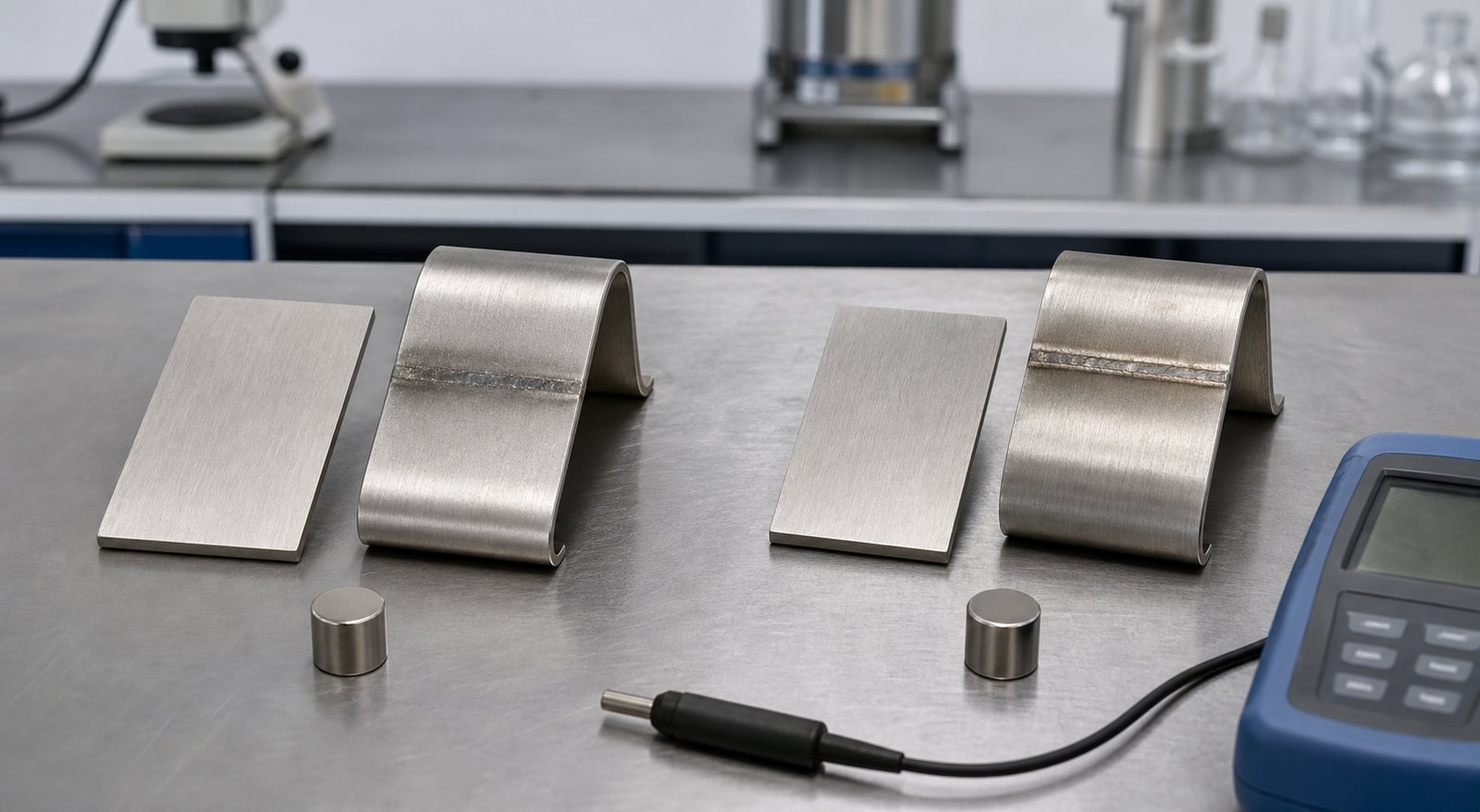
Quick answer: Solution-annealed 304 and 316 are austenitic and normally have low magnetic permeability. Cold forming can create ferromagnetic deformation martensite, particularly in 304, while weld metal may contain ferrite. 316 is often less responsive after deformation, but a magnet cannot distinguish the two grades.
Why annealed 304 and 316 have low permeability
Both grades are chromium-nickel austenitic stainless steels. Their face-centered cubic austenite phase has very low ferromagnetic response in the solution-annealed condition. Nickel stabilizes austenite, and the nickel-molybdenum balance of 316 generally makes its austenite more stable against deformation-induced transformation than 304.
“Nonmagnetic” is a convenient description, not an absolute zero. Sensitive instruments can measure permeability slightly above that of free space, and values vary with chemistry, thermal history and product condition.
Cold work creates local magnetism
Bending, deep drawing, cold rolling, swaging, thread rolling and severe machining can transform some metastable austenite into martensite. The transformed material is ferromagnetic. A formed 304 corner may therefore hold a magnet while the flat annealed sheet does not.
316 usually needs more deformation to create a similar response, but composition ranges overlap and heavy work can still produce magnetism. Low temperature during forming favors transformation. A final solution anneal can restore austenite where the product and specification permit it.
Welds are often different from base metal
Austenitic stainless weld filler is commonly balanced to retain a small ferrite content, which helps resist hot cracking. That weld ferrite responds to a magnet. Dilution, heat input, filler and cooling determine the actual amount.
The heat-affected zone and heat tint can affect corrosion, but a stronger magnet response over the bead alone is not proof of an incorrect base grade. Ferrite number measurement may be specified for weld control.
304 versus 316 magnetic comparison
| Condition | 304 response | 316 response |
|---|---|---|
| Solution annealed | Normally very low | Normally very low |
| Light cold work | May become locally detectable | Often lower response, but variable |
| Heavy cold work | Can become clearly magnetic | Can become magnetic, usually less readily |
| Austenitic weld metal | Weld ferrite may be magnetic | Weld ferrite may be magnetic |
| Cast product | Ferrite content may create response | Ferrite content may create response |
How to verify a grade
A magnet cannot identify molybdenum, so it cannot separate 304 from 316 reliably. Verify heat-number traceability and the MTC. XRF PMI can detect the molybdenum difference and screen nickel/chromium; use a suitable laboratory method when carbon or a formal chemistry determination is required.
If low permeability is a functional requirement for instrumentation, medical, electronic or defense equipment, write the maximum permeability and measurement method into the order. Grade name alone is not a magnetic-performance specification.
Conclusion
304 and 316 begin with low magnetic permeability in the annealed state, but forming and welding can change local behavior. Use magnet response to understand processing, not as a stand-alone grade test.
Technical references
Outokumpu: Stainless steel types · Outokumpu: Cold rolled coil, strip and sheet
Discuss Your Requirement with SAKYMETAL
Send the grade, product form, forming route, weld process, maximum permeability if required, dimensions and certification scope.
Next step: view related products or contact SAKYMETAL.
Technical note: This article is a general selection guide. Final material, condition, dimensions, testing and acceptance criteria shall follow the purchase order, governing specification and material test certificate.