
Call us now:


Material Comparison Guide
Carbon Steel vs Stainless Steel: Which Is Better?
Carbon steel and stainless steel solve different engineering problems; the better choice depends on corrosion, strength, fabrication, maintenance and lifecycle cost.
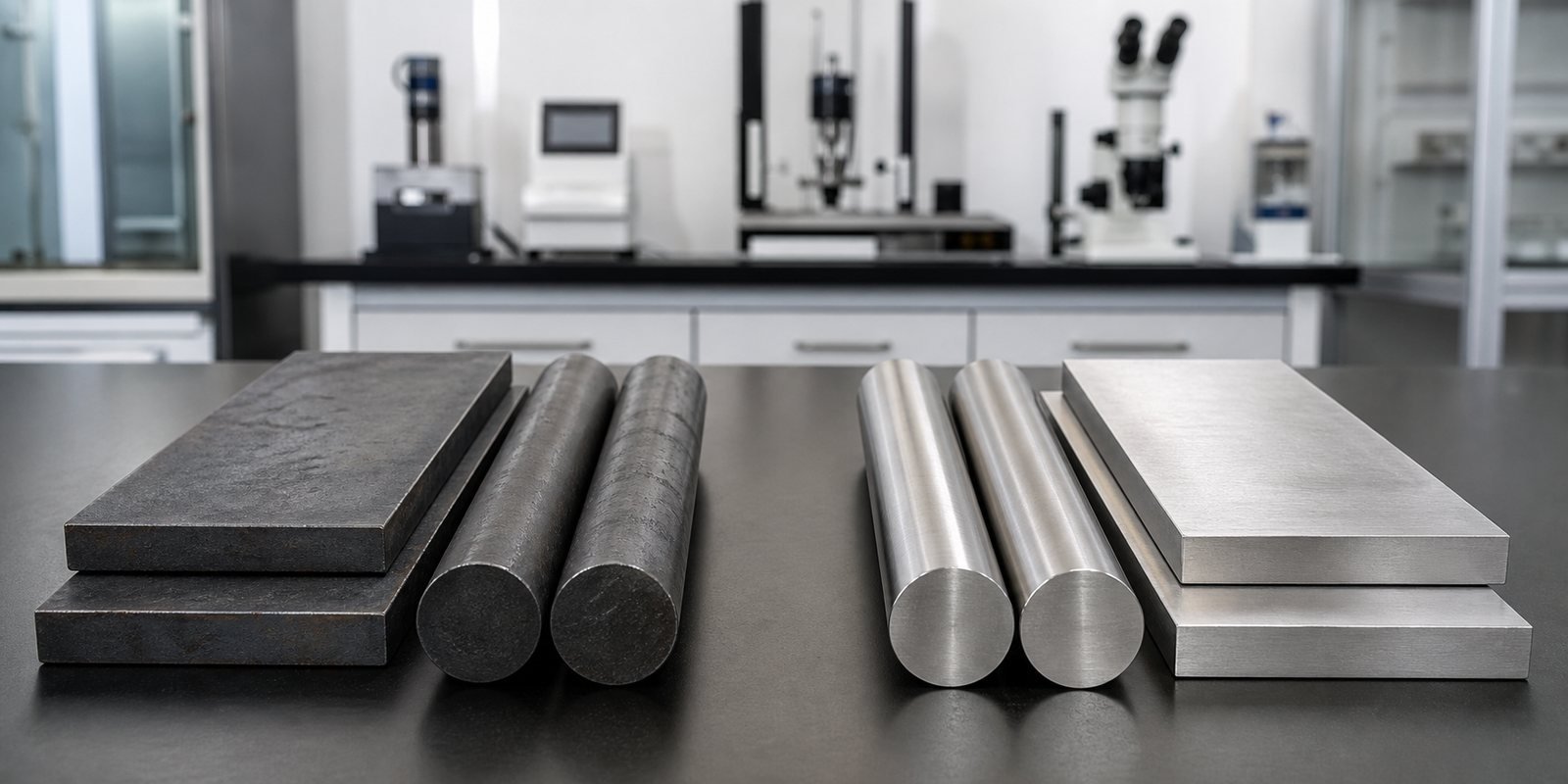
Quick answer: Carbon steel is often more economical, widely available and easy to process, while stainless steel provides a chromium-rich passive film and can reduce corrosion maintenance. Neither family is universally stronger or more durable. Compare the exact grade and condition in the real service environment.
The essential difference
Carbon steels rely primarily on iron and carbon, with manganese and other controlled elements. Stainless steels contain enough chromium to form a thin, self-repairing passive film in many environments. Stainless is a broad family that includes austenitic, ferritic, martensitic, duplex and precipitation-hardening grades.
That family distinction is crucial. Annealed 304, hardened 440C and duplex 2205 have very different strength, magnetism, corrosion and fabrication behavior. “Stainless” is not one property set.
Side-by-side comparison
| Factor | Carbon steel | Stainless steel |
|---|---|---|
| Corrosion | Usually needs coating, oil or corrosion allowance in wet service | Passive film reduces general corrosion; grade and environment still matter |
| Strength | Wide range through carbon level and heat treatment | Wide range from formable austenitic to duplex, martensitic and PH grades |
| Initial cost | Often lower | Often higher alloy and processing cost |
| Fabrication | Common welding and machining routes; grade-dependent | Work hardening, heat tint, distortion and contamination need grade-specific control |
| Maintenance | Coatings and corrosion monitoring may be required | Can reduce coating maintenance but still needs cleaning and inspection |
| Appearance / hygiene | Usually coated or scaled unless maintained | Available in clean, durable finishes for food, architectural and process use |
Strength is not a family-level winner
A low-carbon structural sheet is not directly comparable with quenched-and-tempered alloy steel, and annealed 304 is not directly comparable with hardened martensitic stainless. Yield, UTS, fatigue, hardness and toughness must be compared at the grade and condition level.
Stainless can retain a clean surface and section over time in suitable environments, while unprotected carbon steel loses thickness. Conversely, protected carbon steel can provide excellent service at lower cost where coating inspection and repair are practical.
Fabrication and joining
Carbon-steel welding is widely understood, but high carbon equivalent can require preheat and hydrogen control. Austenitic stainless has high thermal expansion and low thermal conductivity, which increase distortion risk. Duplex welding needs heat-input and filler control to preserve phase balance.
Stainless fabrication should be segregated from carbon-steel dust and tooling, and weld heat tint may need removal. Carbon-steel coating preparation often drives final durability.
Cost means lifecycle cost
Initial material price is only one line. Add fabrication time, coating, inspection, cleaning, shutdown, replacement, contamination risk and residual value. Stainless may be economical for inaccessible or hygienic equipment, while coated carbon steel may be more rational for a large, accessible dry structure.
Availability and lead time can also dominate. A technically ideal grade is not a practical choice if the required size, certificate or welding qualification cannot be obtained.
Quick selection questions
- What liquid, gas, deposit or atmosphere contacts the metal?
- What are the minimum and maximum temperature, pressure and load cycles?
- Is coating possible, inspectable and repairable?
- Are hygiene, surface appearance or metallic contamination important?
- What welding, machining and heat-treatment capabilities are available?
- What design code, product standard and certificate are required?
Conclusion
Carbon steel is often the efficient choice for protected structures and general machinery. Stainless steel is often the efficient choice when corrosion, cleanliness or coating maintenance dominates. The better material is the verified grade-condition system with the lowest safe lifecycle cost.
Technical references
Outokumpu: Stainless steel types · AISC: Steel solutions center
Discuss Your Requirement with SAKYMETAL
Send the service environment, temperature, load, desired life, coating and maintenance constraints, dimensions and governing specification for comparison.
Next step: view related products or contact SAKYMETAL.
Technical note: This article is a general selection guide. Final material, condition, dimensions, testing and acceptance criteria shall follow the purchase order, governing specification and material test certificate.