
Call us now:


Seamless Pipe Manufacturing Guide
What Is Hot-Rolled Seamless Pipe? Process, Features and Selection
Hot-rolled seamless pipe begins as a solid round billet that is heated, pierced and rolled into a hollow product without a longitudinal weld seam.
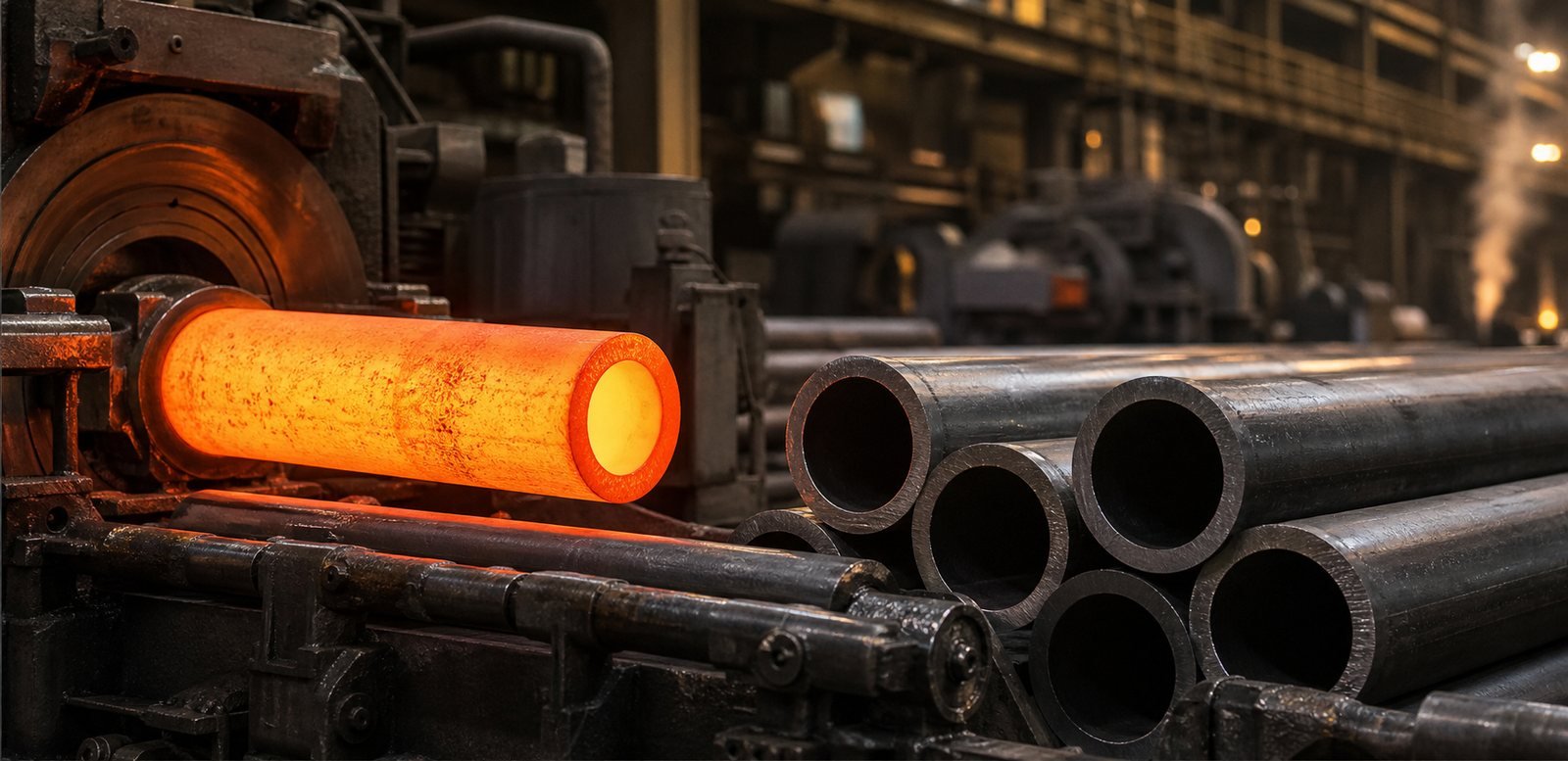
Quick answer: A hot-rolled seamless pipe is made by heating a solid billet, rotary piercing it to create a hollow shell, then rolling and sizing it to the required diameter and wall. Heat treatment, straightening, finishing and nondestructive testing are added as required by the product specification.
From solid billet to hollow shell
The process starts with a round cast or rolled billet of controlled chemistry. After inspection and cutting, the billet is heated to the rolling temperature. In rotary piercing, opposing skewed rolls rotate and advance the billet over a plug, creating the initial hollow shell.
The shell then passes through a mandrel, plug or similar rolling system that controls wall thickness and elongates the pipe. A sizing or stretch-reducing mill establishes the outside diameter, followed by controlled cooling.
Typical production sequence
- Billet chemistry, surface and dimensional inspection.
- Cutting and heating in a rotary-hearth or equivalent furnace.
- Rotary piercing to create the hollow shell.
- Mandrel or plug rolling to reduce and control wall thickness.
- Sizing or stretch reduction to control outside diameter.
- Cooling, straightening and cutting to length.
- Heat treatment, end finishing, threading or other operations when specified.
- Nondestructive examination, hydrostatic testing, dimensional inspection, marking and certification.
Why “seamless” does not mean perfect
Seamless pipe has no longitudinal fusion weld, which is valuable for many pressure, mechanical and high-temperature applications. It can still contain manufacturing discontinuities such as laps, eccentric wall, internal surface imperfections or material inclusions. Product standards therefore control dimensions, permissible imperfections, testing and repair.
Wall thickness can vary around the circumference, especially in heavy-wall hot-finished product. Buyers should apply the dimensional tolerances in the governing standard rather than assume nominal wall everywhere.
Hot-finished versus cold-drawn
Hot-finished seamless pipe is shaped at elevated temperature and can cover a broad size and wall range. Cold drawing or cold pilgering adds reduction at lower temperature for tighter dimensional control, surface finish or mechanical properties. Cold-worked products generally require a specified final heat treatment.
The terms describe manufacturing routes, not automatically higher or lower quality. The correct route depends on tolerance, surface, size, grade, mechanical properties and cost.
Common applications
Hot-rolled seamless pipe is used in oil and gas tubulars, line pipe, boilers, heat exchangers, pressure equipment, mechanical cylinders, bearings and structural or machining applications. Each field uses its own product standards and testing.
Do not order a mechanical tube for a pressure-code application or assume an OCTG grade meets boiler requirements. Product specification and design code must align.
Ordering checklist
- Material grade and complete product standard with revision.
- Outside diameter, wall thickness or schedule, length and end finish.
- Hot-finished, heat-treated, normalized or quenched-and-tempered condition.
- Mechanical tests, impact temperature and corrosion/sour-service requirements.
- UT, eddy current, magnetic-flux leakage, hydrostatic or other examination.
- Straightness, surface, marking, traceability and MTC type.
Conclusion
Hot-rolled seamless pipe is a controlled sequence of billet heating, piercing, rolling and finishing. Its suitability comes from the grade, process, heat treatment, inspection and product standard together—not from the absence of a weld seam alone.
Technical references
Tenaris: Hot rolling process at Bay City · Tenaris: Hot rolling mill equipment
Discuss Your Requirement with SAKYMETAL
Send the grade, product standard, OD, wall, length, heat-treatment condition, end finish, testing and certificate requirements.
Next step: view related products or contact SAKYMETAL.
Technical note: This article is a general selection guide. Final material, condition, dimensions, testing and acceptance criteria shall follow the purchase order, governing specification and material test certificate.