
Call us now:


Cold-Work Steel Comparison
DC53 vs D2 Tool Steel: What Is the Difference?
Compare DC53 and D2 by wear, toughness, heat treatment, dimensional control, surface treatment and tooling economics.
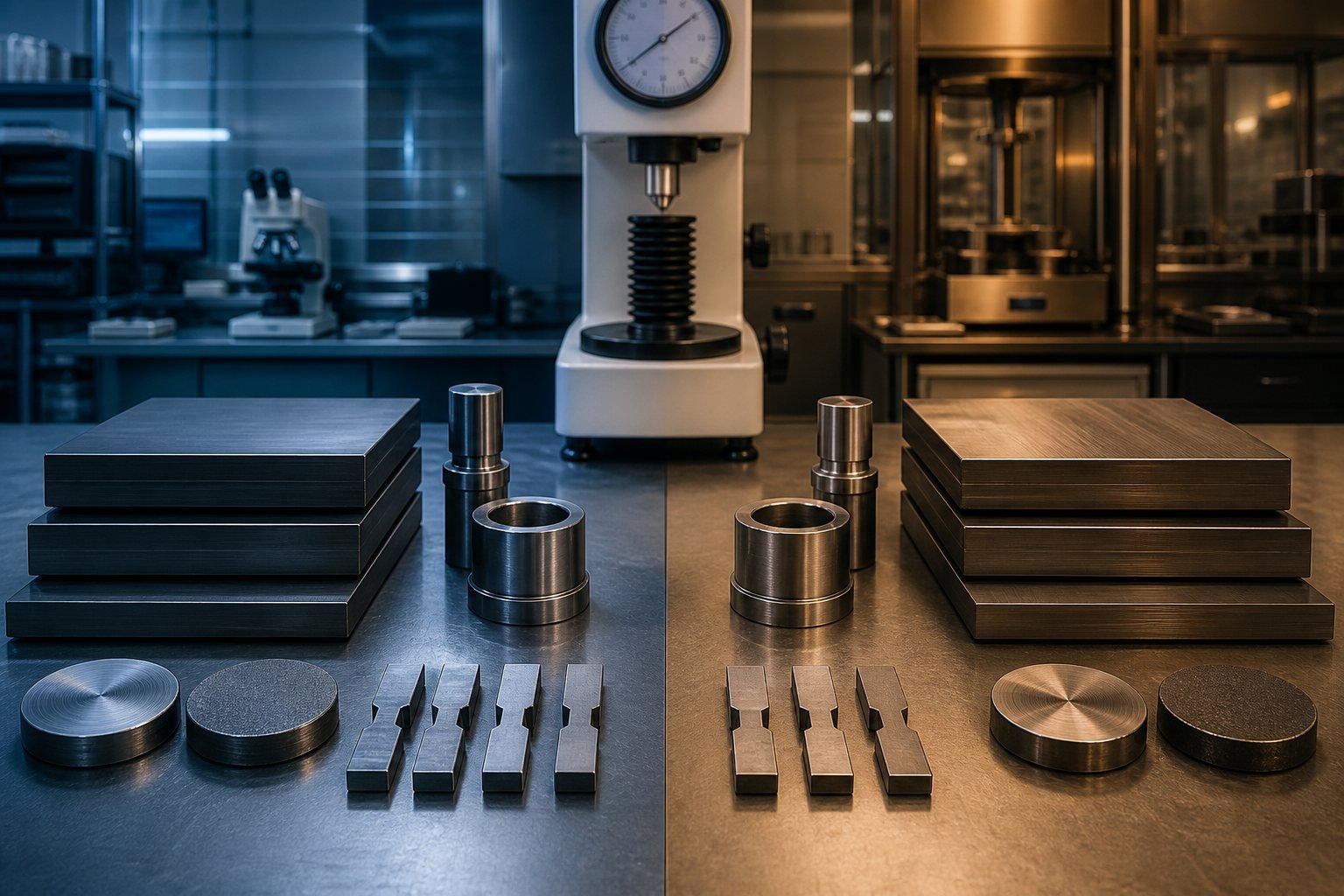
Quick answer: D2 is a standardized high-carbon, high-chromium cold-work tool steel known for strong wear resistance. DC53 is Daido’s proprietary 8% Cr high-hardness, high-toughness steel developed in the SKD11/D2 application space. DC53 is often considered where chipping resistance, high-temperature tempering or the hardness-toughness balance needs improvement; D2 remains widely standardized and available. The better choice depends on the tool’s real failure mechanism.
DC53 and D2 compared
| Decision factor | DC53 | D2 |
|---|---|---|
| Grade status | Daido proprietary grade and trademark | Widely standardized AISI cold-work tool steel designation |
| Alloy concept | Approximately 8% Cr with Mo and other controlled additions | High-carbon, approximately 12% Cr class with Mo and V |
| Wear resistance | High, with a balance aimed at toughness | Very high conventional wear resistance in many applications |
| Toughness/chipping | Often selected for improved balance and resistance to chipping | Can be more sensitive to chipping when hardness, geometry or heat treatment is unfavorable |
| Tempering strategy | Designed for a strong secondary-hardening response and high-temperature tempering | Can use low- or high-temperature routes depending on required properties |
| Availability | Source authenticity and regional supply should be confirmed | Broadly available from many qualified producers |
When DC53 may be the better candidate
- Existing D2 or SKD11 tools fail by chipping before abrasive wear consumes the tool.
- High substrate hardness is required with a high-temperature temper compatible with coating.
- Dimensional control and retained-austenite management are central to the process.
- The buyer can obtain authenticated DC53 stock and follow the producer heat-treatment route.
When D2 may remain the practical choice
- The drawing, customer or standard explicitly requires D2.
- The tool is wear-limited and has no significant chipping or impact problem.
- Broad availability, multiple section sizes and standardized sourcing matter.
- The organization already has a robust, proven D2 heat-treatment and toolmaking process.
Do not compare hardness alone
Two tools at the same measured HRC can behave differently because carbide type and distribution, retained austenite, toughness, residual stress, surface condition and heat-treatment quality differ. Compare the complete route: certified stock, geometry, machining, heat treatment, EDM finishing, grinding, coating and service.
A controlled A/B tool trial using the same design and operating conditions is more valuable than a generic ranking when production cost is significant.
Selection worksheet
- Record current tool failure: abrasive wear, adhesive wear, deformation, chipping, gross cracking or heat checking.
- Define workpiece grade, hardness, thickness and coating.
- Record current tool steel, hardness, heat-treatment certificate and tool life.
- Identify geometry, stress raisers and maintenance practice.
- Calculate cost per good part, not material cost per kilogram.
Heat-treatment and coating considerations
DC53 and D2 should not share a copied heat-treatment recipe simply because both are cold-work die steels. Austenitizing, quenching, retained-austenite control and tempering response differ. Follow the current producer documentation for each candidate and validate the process on the relevant section size.
For nitriding or PVD coating, the substrate must have adequate tempering resistance and surface preparation. Coating cannot repair a weak edge, grinding crack or unsuitable substrate. The coating temperature should remain compatible with the established tempering condition.
Cost and availability
D2 usually offers broad multi-source availability and familiar processing. DC53 can justify a higher or less predictable sourcing cost if the authentic grade extends tool life or reduces chipping. Conversely, an application that already achieves stable wear-limited D2 life may see little benefit from changing.
Include stock size, machining allowance, delivery lead time, minimum order quantity, authentication and local heat-treatment capability in the decision. Production resilience is part of tooling economics.
A controlled comparison plan
- Select matched stock with full certification and record annealed condition.
- Machine identical tool geometry with the same surface allowances.
- Heat treat each grade to its qualified route and document furnace cycles.
- Verify hardness, dimensions, surface integrity and any coating.
- Run both tools on the same work material and press settings.
- Record wear, chipping, dimensional drift, maintenance and total parts produced.
Frequently asked questions
Is DC53 tougher than D2?
DC53 is marketed and commonly selected for a better toughness balance than conventional D2/SKD11, but actual performance depends on authentic material, hardness, heat treatment, geometry and service.
Which has better wear resistance, DC53 or D2?
Both can provide high wear resistance. D2 is a classic wear-focused grade; DC53 targets a broader hardness-toughness balance. The actual wear mechanism and hardness determine the result.
Can DC53 replace D2 directly?
Not without engineering review. Heat-treatment schedules, dimensional response, machining and coating compatibility may differ, and customer approval may be required.
Which steel is easier to source?
D2 is generally more widely available as a standardized grade. DC53 sourcing should confirm authenticity and traceability.
Technical references
Discuss Your Requirement with SAKYMETAL
Share the current grade, tool life, failure mode, work material, dimensions, target hardness, heat treatment and coating. We can help structure a supply comparison.
View related products or send your specification for a quotation.
Engineering note: Typical values are informative, not acceptance criteria. Confirm the applicable standard edition, grade designation, product form, dimensions, delivery condition and test requirements on the purchase order and material test certificate.