
Call us now:


Plastic Mould Steel Selection
Best Tool Steels for Plastic Injection Moulds
Select injection mould tool steel by production volume, resin, finish, corrosion, wear, toughness, thermal control and mouldmaking cost.
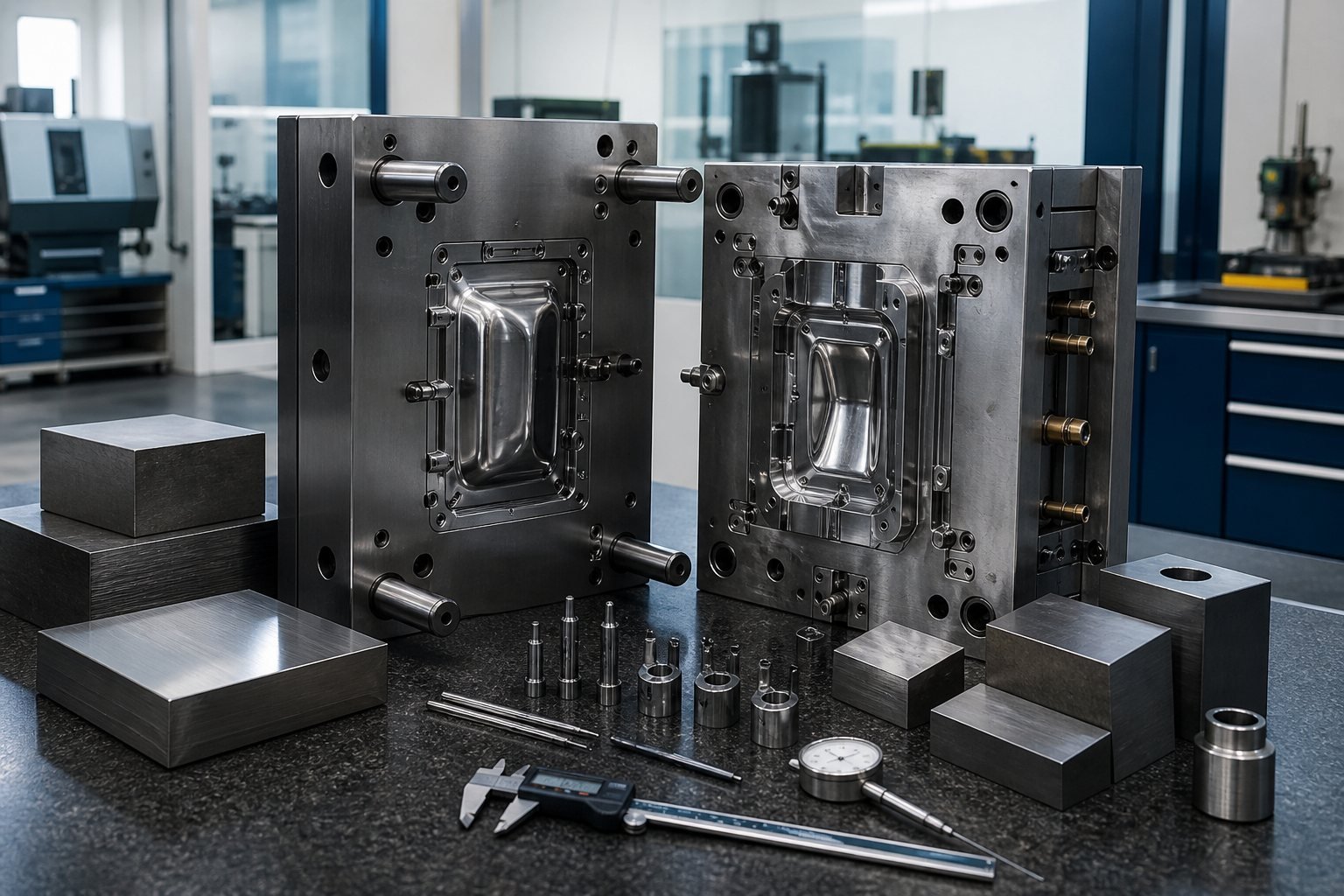
Quick answer: There is no single best injection mould steel. P20-type prehardened steels suit many general mould bases and medium-volume cavities; 420-type stainless mould steels suit humid, corrosive or mirror-polished service; H13-type steels suit thermally or mechanically demanding inserts; and higher-wear or high-cleanliness ESR/PM grades suit reinforced resins, long runs or optical finishes. Selection must follow the part and production plan.
Injection mould steel selection matrix
| Mould requirement | Common starting-point steels | Why they are considered |
|---|---|---|
| General mould base and medium production | P20 / 1.2311 / 1.2738 type | Prehardened supply, good machinability and no full hardening step for many sizes |
| High polish and corrosion resistance | 420 / 1.2083 type and premium ESR variants | Stainless response, cleanliness and polishability for medical, optical or humid service |
| High wear from glass-filled resin | Hardened high-wear cold-work or PM grades; selected stainless wear grades | More wear resistance for abrasive reinforcement, balanced against toughness |
| High stress or elevated mould temperature | H13 / 1.2344 or premium hot-work variants | Toughness, hot strength and resistance to thermal/mechanical fatigue |
| Large mould, high toughness and machinability | Prehardened Ni-Cr-Mo mould steels | Uniform through-section properties and practical machining |
| Optical or extreme surface finish | Premium remelted stainless mould steels | High cleanliness, polishability and reduced defect risk |
Seven questions to answer before choosing steel
- How many shots must the mould deliver between major refurbishments?
- Is the resin abrasive, filled, flame-retardant, PVC-based or chemically aggressive?
- What surface finish or texture must the part reproduce?
- What hardness, compressive strength and toughness are required?
- Will the mould operate with condensation, aggressive cooling water or humid storage?
- How large is the block, and can it be heat treated with acceptable distortion?
- How do machining time, polishing, repair welding and maintenance affect total cost?
Why resin and surface finish change the answer
Glass fiber and mineral fillers create abrasive wear at gates, runners and cavity surfaces. Flame retardants and PVC can release corrosive species. Transparent or optical parts demand exceptional cleanliness and polishability. High-gloss consumer parts reveal inclusions, orange peel and polishing defects that may not matter in a textured industrial housing.
The mould base, cavity, core, slides, inserts and wear components do not have to use one grade. A multi-material mould can place premium steel only where the service demands it.
Mould steel failure modes
- Abrasive or adhesive wear at gates, slides and shut-offs
- Plastic deformation under injection or clamping load
- Chipping and cracking at sharp details or thin inserts
- Corrosion in cavities, cooling channels or storage
- Polishing defects caused by cleanliness or heat-treatment variation
- Dimensional change after hardening, EDM or surface treatment
A practical specification
- Identify mould component: base, cavity, core, insert, slide or wear plate.
- State steel grade and accepted equivalent policy.
- Define supplied hardness or annealed condition.
- Set ultrasonic quality, cleanliness or ESR requirement when justified.
- Specify machining allowance, surface condition and dimensional tolerance.
- Coordinate hardening, tempering, nitriding or PVD with the steel supplier.
- Require traceability and material certification for critical moulds.
Thermal performance and cycle time
The mould is also a heat exchanger. Steel thermal conductivity, cooling-channel layout, contact resistance, scale and water quality affect cooling uniformity and cycle time. A very wear-resistant grade is not automatically the most productive if it creates hot spots or makes conformal cooling difficult.
High-conductivity copper alloys may be used locally with suitable strength and corrosion review, while tool steel remains in highly loaded or wear-critical areas. The mould designer should evaluate material and cooling design together.
Polishing, texturing and repair
Mirror polishing requires clean, homogeneous steel and a controlled polishing sequence. Inclusions, segregation, local hardness variation and EDM damage can produce pits or orange peel. Chemical texturing also depends on uniform microstructure and surface preparation.
Repair welding should use a grade-compatible filler, preheat and post-weld plan. The repaired zone must meet finish and hardness needs without cracks or visible color/texture mismatch on the moulded part.
Frequently asked questions
What is the most common steel for injection moulds?
P20-type prehardened mould steel is a common general-purpose starting point because it combines machinability, strength and practical large-section supply.
What mould steel is best for corrosive plastics?
A corrosion-resistant martensitic stainless mould steel, often a 420/1.2083-type or premium variant, is commonly considered. Resin chemistry and cooling-water conditions must be reviewed.
What steel is used for glass-filled plastic?
Higher-wear grades or hardened inserts are often used at gates and cavities. Toughness, polishability, corrosion and repair requirements still need to be balanced.
Is H13 used for plastic injection moulds?
Yes. H13-type steel can suit high-stress, thermally demanding cores and inserts and applications needing toughness and hot-strength capability.
Technical references
Discuss Your Requirement with SAKYMETAL
Send the mould component, resin, annual shots, dimensions, desired finish, hardness, corrosion and wear requirements, along with certification and delivery needs.
View related products or send your specification for a quotation.
Engineering note: Typical values are informative, not acceptance criteria. Confirm the applicable standard edition, grade designation, product form, dimensions, delivery condition and test requirements on the purchase order and material test certificate.