
Call us now:


Cold-Work Tool Steel Guide
DC53 Tool Steel Material: Properties, Heat Treatment and Applications
An engineering overview of DC53’s performance profile, heat-treatment sensitivity, tooling applications and procurement details.
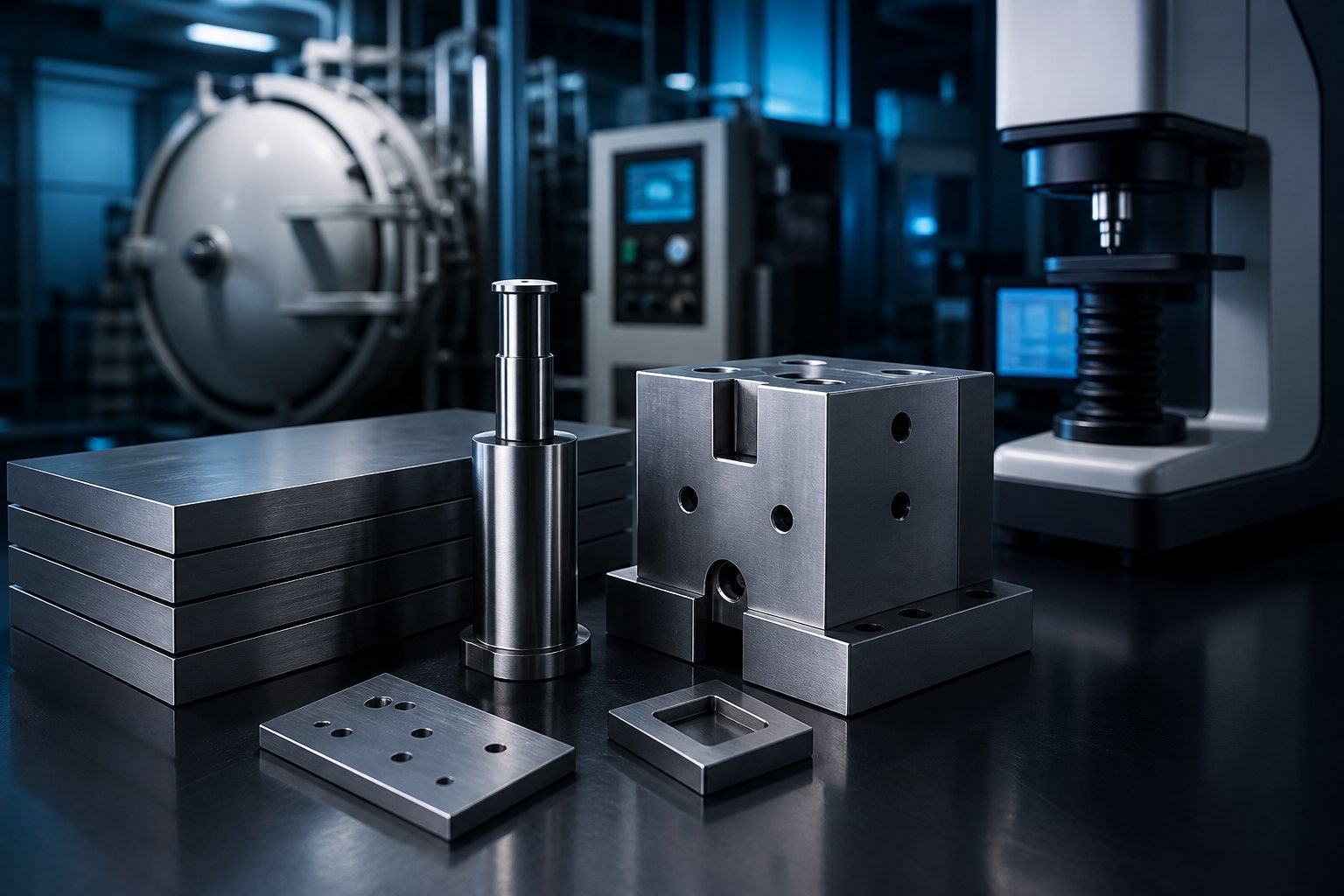
Quick answer: DC53 is Daido Steel’s proprietary 8% chromium, high-hardness and high-toughness cold-work die steel in the SKD11/D2 application space. It is used for cold-work tools and selected plastic mould applications. Its appeal is the balance of attainable hardness, toughness, wear resistance, machinability and dimensional stability when processed with the producer’s heat-treatment guidance.
What is DC53 tool steel?
Daido describes DC53 as an 8% Cr high-hardness, high-toughness steel related to SKD11-type die steels. It is a proprietary grade and trademark; “DC53” should therefore be tied to authenticated producer supply or an explicitly agreed alternative, not used as a generic chemistry label.
Daido lists cold-work tooling and plastic mould steel among its principal applications and publishes separate resources for basic properties, heat treatment and practical evaluations.
Performance profile
| Attribute | Practical significance |
|---|---|
| High attainable hardness | Supports compressive strength and wear resistance in punches, dies and blades. |
| Improved toughness balance | Can reduce chipping and cracking risk compared with a wear-only selection approach. |
| Secondary-hardening response | High-temperature tempering can support useful hardness and downstream surface treatment. |
| Dimensional stability | Important for precision tooling, though geometry and process control remain critical. |
| Machining and grinding response | Toolmaking route must avoid excessive heat, stress concentration and grinding burn. |
Heat-treatment route
A typical route includes soft annealing before machining, stress relief for heavily machined tools, controlled preheating, austenitizing, gas or oil quenching as qualified, and multiple tempering. Optional sub-zero or cryogenic treatment may be considered to manage retained austenite where supported by the producer and tool requirements.
Exact temperatures and soak times must come from the current Daido manual or qualified heat treater. Furnace type, section size, loading, quench rate and temper timing can change the outcome.
Common applications
- Fine blanking and general blanking dies
- Punches, forming rolls and thread-rolling dies
- Shear blades and precision cutting tools
- Cold forging and cold-extrusion tooling
- Wear inserts, gauges and selected plastic mould components
Ordering and processing checklist
- Confirm authentic DC53 supply and traceable certification.
- State product form, dimensions, machining allowance and annealed hardness.
- Agree ultrasonic testing or cleanliness requirements for large tools.
- Provide final application, target hardness and heat-treatment route.
- Control sharp corners, section transitions, EDM recast layer and grinding burn.
- Qualify PVD or nitriding after confirming the tempering condition.
Toolmaking practices that protect performance
Rough machining removes a large volume of material and can release residual stress, so stress relief may be appropriate before finish machining. Generous radii and smooth section transitions reduce local stress. EDM surfaces should be finished to remove the brittle recast layer where cracking risk is significant.
Grinding after hardening needs sharp wheels, adequate coolant and controlled feeds. Temper colors, tensile residual stress and fine grinding cracks can erase the benefit of a tougher steel. Final inspection should cover hardness, critical dimensions and surface integrity.
Evaluating DC53 in production
A responsible conversion trial compares DC53 with the current tool under the same geometry, hardness, finish, coating and operating conditions. Record the number of parts, failure mode, maintenance intervals and dimensional quality.
If tool life improves, calculate the saving from downtime, repair and rejected parts as well as steel cost. This prevents a decision based on purchase price or a single hardness number.
Certification and authenticity
Because DC53 is a proprietary grade, traceability is important. The certificate should identify the producer, grade, heat number, chemistry and supplied condition. Stock markings and documents should remain connected through cutting and machining.
If an “equivalent” is offered, require the supplier to state the actual grade and producer rather than relabeling it as DC53. Evaluate that alternative on its own certified chemistry, datasheet, heat treatment and production trial.
Frequently asked questions
Is DC53 the same as D2?
No. DC53 is a proprietary 8% Cr cold-work tool steel developed in the D2/SKD11 application space, with a different composition and property balance.
What hardness can DC53 reach?
Daido positions DC53 as a high-hardness grade. The achieved value depends on section and heat treatment; use the current producer manual and certified results.
Does DC53 require cryogenic treatment?
Not universally. Sub-zero treatment may help manage retained austenite in some routes, but it must be coordinated with quenching and tempering under a qualified procedure.
Can DC53 be nitrided or PVD coated?
It can be considered for surface treatment when the substrate heat treatment, tempering temperature, surface preparation and coating cycle are compatible.
Technical references
Discuss Your Requirement with SAKYMETAL
Send the tool drawing size, application, failure mode, target hardness, heat-treatment and inspection requirements. We can review material form and supply options.
View related products or send your specification for a quotation.
Engineering note: Typical values are informative, not acceptance criteria. Confirm the applicable standard edition, grade designation, product form, dimensions, delivery condition and test requirements on the purchase order and material test certificate.